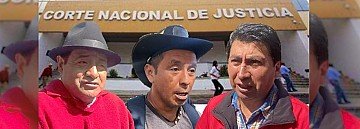
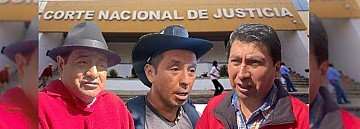
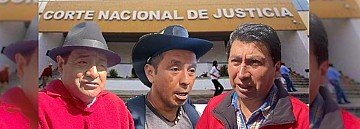
© CEDHU
The signatory organisations, including the International Federation for Human Rights (FIDH) and the World Organisation Against Torture (OMCT), within the framework of the Observatory for the Protection of Human Rights Defenders, draw attention to the criminalisation currently faced by defenders of water, nature, and land in Ecuador, in particular the community leaders Guilberto Talahua, Fausto Arechua, and Wilfrido Escobar, who could face four-year prison sentences for their opposition to the Curipamba–El Domo mining project.
The undersigned national and international human rights and environmental organisations express our deep concern regarding the criminalisation of human rights and nature defenders in Ecuador, Guilberto Talahua, Fausto Arechua, and Wilfrido Escobar, community leaders actively involved in the fight for the communities and water sources impacted by the Canadian mining project Curipamba–El Domo in Las Naves county, Bolívar province.
Their case is of particular concern because, although the defenders were acquitted on appeal for lack of evidence to support the criminal charges, the complainants and the State Attorney General’s Office have continued to pursue the case in an effort to condemn them to four-year prison sentences. The decision now lies with the National Court of Justice, which is processing the case on an unusually accelerated timeline. The last hearing took place on May 11, 2026, where, after hearing the arguments, the judges adjourned the hearing and announced they would convene a new hearing to deliver their decision.
This case is part of a systematic pattern of criminalisation targeting those who defend water, nature, and their territories and who have spoken out against the advancement of the Curipamba–El Domo mining project. Currently, 32 defenders have been criminalised for their involvement in this case; 15 of them have received convictions despite the lack of sufficient evidence to establish criminal liability.
We recall that the legitimate exercise of peaceful protest falls within the constitutional right to resistance, recognised in Article 95 of the Ecuadorian Constitution, and is supported by international human rights standards. Protest is an essential means of advocacy for peoples and communities in the context of socio-environmental conflicts. In this regard, we urge that the proceedings remain free from interference or undue pressure, especially involving economic interests linked to extractive projects such as Curipamba–El Domo, operated by the mining company Curimining S.A.
For these reasons, we call upon the judges of the National Court of Justice of Ecuador to act with full independence, impartiality, and transparency; to guarantee due process for the human rights defenders Guilberto Talahua, Fausto Arechua, and Wilfrido Escobar; and to adopt a decision based on the highest international human rights standards, particularly those relating to the protection of human rights defenders.
Criminal law must not be used as a tool to punish those who exercise their legitimate right to defend rights. The Court’s decision comes at a decisive moment for the Ecuadorian justice system to fulfil its heightened duty to protect defenders, particularly those who defend water and nature.