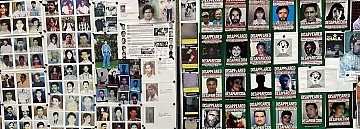
The appeal trial of Yuri Harauski, a former member of SOBR, a special police force under President Aliaksandr Lukashenka, will take place on 24 June 2026 in St. Gallen, Switzerland. Harauski is accused of participating in the enforced disappearances of three political opponents in Belarus in 1999, to which he confessed. See the press release.
1. Who is Yuri Harauski and what are the charges brought against him?
Yuri Harauski is a Belarusian citizen, former member of an elite unit of the Internal Troops of the Belarusian Ministry of Internal Affairs (SOBR), which was created by President Lukashenka in 1998. He is accused of having participated in the enforced disappearances of two emblematic figures of the opposition to the regime and of a businessman, who disappeared in May and September 1999, allegedly at the hands of SOBR.
2. What does “enforced disappearance” mean?
The crime of enforced disappearance is to be considered in two phases: First, there is an act of making someone disappear against his or her will, often suddenly. It therefore refers to the arrest, detention or abduction of a person. It is followed by the refusal by the State to acknowledge the fate of that person, who remains outside the protection of the law: without an arrest warrant, charges or official prosecution. The direct victims find themselves in a situation of vulnerability and are at risk of being tortured or executed with complete impunity. International law recognises that, just like the disappeared, their families are victims too. Sudden separation, a lack of news, uncertainty and fear of reprisal makes the mourning of a loss impossible and causes indelible suffering.
Swiss law punishes the crime of enforced disappearance – Art. 185bis of the Criminal Code (CC) – entered into force in 2017 and had never been applied by the authorities until the case of Yuri Harauski. As a consequence, his trial was the first at which the prosecution of enforced disappearances was discussed before a court based on the principle of universal jurisdiction (see Q. 6).
3. Why does the trial of Yuri Harauski take place in Switzerland?
Yuri Harauski appeared in the media in 2019, reporting in an article that he had been involved in three disappearances in 1999, on which he provided extensive details. It emerged from this interview that he was living in a German-speaking region of the Alps. After an investigation, TRIAL International could confirm his presence in Switzerland, in the canton of St. Gallen. According to available information, he arrived in the country to seek asylum, arguing that his life was at risk in Belarus given his will to speak out about his past involvement with SOBR.
The Swiss authorities are competent in this case in application of the principle of universal jurisdiction, which allows the prosecution of suspects of international crimes, even when there is no connection with the crime, other than the presence of the suspect on the territory. (see Q. 6) Under Swiss law, the prosecution of war crimes, crimes against humanity and genocide, falls under the jurisdiction of the federal criminal justice authorities. However, as enshrined in Art. 185bis CC, the crime of enforced disappearance falls under the jurisdiction of the authorities of the canton in which the suspect is present – in this case the canton of St. Gallen.
4. What happened in the case until now?
In Spring 2021, after Yuri Harauski’s presence in Switzerland was confirmed, two relatives of the victims, along with TRIAL International, the International Federation for Human Rights (FIDH) and the Human Rights Center Viasna, filed criminal complaints for enforced disappearance with the office of the Prosecutor of St. Gallen. The suspect was examined twice in 2021. Yuri Harauski made a full confession and provided detailed descriptions of the crimes he is accused of. He nevertheless remained free due to the lack of another compulsory reason for his detention. In addition to his statements, documentation by international agencies (UN, EU, PACE) and NGOs was analysed and the testimony of a witness taken by the prosecutor in 2022. The latter connected the accused directly with one of the crimes and thereby confirmed his participation.
The investigation was concluded in spring 2022 and the Office of the Prosecutor charged the suspect in court on 2 May 2022. The first instance trial took place on 19-20 September 2023 before the District Court of Rorschach (canton of St. Gallen). On 28 September 2023 the court acquitted Yuri Harauski of the crime of enforced disappearance of the three political opponents in 1999. While it recognised the responsibility of the regime in the crimes, the judges were not convinced of the statements the defendant made.
5. What will happen during the appeal trial?
An appeal against the acquittal was initially lodged by the plaintiffs and the Prosecutor. The latter withdrew his appeal after the publication of the written judgement. The appeal trial will take place on 24 June 2026 before the Criminal Division of the Cantonal Court of St. Gallen (Klosterhof 1, 9001 St. Gallen, Switzerland). The court will re-examine the case in the light of additional information filed by the lawyer of the plaintiffs and will have to decide whether Yuri Harauski is indeed guilty of participation in the crime of enforced disappearance of three political opponents in 1999 in Belarus. If convicted, the defendant faces a prison sentence of between one and twenty years in prison, the legal maximum sentence in Switzerland.
6. What is universal jurisdiction?
Universal jurisdiction (UJ) is a legal principle that allows states to investigate and prosecute individuals suspected of having committed international crimes (genocide, crimes against humanity, war crimes, torture and enforced disappearance), regardless of where the crimes were committed or the nationality of the suspect(s) or victim(s). Universal jurisdiction cases are playing an increasingly important role in international efforts to hold perpetrators of atrocities accountable and to bring justice to victims. These cases help to deter the commission of future crimes and send a powerful message that perpetrators of human rights abuses will not find a safe haven abroad.
TRIAL International, FIDH and its partners publish the Universal Jurisdiction Annual Review (UJAR), which yearly highlights key developments in cases brought before national courts around the world on the basis of this principle. The 2026 edition of the UJAR includes 86 cases concerning international crimes currently being investigated and prosecuted in 20 countries, four of which are exercising UJ for the first time.
7. What was the situation in Belarus when the crimes were committed and has anything changed since then?
Since his first election in 1994, Aliaksandr Lukashenka has been ruling Belarus with an iron fist, violently repressing any opposition to his regime as well as human rights activism. Enforced disappearances have been one of the tools used by the government to shut down contestation. Lukashenka was re-elected for a seventh presidential term in January 2025, following a political campaign tainted by extreme political repression, as authorities continued to harshly persecute any expression of dissent.
On 12 March 2026, the International Criminal Court (ICC) announced the opening of an investigation into crimes against humanity committed by the Belarusian authorities since 2020, in the aftermath of the previous presidential elections.
Despite recent releases of political prisoners, the detention and deprivation of fundamental rights of political opponents, human rights activists, lawyers, journalists and other ordinary citizens continues to be a pattern in Belarus. Around 250 political prisoners were released and exiled in spring 2026, including Alès Bialiatski – Nobel Peace Prize winner and Chairman of Viasna, Valiantsin Stefanovich – Deputy Head of Viasna and Vice-President of FIDH - and Uladzimir Labkovich – Viasna’s lawyer. Their case is both symbolic of the risks taken by anyone who challenges the power in place for the sake of the Belarusian people and democracy. Numerous others are still behind bars.
Belarus’ apparent participation in Russia’s 2022 aggression against Ukraine – by allowing the large-scale invasion from its territory - is another demonstration not only of the regime’s total contempt for international human rights law but also for its other international obligations.
8. Who are the victims of the crimes allegedly committed by Yuri Harauski?
The three disappeared are: Yury Zakharenka, former Minister of Interior; Viktar Hanchar, former Deputy Prime Minister during the early years of Lukashenka’s presidency; and Anatoly Krasouski, a businessman and close friend of Hanchar. They are the primary victims of the crimes committed. They were all leading figures of the opposition and were abducted and murdered because they rose up against the regime.
Since 1999, the families of the disappeared have made numerous attempts to initiate an investigation in Belarus into the disappearances of their loved ones, without having been able to obtain justice in their country. The children of two of the disappeared, represented by attorney Severin Walz, have filed individual criminal complaints on the same day the denunciation against Yuri Harauski was presented to the Prosecutor in St. Gallen by the three partnering organisations. As victims, relatives of the disappeared have the right to file a complaint, to participate in the proceedings and to request reparations. (see Q. 2)
9. What does this case mean for the victims and for Belarusians?
It is important to bear in mind that until today there has been total impunity in Belarus for the crimes that were committed. Despite thorough documentation and reporting from civil society, there has never been any investigation led by the authorities, nor any prosecution. The families of the disappeared have never been able to find out what happened to their loved ones and under which circumstances.
Although the enforced disappearances in question date back to 1999, they are symptomatic of the culture of human rights violations that is still ongoing in Belarus. (see Q. 7) The proceedings against Yuri Harauski are the first time in which a tribunal is dealing with those crimes. This appeal trial will be an opportunity to shed more light on the facts and discuss them in a court of law. The acknowledgement of past crimes during the trial in first instance were of importance to Belarusians. Therefore, the three partnering organisations hold the hope that the court of appeal will go even further and, will thus set a precedent by doing so.
10. Are other individuals being prosecuted under UJ for the crimes committed in Belarus?
An investigation is currently ongoing in Lithuania against Belarusian security officers including Nikolay Karpenkov – Deputy Minister of Interior – for alleged acts of torture committed during protests against the re-election of Aliaksandr Lukashenka in 2020. However, the suspects are still in Belarus. Pursuant to international law, a restrictive list of high-level individuals - amongst whom Aliaksandr Lukashenka – would arguably benefit, under certain conditions, from immunities. This means that any prosecution would be barred against him for as long as he remains in power.
11. Aren’t those disappearances of 1999 barred with statute of limitations?
According to the United Nations Working Group on Enforced Disappearances (WGED), an offense persists in time between the moment when the disappearance takes place and the moment when light is shed on the victim’s fate. In this case, from a legal point of view, the offense in question has not come to an end, since the families do not yet know what happened to their loved ones. It follows that the statute of limitations has not begun to run and therefore the offense is not time-barred. In its reasoning, the court of first instance followed the opinion of WGED about the continuous nature of the crime.
12. How accessible will the trial be to the public?
The principle of a public trial plays a fundamental role in a democratic society by promoting transparency of the justice process and contributing to public confidence in the judicial system. According to this principle, the appeal trial of Yuri Harauski, like the trial in first instance, will be accessible to the public, within the limits of the available courtroom space. However, the hearings will be conducted in German and a public translation might again not be provided. This will make it potentially inaccessible to non-German speakers, including the plaintiffs, the press and the Belarusian public.
In this regard, FIDH, TRIAL International and Viasna would like to draw the attention of St. Gallen’s judicial authorities on the tremendous importance of this trial for the Belarusian people. An interpretation service made available in the courtroom would contribute to making sure that justice is not only done but also seen to be done and that access to information by those directly affected is guaranteed.