
Faraday Future Intelligent Electric Inc. (NASDAQ: FFAI) (“Faraday Future”, “FF” or the “Company”), a California-based global Embodied AI (EAI) ecosystem company, today announced a series of major strategic developments during Part Two of its FF EAI “Built in USA” Upstream & Downstream Business Partner Conference, Upstream Partner Session & Industry Ecosystem Co-Creation Session.
This press release features multimedia. View the full release here: https://www.businesswire.com/news/home/20260929114466/en/
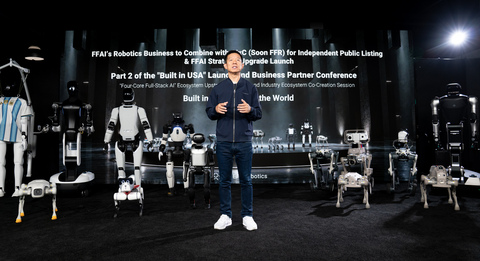
Faraday Future Unveils More Execution Plans for “Built In USA” Acceleration Program and Initiates the Conditional Approval Application, Will Roll out New Robot Product in Q1 2027; FF Robotics Business to Combine with AIxC (FFR) for Standalone Listing
The announcements include the proposed strategic combination of FF’s EAI robotics business with Nasdaq-listed AIxC, whose controlling stockholder is FFAI, which currently trades under the ticker AIXC, FFAI’s planned strategic upgrade, execution plans for Phase Two of FF’s “Built in USA” Acceleration Program, and the official opening of the EAI Robotics “Made in USA” Industry Alliance. The conference is being held in conjunction with IROS 2026 in Pittsburgh, Pennsylvania, where FF is participating from September 28-30. Together, these initiatives are designed to accelerate FF’s transition from individual intelligent products toward a broader Physical AI ecosystem spanning robotics, AI, real-world data, industry applications, U.S. manufacturing and shared intelligent mobility.
Proposed AIxC Combination Could Establish a Dedicated Public Platform for FF’s EAI Robotics Business
On September 28, AIxC announced that it had signed a non-binding term sheet with FFAI for a proposed all-stock acquisition of FFAI’s robotics business at a proposed valuation of approximately $200 million. Both the FFAI and AIxC special committees and boards have approved the term sheet. Under the proposed transaction, AIxC would acquire the FF EAI robotics business from FFAI in exchange for AIxC stock. The transaction remains subject to due diligence, definitive transaction documents, applicable approvals and other conditions. The term sheet filed with the SEC expressly states that it is non-binding except for specified provisions and contemplates an internal restructuring through which the robotics-related assets, intellectual property, data, contracts, employees and liabilities would be contributed into the entity to be acquired by AIxC.
AIxC will to be renamed FF EAI Robotics Ecosystem Inc., and its Nasdaq ticker is will change from AIXC to FFR, effective September 30, 2026. Upon completion of the proposed acquisition, AIxC plans to discontinue its crypto strategy and transition into a pure-play robotics ecosystem company centered on FF’s “Four-Core Full-Stack AI” model. FF believes the transaction could give its robotics business a dedicated public-market platform, greater operational and financing independence and a clearer mechanism through which investors can evaluate the business on its own operating fundamentals and long-term potential.
FFAI expects to remain the single largest and controlling stockholder of FFR following completion of the transaction, allowing FFAI to continue participating in the potential future value of the robotics business.
Rationale behind the $200 million valuation of FF EAI Robotics
FFAI and FFR believe that the approximately $200 million market-based valuation reflects the established product, delivery, and commercialization foundation of the FFAI Robotics business, as well as the significant value and long-term growth potential of its “Four-Core Full-Stack AI” ecosystem. In less than one year, the business has launched 24 products across three robot forms, five product series and 11 models, all of which have received FCC certification and achieved commercial deliveries of humanoid and biomimetic robotic products. As of the end of August, cumulative shipments reached 552 units. In the unaudited second quarter of 2026, the business recorded an average gross margin of approximately 30.9% on its “Four-Core Full-Stack AI” robotics products, with cumulative revenue of approximately $1.52 million. FFR targets positive quarterly operating cash flow in the third quarter of 2028 and aims to maintain a Top 3 comprehensive ranking among EAI robotics ecosystem companies over the next five years.
Total revenue from the “Four-Core Full-Stack AI” ecosystem is expected to reach approximately $7.1 million in 2026 and approximately $45.17 million in 2027, with projected cumulative revenue of approximately $1.98 billion over five years. Cumulative EAI Device sales are targeted to exceed 130,000 units over the five-year period.
FF EAI Robotics (FFR) Targets First New EAI Device from U.S. Production in Q1 2027
FF EAI Robotics is now advancing Phase Two of its “Built in USA” Acceleration Program, building on the three-phase roadmap introduced at Part One of the Company’s business partner conference on August 26. The program is intended to turn FF’s EAI technologies and ecosystem capabilities into longer-term U.S. capabilities in R&D, supply-chain integration, compliance, certification, manufacturing, testing, delivery and services. FF is advancing the development of its Next Futurist and Next Aegis product series while working to build U.S.-based supply-chain and manufacturing capabilities.
The Company has also taken steps to address applicable U.S. regulatory and compliance requirements. On September 2, FF announced an agreement under which AIBOT would provide advisory services concerning applicable FCC, Information and Communications Technology and Services (“ICTS”) and National Defense Authorization Act (“NDAA”) requirements, along with U.S. localization. FF also announced its participation in the FCC’s public-comment process.
The Company intends to evaluate localization opportunities for key EAI Device components, including batteries, motion-control boards, computing boards and robot structures, while progressively expanding U.S.-based assembly, sourcing and manufacturing.
FF is targeting first quarter of 2027 for its first new EAI Device to roll off a U.S. production line, a target the Company publicly announced earlier this month as part of its continuing “Built in USA” strategy. The Company intends to leverage existing manufacturing, supply-chain management, testing, validation and quality-control resources while adapting flexible production lines for final assembly and end-of-line testing of humanoid and quadruped robots.
Over the longer term, FF plans to establish flexible production capabilities capable of supporting multiple EAI Device models on shared manufacturing lines. For FF, “Built in USA” is intended to be more than final assembly. The Company’s long-term objective is to progressively increase U.S. participation across product development, core components, supply chain, compliance, production, testing and delivery while working toward applicable federal sourcing and procurement requirements.
FF EAI Robotics “Made in USA” Industry Alliance Officially Opens for Membership
As part of the conference, FF is also officially opening its EAI Robotics “Made in USA” Industry Alliance to new members. FF originally introduced the Global Industry Alliance initiative during Part One of its “Built in USA, Benefit the World” event on August 26, alongside the three-phase roadmap for its EAI robotics acceleration program. The alliance is centered around three ideas:
Global Innovation. U.S. Platform. Ecosystem Synergy.
FF intends to bring together partners from around the world across robotics, AI, semiconductors, core components, manufacturing, supply chains, research, real-world applications and capital, using the United States as an important platform for innovation, R&D, advanced manufacturing and commercialization.
The alliance is being opened to four broad partner groups:
- Technology and product partners, spanning EAI Devices, components, EAI Brain technologies, developer tools, Industry Productivity Solutions and data;
- Manufacturing and supply-chain partners, including factories, manufacturing equipment and processes, testing, quality, certification and component suppliers;
- Commercialization and application partners, including industry customers, system integrators, channel partners, operators, asset owners and rental-service providers; and
- Government, research, capital, and long-term strategic partners.
FF plans to work with developers through its EAI Brain and Developer Platform, with suppliers through joint validation and progressive U.S. localization, and with industry partners by identifying real-world tasks around which deployable Industry Productivity Solutions can be developed. Ten global partners were invited to participate in Part Two of the conference and shared their perspectives on the EAI robotics industry and FF’s “Built in USA” initiative.
FFAI Plans Strategic Upgrade Around Physical AI and Shared Intelligent Mobility
The proposed restructuring also creates a pathway for FFAI itself to evolve. FFAI plans to develop into a Physical AI investment, incubation and holding company, while expanding its automotive and mobility strategy into shared intelligent mobility and EAI cabin opportunities. The Company plans to explore three principal areas:
1. Robotaxi sharing network and shared-mobility operations, including potential connectivity with third-party Robotaxi networks;
2. EAI cabin commercialization, with the goal of bringing FF’s intelligent-cabin capabilities to other intelligent vehicles and future Robotaxis; and
3. Connecting FF vehicles with Robotaxi and shared-mobility networks, where technically and commercially feasible.
FF believes this strategy can leverage capabilities developed across intelligent electric vehicles, AI, intelligent cabins, shared-platform operations and EAI robotics. RoboShare provides one potential foundation for that evolution. AIxC publicly designated RoboShare as its top operating priority for the second half of 2026, and the platform is designed to connect robot manufacturers and asset owners with customers while coordinating booking, pricing, scheduling, payments and service delivery. RoboShare is evaluating expansion into additional AI-device categories, including autonomous shared mobility, as part of its exploration of broader Physical AI asset-sharing services.
FF has five strengths that can help make these upgrades.
First, FF’s DNA and forward-looking strategy. Back in 2014, FF was the first to bring up the “Four Future Trends” strategy: electrification, AI, Internet and sharing. Autonomous driving has developed for more than a decade. Now, as the technology matures, shared mobility is once again becoming a major direction for the auto industry. At this turning point, FF has a natural advantage in helping drive the change.
Second, FF team’s experience in shared mobility network operations.
Third, FF’s EAI cabin technology. Drawing on more than 20 years of intelligent cabin experience, we plan to bring FF’s “3rd aiSpace” to Robotaxis network, including Cybercab, and to conventional intelligent vehicles. We want to give passengers two kinds of value: a ride from A to B, and an AI-powered living space inside the vehicle.
Fourth, synergy across shared platform operations. RoboShare already has operating capabilities FF can build on. FF plans to extend them quickly into Robotaxi mobility services, from bringing vehicles onto the platform to operating them and serving users. By using resources well and keeping costs as low as possible, FF aims to build a real competitive advantage.
Lastly, ecosystem investment holding. FFR is set to become the first publicly traded robotics ecosystem FF has incubated. That will demonstrate FFAI’s ability to incubate businesses in Physical AI and also show the strength of its model.
“We believe this is an important new starting point for both FFAI and the future FFR,” said YT Jia, Founder and Global Co-CEO of Faraday Future. “The proposed transaction could provide our EAI robotics business with a more independent platform to pursue growth and long-term value creation, while allowing FFAI to accelerate its strategic evolution around Physical AI and shared intelligent mobility. Through our ‘Built in USA’ strategy, our goal is to connect the best global innovation with U.S. technology, manufacturing, supply-chain and commercialization capabilities and build the Physical AI ecosystem together.”
ABOUT FARADAY FUTURE
Founded in 2014, Faraday Future (FF) is a U.S.-based Physical AI ecosystem company dedicated to reshaping the future of robotics and mobility solutions through AI innovation and technologies. FF focuses on two major product strategies within the Embodied AI (EAI) robotics business: EAI humanoid and bionic robots, and EAI automotive-focused robots. By building a "Four-Core Full-Stack AI" ecosystem of EAI Brain and Developer Platform, EAI Devices, Industry Productivity Solutions and EAI Data Factory, FF aims to create an evolutionary flywheel: scaled device delivery, data collection and training, continuous evolution of the EAI Brain, stronger product capability, and even larger-scale delivery and deployment. Through this flywheel, FF seeks to maximize its commercial value and lead to the advancement of Physical AI. For more information, please visit Faraday Future's official website: https://www.ff.com/
FORWARD LOOKING STATEMENTS
Important factors, that may affect actual results or outcomes include, among others: the Company’s ability to continue as a going concern and improve its liquidity and financial position; the Company’s ability to pay its outstanding obligations, which it currently lacks; the availability of sufficient share capital to meet its current obligations and execute on its strategy; the willingness of convertible debt investors to fund the Company; demand for the Company’s robotics products; the ability of B2B preorder companies to locate customers to purchase our robotics products, on which their nonbinding preorders substantially depend; competition in the robotics industry, which includes companies with far superior experience, funding and name recognition; the ability of the Company to build an EAI education ecosystem that serves both the B2C consumer market and the B2B institutional education market; the acceptance by teachers and students of the Company’s robotics products in the education market; the ability of the Company to expand into additional markets for its robotics products; the Company’s reliance on a single OEM for most of its robotics products; the Company’s reliance on Chinese OEMs for all of its robotics products; the possibility of the federal government banning imports of Chinese robotics products; the Company’s ability to get the planned robotics products to comply with all applicable U.S. rules and regulations; the ability of the robotics OEM to timely supply robotics to the Company; tariff uncertainty for imported products, particularly from China; demand from automobile dealers for robotics products; the Company's ability to homologate FX vehicles for sale; the Company’s ability to secure the necessary funding to execute on the FX strategy, which is substantial; the Company’s ability to secure an occupancy certificate covering all of its Hanford facility; the Company's ability to remediate its material weaknesses in internal control over financial reporting and the risks related to the restatement of previously issued consolidated financial statements; the Company’s limited operating history and the significant barriers to growth it faces; the Company’s history of substantial losses and expectation of continued losses; the success of the Company’s payroll expense reduction plan; the Company’s ability to execute on its plans to develop and market its vehicles and the timing of these development programs; the Company’s estimates of the size of the markets for its vehicles and cost to bring those vehicles to market; the rate and degree of market acceptance of the Company’s vehicles; the Company’s ability to cover future warranty claims; the success of other competing manufacturers; the performance and security of the Company’s vehicles; current and potential litigation involving the Company; the Company’s ability to receive funds from, satisfy the conditions precedent of and close on the various financings described elsewhere by the Company; the result of future financing efforts, the failure of any of which could result in the Company seeking protection under the Bankruptcy Code; the Company’s indebtedness; the Company’s ability to use its “at-the-market” program; insurance coverage; general economic and market conditions impacting demand for the Company’s products; potential negative impacts of a reverse stock split; potential cost, headcount and salary reduction actions may not be sufficient or may not achieve their expected results; circumstances outside of the Company's control, such as natural disasters, climate change, health epidemics and pandemics, terrorist attacks, and civil unrest; risks related to the Company's operations in China; the success of the Company's remedial measures taken in response to the Special Committee findings; the Company’s dependence on its suppliers and contract manufacturer; the Company's ability to develop and protect its technologies; the Company's ability to protect against cybersecurity risks; and the ability of the Company to attract and retain employees, any adverse developments in existing legal proceedings or the initiation of new legal proceedings, and volatility of the Company’s stock price. You should carefully consider the foregoing factors and the other risks and uncertainties described in the “Risk Factors” section of the Company’s Form 10-Q for the quarter ended June 30, 2026, filed with the SEC on August 13, 2026; the quarter ended March 31, 2026, filed with the SEC on May 14, 2026, and Form 10-K filed with the SEC on March 31, 2026, and other documents filed by the Company from time to time with the SEC.
View source version on businesswire.com: https://www.businesswire.com/news/home/20260929114466/en/
Investors (English): ir@ff.com
Investors (Chinese): cn-ir@faradayfuture.com
Media: john.schilling@ff.com
