Forced labor in the commercial fishing industry
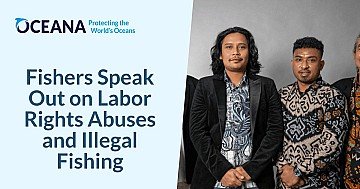
Rizky Oktaviana was working as a waiter at a Japanese restaurant in Jakarta when a recruiter arrived at his door one day with an exciting job prospect: Work on a foreign fishing vessel and make a handsome salary of $350 USD per week, plus bonuses and holidays.
Oktaviana had a college degree in science, and didn’t consider himself the office-job type, so advancing his career at sea seemed like a smart move. Before signing the contract, he asked the director of the recruitment agency a series of questions to better understand the job. Instead of the conversation settling his concerns, however, Oktaviana received the first of many threats: “Do not sign, and you’ll owe us $2,000 USD,” the director reportedly told him.
Oktaviana knew that the agency already had his private documents, including his Indonesian ID card and education certificates, and if he walked away, they likely wouldn’t be returned. He also faced the social pressure of cancelling his plans and having to answer to those in his hometown. “I felt set up,” Oktaviana says.
The sour events that preceded Oktaviana going to work on a foreign fishing vessel only foreshadowed worse transpirings out on the high seas, where external contact was impossible; land was thousands of miles away; and nothing was as promised. There, he would meet others, Indonesian migrant workers like himself, many trying to support their families in a struggling job market while their dreams darkened into a nightmare.
Life at sea
While some challenges of life at sea come with the territory – seasickness, cramped space, and homesickness to name a few – many Indonesian migrant fishers describe the conditions on bad-acting foreign fleets as unlivable. Some reported that they were regularly served expired or rotten food, at times had to drink dirty water, and were subjected to 20+ hour workday schedules.
The few hours for sleep were hardly enough to survive on, much less to do the labor-intensive work of manning a fishing vessel. Fishers typically piled into a single room to sleep, each person with a patch of floor so small they had to contort their bodies to fit inside it.
Oktaviana recalls that the boat’s captain, who hailed from a different country than the migrant workers
(and had his own room), regularly threatened the fishers to comply with his demands. Because of the lack of Wi-Fi, there was no way to report abuses or to get help while at sea, says another former fisher, Adrian Dogdodo Basar, who has since become a human rights activist.
These abuses at sea are not new, and perpetrators have faced little accountability or justice. A 2021 study estimates that 128,000 fishers are in forced labor globally, and another suggests 20% of migrant fishers are from southeast Asia. They endure deception, violence, coercion, and abuse on vessels that can remain at sea for years at a time, far from any government oversight.
The long stints at sea are made possible by a practice known as “transshipment,” in which other vessels restock supplies, refuel, and transfer the catch to allow the main fishing vessel to avoid going ashore to dock or be inspected. As a result, the migrant workers have few opportunities to reach the outside world or escape from the boat — and could be moved onto another vessel during the transshipment, forced to stay at sea.
“In some places, fisheries and human rights abuses manifest with violence against the crew. Oftentimes we see wages being withheld. Sometimes crews are kept at sea for extended periods of time without access to medical care or contact with loved ones,” says Oceana’s Senior Director of Global Transparency Maisie Pigeon.
When working on a Taiwanese-owned tuna fishing vessel that he says was illegally fishing sharks and squid, Basar remembers the day his friend’s leg started to swell. Worried about an infection, the crew asked the captain for medicine, though they couldn’t be sure what pills were in the bottle he was given – labelled in Mandarin – or if it had expired. Basar’s friend took a turn for the worse, and days later, died.
“I can’t do this anymore,” Basar recalls telling the captain, pleading with him to dock so that the crew could give their friend a proper burial. Instead, says Basar, “the vessel continued to operate and the captain put my friend’s body in the ship’s freezer along with the fish.” He said they were forced to keep working as usual for two more months, and the captain threatened to block their passports – barring them from future employment – if they didn’t.
Basar’s voice trembled as he recounted the story during a trip to Washington, D.C. in May of 2026, organized by the U.S. IUU and Labor Rights Coalition to raise awareness of these issues. “Would you buy the fish if you knew that my friend’s body was in the same freezer as your fish?”
In the dark
Worldwide, fish is rarely traced from the fishing vessel to the consumer’s plate, leaving most consumers unaware of the illegal practices and human rights abuses rife throughout the supply chain. An estimated one in five wild fish comes from illegal, unreported, and unregulated (IUU) fishing – practices that can also overlap with forced labor – and generate up to $36.4 billion in illegal profits each year. Lack of national and international regulation and adequate enforcement has allowed abuses to continue at sea largely unabated.
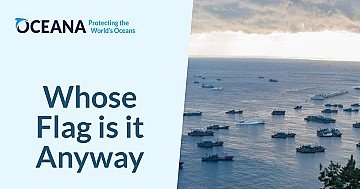
Boats that carry the catch to shore via transshipment often end up mixing fish – those legally and illegally caught – together, making it easier to give illegally caught fish a new identity. Illegal fishing vessels also commonly use “flags of convenience,” flying the flag of a different country with looser regulations. In the U.S., where 90% of seafood is imported, only some imported fish is required to be traced from the boat to the U.S. border, says Pigeon.
In 2026, the Cape Town Agreement, an international agreement drafted nearly 15 years earlier to improve safety requirements aboard fishing vessels, received its final ratifications, and will go into effect in 2027. Among the 65 countries that have signed on, authorities are responsible for ensuring vessels flying their country’s flags must adhere to global minimum safety standards. “It’s a small step, but an important one,” says Pigeon.
The Coalition for Fisheries Transparency, co-chaired by Oceana, Environmental Justice Foundation, and Global Fishing Watch, also launched the Mombasa Declaration at the 2026 Our Ocean Conference. The Declaration is a global call to action for countries to establish transparency, accountable, and fair fishing practices. This vital first step of countries publicly committing to transparent reforms “gives us really good ground to begin to develop new policies to advance transparency in the 16 countries that have committed so far,” she says.
Meanwhile, in the U.S., Oceana and other organizations are pushing Congress and the administration to strengthen import controls requiring catch documentation and traceability for all seafood imports, provide increased resources for the government to fight IUU fishing, and expand the tools the U.S. has to ensure that all seafood sold in the U.S. is safe, legally caught, responsibly sourced, and honestly labeled. In Europe, campaigners are pushing to hold insurance companies and other businesses that service fishing vessels accountable if they do not screen for illegal fishing activity.
“IUU fishing and human rights and labor abuses at sea are inextricably linked,” she says. “As companies are looking to cut corners, they’re exploiting their workers and they’re over-exploiting the ocean itself. If we have better information about vessels, we have better tools to combat both the destructive impact of illegal fishing on the oceans and the human rights abuses happening on fishing vessels.”
Transparency alone will not solve the pervasive problem, Pigeon explains. “Disclosure of information is not the end goal. It’s a tool to put in place better policies. But better information ultimately leads to better decisions that protect the oceans and the people who depend on them.”
Into the unknown
In 2013, several fishing vessels were impounded off the coast of South Africa for illegal fishing. Approximately 75 fishers were aboard – including Oktaviana. Some of the fishers shared their stories with the press, and their testimonies of slavery-like working conditions exploded into international headlines. Despite the news traveling throughout South Africa, Indonesia, and beyond, the crew spent two weeks stranded in Cape Town, sleeping on the boat and relying on locals to bring them food since they did not have the legal papers to go ashore. That was followed by months in an overcrowded detention center.
Meanwhile, Basar escaped when his Vanatau-flagged vessel was docked in Taiwan, but with no ID, phone, or money since he was never paid. Basar is not the only one in this situation; the Union of Indonesian Migrant Workers says that many migrant workers must fend for themselves to find an embassy or consulate in a foreign country and make their way back home.
Others, like Resi Yulianto, return in debt after being forced to pay large sums to recruiters before even stepping on board the vessel. This debt deeply impacted Yulianto’s family, eventually tearing it apart.
When Oktaviana finally arrived home to Indonesia after months stranded in South Africa, he, too, had not received any pay for his years working on the vessel. Today, he advocates for fisher rights, including receiving their rightful pay. Oktaviana and Basar are training to become lawyers so others do not face the same injustice. “Because of my experience being a victim, I decided to fight for and defend others like me,” Basar says.
“We have to tell [consumers] the real situation,” Okatviana emphasizes. “We have to put pressure on. The people’s power is more important than anything.”