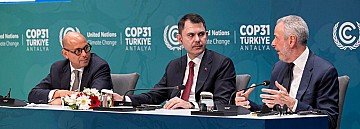
The COP31 climate conference in Turkey will take place after a summer that has proven how even a fraction of climate breakdown can be devastating to communities and their rights. In attendance at the negotiations, the International Federation for Human Rights (FIDH) calls on Parties to finally deliver on their obligations under the Paris Agreement and make human rights a core issue in all decisions – from the transition away from fossil fuels to electrification and finance targets.
4 November 2026. Catastrophic flash floods in Nepal. Record-breaking, deadly heat overcharged worldwide by the “super-El Niño”. Wildfires engulfing entire regions in Oceania and North America. This summer’s climate disasters have shown that a world even just minimally over the 1.5-degree temperature limit of the Paris Agreement is one with unprecedented threats to lives, human rights and nature.
This year also confirmed what was already known about the injustices of climate breakdown: those least responsible for historical emissions, like Nepal, suffer the most and have the fewest means to adapt to the crisis and its impacts. The UN Environment Programme’s report made it clear that we are on an overshoot trajectory that would make things even worse. But this should not lead to resignation.
Instead, it should push us to act urgently to get back to below 1.5 degrees, before we cross irreversible thresholds. Leaders and negotiators in Antalya must make this a collective ambition and finally deliver on their obligations to protect the climate and the human rights that depend on it. Centering rights and their defenders in negotiations is part and parcel of the solution.
No just transition without human rights
At COP30, in the Just Transition Work Programme, civil society secured a groundbreaking decision to develop a Just Transition Action Mechanism – known as the BAM – to accelerate and coordinate climate action that advances social justice and rights for all. COP31 is the time to deliver it.
A just transition cannot be considered as such if it does not fulfil human rights and give space to the voices and solutions of civil society, environmental defenders, Indigenous Peoples and workers. The BAM must ensure their participation and make human rights a core concern of its operations, structure and activities, as FIDH and its member organisations argue in a new briefing to negotiators.
A just transition is not limited to the BAM. COP31 will discuss the voluntary Roadmap to transition away from fossil fuels and the Co-Presidency’s goal to increase electrification to 35% of final energy demand by 2035. A fossil fuel phaseout and other energy transition policies must happen together to secure absolute emissions cuts in line with the science and the goal of 1.5 degrees or below. Scaled-up finance from high-income countries to low-income ones needs to follow to make this a reality.
States must guarantee the rights and meaningful consultation of affected communities – from securing livelihoods in phased-out sectors to repairing environmental damage from fossil fuel projects. A just transition means bringing about a new economic model that simultaneously respects planetary boundaries and achieves the fulfilment of all human rights.
Phaseout is only one part of the equation. States must also prevent the acceleration of “green extractivism” without human rights protections, which repeats violations and unsustainable consumption patterns similar to those of the fossil fuel past. This is the case for many Indigenous Peoples whose rights are under growing pressure due to the race for “critical minerals” in their territories.
Fighting to protect environmental defenders – inside and outside the COP
The Antalya talks also come almost a year after Indigenous climate defender Daria Egereva was arbitrarily detained by Russian authorities under unfounded charges of terrorism shortly after her return from COP30. She has been held in pre-trial detention since, together with her colleague Natalia Leongardt, with both of them risking up to 20 years in prison.
Egereva and Leongardt’s case is a painful reminder that the space for environmental defenders to speak out and demand real climate action keeps shrinking globally, at a huge cost for them and our common future. That is also true at the COP, where there has been a trend of negotiations being hosted in countries with concerning human rights records.
An open civic space must be a priority in climate policy and its implementation. The UN secretariat and States must express their zero tolerance for reprisals and introduce safeguards to protect defenders before, during and after COPs, as FIDH’s Observatory for the Protection of Human Rights Defenders and its member and partner organisations explain in a new note.
One cornerstone must guide all the work in Antalya: there is no climate justice without human rights.