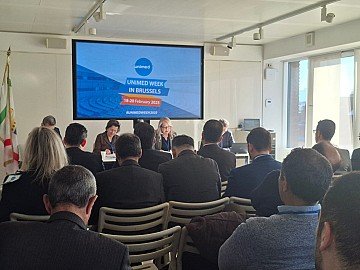
More than 90 participants gathered in Brussels – and many joined online – for the 8th Edition of the UNIMED WEEK IN BRUSSELS.
This annual event – promoted and coordinated by UNIMED – provides the Euro-Mediterranean academic community with a platform for dialogue between European Institutions and the Mediterranean region. Concurrently, this event allows to improve the knowledge and use of EU supported programmes in this field, facilitating the identification of further support needs.
This edition has seen the participation of European Commission representatives of DG EAC, DG NEAR, DG INTPA, DG R&I, EEAS, the Union for the Mediterranean (UfM) and Africa-Europe Foundation, together with UNIMED members. It was discussed the role of Higher Education in crisis contexts as a tool to foster regional cooperation not only at the university level, but also addressing the Research and Innovation efforts regarding sustainability and health in the Euro-MED area.
The focus was, as well, on the relations between the two shores of the Mediterranean, discussing the implementation and evaluation of regional policies and programmes such as Erasmus+ and Horizon Europe. Moreover, it addressed the importance of cooperation and capacity building programmes between Europe and Sub-Saharan Africa.
The three-days event focused on the topics of Higher Education and Regional cooperation was organised in three thematic panels.
Higher Education, Erasmus+ and Horizon Europe Programmes
Representatives of the European Commission and namely Bernal Rios, from Directorate-General for Education, Youth, Sport and Culture, Unit C3 “International Cooperation”, Olga Martín González from European Education and Culture Executive Agency and Thierry Devars from Directorate-General for Education, Youth, Sport and Culture, Unit C2 “Marie Skłodowska Curie Actions”. The main message was that all the programmes and actions presented such as Erasmus+, Jean-Monnet, Marie-Skłodowska Curie Actions in Horizon Europe are not fostering cooperation in Europe but with Europe. So the collaboration in the Mediterranean Region is more and more encouraged and supported.
And to better analyse the status of the collaboration in particular situations such as the crisis contexts, the cases of Iraq and Yemen were presented and discussed by Leopold Gritschneder, from the Directorate-General for International Partnership, Unit C.1, Middle East, Central Asia of the European Commission. An overview of the challenges and the status of collaboration of UNIMED with Syrian and Libyan Universities was, instead, presented by UNIMED Director, Marcello Scalisi.
Regional Cooperation in the Euro-Mediterranean Region
The panel of “Regional Cooperation in the Euro-MED” was opened by Birgit Loeser, Head of Division MENA.1 Regional Affairs of the European External Action (EEAS), who stressed the need of revising the European Southern Neighbourhood policy to create a more stable, peaceful and prosperous region. Meanwhile, UNIMED members and partners presented concrete actions and initiatives to reach this common goal.
The UNIMED President, Vice President of An-Najah National University, Palestine, Kherieh Rassas introduced the Technical Education Support for Higher Education Students Initiative – TESI, an initiative aiming at empowering Gaza students to complete their university education remotely as visiting students for a limited period, with no financial burden on the students or their respective universities. The initiative has raised interest and support within the attendants and beyond.
In the frame of migration, Professor Andrea Miconi, from IULM University, showed the results of the EUMEPLAT project, analyzing the European media narratives about migrants and refugees and outlining the misinformation and disinformation as a results of the process that the migrants voice – to speak about themselves – is missing in the public debate.
Other programmes were also presented in the framework of the refugees and migrants issue, Stefanie Kottowski from Deutscher Akademischer Austausch Dienst – DAAD presented an initiative for scholars at risk supporting migrants and refugees.
Focusing on student empowerment in the Mediterranean, UNIMED Project Manager, Anne-Laurence Pastorini and the Erasmus Student Network President, Rita Dias, presented the “Mediterranean Student Summit – MSS”, soon at its third edition.
With the aim of giving more space and making students’ voices heard, they showcased some of the students’ recommendations, which emerged during the last MSS edition and aimed at redefining the Higher Education sector in the Mediterranean Region, according to their needs and aspirations.
Another initiative for African and Middle Eastern students was launched by NATO Strategic Direction-South Hub, with the support of UNIMED, to foster South-South cooperation.
The role of Higher Education in the MED was also addressed by Itaf Ben Abdallah, Senior Advisor at UfM, who stressed the important contribution the academic and universities cooperation brings to the work of UfM and the broader regional policy. Moreover, moving from the Euro-Mediterranean space to Sub-Saharan Africa, the Africa-Europe Foundation moderated an interesting debate between universities, scholars and African students representatives, outlining the positive outcomes for Europe-Africa relations in developing mobility programmes and exchanges and not neglecting the challenges ahead.
Regional Cooperation in the Euro-Mediterranean Region
The last panel, organized by European Commission DG R&I in collaboration with UfM and UNIMED, focused the debate on Research&Innovation policy in the MED region, addressing the common challenges we share such as climate change, renewable energy, health, innovation and employability. With the support of academic cooperation and European institutions, different projects and initiatives have been established for sustainable development in the Euro-Mediterranean area.
“The Green Innovation and Employability in the Med through the Triple Helix” a study launched by the UfM and conducted by UNIMED, has been used as a theoric guideline for talking about green innovation in the region. The study sets forth detailed country analysis with a focus on green transition policies and tools, complemented by a wide range of inspiring and scalable practices at national, regional and Euro-Med level.
In this framework, UfM and European Commission DG R&I, launched the EuroMed Hub for Research and Innovation, who serves as a learning and collaborative platform for Mediterranean cooperation, aiming at bolstering the UfM Regional Policy Dialogue on Research and Innovation (R&I) and facilitating the implementation of R&I roadmaps on sustainability.
The launch of the new hub was followed by the evaluation and implementation of the Union for the Mediterranean Ministerial Conference on Research and Innovation adopted in June 2022 in Cairo, with the aim to promote the European Commission programmes dissemination and acknowledgement in the Euro-MED.
In this context the speakers explained Horizon Europe, EU’s key funding programme for research and innovation, with a specific focus on the Horizon Europe Work Programmes and the opportunities for cooperation under the Mediterranean Initiative and the African Initiative. Among others, it is also worth to mention the Marie Skłodowska-Curie Actions (MSCA), a mobility programme for researchers. Moreover, in the last session, National Programme Coordinators from Algeria, France, Lebanon, Portugal and Egypt shared their experiences and insights.
“The UNIMED WEEK 2024 was a great opportunity to connect representatives – at all levels – of the two shores of the Mediterranean. The only way to succeed and proceed is by doing things jointly. It is a journey and we have to continue to travel and also to enjoy it, becaus, in the end, we are Mediterraneans” with these words, Marcello Scalisi, UNIMED Director, closed the eight edition of the UNIMED WEEK.