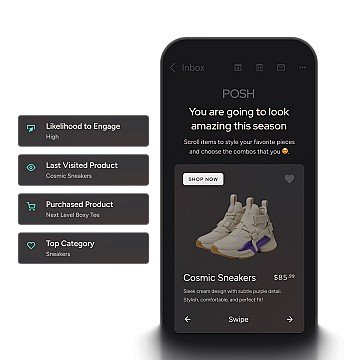
While personalization has been around for a long time, today’s martech solutions have made it more prevalent and accessible than ever. This brings both benefits and challenges for marketers.
On the one hand, it’s easy to implement basic personalization tactics, like adding someone’s name, birthday, or last visited product to an email. On the other hand, customers have gotten used to these tactics and are expecting brands to deliver a completely individualized experience across all channels.
Marketers also face other obstacles in this regard, like:
- The impending elimination of third-party cookies.
- The vast volumes of customer data that’s typically siloed off in different tools.
- The difficulty in building, analyzing, and optimizing personalization campaigns across different channels and ensuring a consistent brand experience.
This makes personalization at scale — i.e., across thousands of users, different channels, and customer lifecycle stages — incredibly difficult.
In this guide, you’ll learn how to overcome the challenges of personalization at scale. We’ll also explore examples of large brands that managed to implement successful personalization techniques using Insider — our enterprise marketing platform for creating individualized, cross-channel customer experiences.
Insider helps companies like Adidas, Philips, Allianz, GAP, and Lexus implement personalization at scale across their websites and mobile apps, as well as channels like email, push notifications, SMS, WhatsApp, and more.
Visit our website or schedule a demo with our team to learn how Insider can benefit your business as well.
Personalization at scale: Definition, benefits, and examples
Personalization at scale is the process of using reliable data — like purchase histories, on-site actions, and survey responses — to deliver individualized experiences to a large number of customers across different channels.
You can find examples of personalization at scale across industries and businesses. For example:
- eCommerce stores (like Amazon) show different products to each individual visitor based on their browsing and purchase history.
- Online streaming services (like Netflix) suggest different shows and movies based on what viewers have previously watched and searched for.
- Brands with strong digital and physical presence (like Disney) deliver individualized experiences offline based on what customers have shown interest in online (or vice versa).
When it involves multiple online and offline channels, the process of individualizing the customer experience is also referred to as omnichannel personalization. To do it successfully, teams need the right martech infrastructure to:
- Unify their customer data.
- Segment and analyze their audiences.
- Build, launch, and automate personalization campaigns.
The benefits of personalization at scale include:
- Higher conversion rates, as more customers are willing to buy products and services that are relevant to them.
- A more engaged customer base due to the experience being tailored to fit each person’s needs, interests, and preferences.
- Higher customer lifetime value (CLTV), retention, and long-term loyalty, as customers feel like the brand understands what they’re looking for and won’t waste their time with irrelevant offers.
How to make personalization work at scale
While commonly used, personalization tactics can be very difficult to implement, especially at scale. Below, we’ll explore a three-step process for doing so that has worked for many of our clients.
1) Set the foundation with unified customer data
Just like you can’t build a house without a solid foundation, you can personalize successfully without reliable customer data. The problem is that for many brands, that data is scattered across disconnected systems, like CRMs, CMSs, point solutions (e.g., email marketing software and push notification tools), legacy systems, and so on.
This prevents marketers from getting a clear understanding of their customers. It also hides key insights from them that should be factored into the decision-making process when building personalization campaigns.
That’s why the first step to successful personalization at scale is to integrate your customer data.
There are different ways to do so but perhaps the most popular one is to use a customer data platform (CDP). CDPs are solutions built specifically for aggregating customer data from online and offline sources into a single unified database.
For example, Insider comes with a built-in CDP that can aggregate data from:
- CRMs like Salesforce, Pipedrive, and Microsoft Dynamics CRM.
- Point solutions like Mailchimp, ActiveCampaign, and Constant Contact.
- Analytics and attribution platforms like Mixpanel, Amplitude, and AppsFlyer.
- Marketing automation tools like Adobe Marketo and Pardot.
- Live chat software like Drift and Intercom.
- And many other popular SaaS solutions.
Using this data, our CDP can resolve omnichannel identities into detailed 360-degree customer profiles, like the one shown below. These profiles contain everything you need to make data-driven decisions and build successful personalization campaigns, including:
- Demographics.
- Purchase history.
- Channel reachability.
- Last purchased and abandoned products.
- Predictive characteristics, such as likelihood to purchase or engage on a channel.
- Interactions with the site, mobile app, or channels like email, SMS, and push notifications.
- Survey responses (and other first-party data).
At the same time, you don’t need as much information to get started with personalization.
You can start by using only a few key data points — like website actions, purchase and browsing history, and location — to create successful personalization campaigns. The rest of the data can be aggregated over time as you start to generate results.
You also don’t need to limit your personalization efforts to leads and known customers.
For example, Insider’s CDP also creates 360-degree profiles of website visitors who haven’t shared any contact information with you. These profiles don’t contain contact information but still have essential insights into what visitors are browsing, which attributes they’re interested in (e.g., prices, colors, sizes), and which products they add to their carts.
This enables you to implement anonymous visitor personalization by:
- Tailoring your website content, messaging, and product recommendations in real-time.
- Engaging anonymous visitors and bringing them back to your site with personalized web push notifications.
Put simply, unifying your customer and anonymous visitor data lays the foundation for successfully implementing personalization at scale across first-time visitors, anonymous users, leads, and known customers.
2) Deliver personalized content, messaging, and product recommendations
Besides reliable data, personalization requires the necessary tools to activate that data across channels and for different use cases. Companies often use a plethora of solutions for that purpose, like:
- Website personalization software.
- Email marketing platforms (most of which have at least some personalization features).
- Different channel-specific tools for SMS, WhatsApp, online ads, push notifications, and other channels they’re using.
While this approach can work, it also has significant downsides. It forces marketers to juggle together a bunch of different tools, each with its own UI, credentials, and learning curve. It can also lead to very expensive and hard-to-track martech stacks, as each tool has its own pricing and renewal periods.
The alternative approach is to use a unified marketing platform that combines these personalization tools and channels in one place. For example, Insider can unify your customer data and enable you to personalize your customer experience across 12+ channels — including your website, mobile app, email, SMS, WhatsApp, and more.
Website and mobile app personalization
Website personalization can take many different forms. Content, messaging, and product recommendations can all be tailored to each individual visitor, which helps create a more consistent customer experience and maximize conversion rates.
Insider’s Web Personalization Suite is built to tailor all on-site elements based on users’ needs, interests, and preferences, including:
- Banners.
- Categories.
- Product recommendations.
- And more.
For example, you can use our versatile product recommendation engine to match every visitor with personalized products. You can also choose from a variety of personalization strategies, including viewed together, recently viewed, purchased together, location-based top sellers, checkout recommendations, purchased with last purchased, and more.
It’s also easy to create product recommendation widgets using a simple drag-and-drop editor. This means you can implement personalization strategies across your site without needing constant IT support.
Templates are also essential in that regard. Regardless of the personalization solution you’re using, you need to have proven, easily customizable templates in order to quickly launch and optimize personalization campaigns without a heavy reliance on technical teams.At Insider, we offer a plethora of templates for various use cases, like generating leads via gamification, adding social proof, displaying purchase progress bars, and much more.
Besides content, messaging, and product recommendations, there’s another key element of the on-site experience that must be personalized — site search results. This is especially true for eCommerce stores where many potential customers bounce due to poor product discovery.Again, this is something we offer at Insider via Eureka — a site search and personalization tool powered by artificial intelligence (AI). This tool delivers personalized search results to every shopper and lets you improve the overall search experience with advanced faceting filters based on product attributes (price, category, brand, ratings, etc.)
Omnichannel personalization
Tailoring your website and mobile app is essential but not enough to create a truly personalized customer experience. For that, you also need to individualize every other customer interaction with your brand.
This depends entirely on the channels you’re using. Established brands use a mix of touchpoints, usually including email, a messaging channel (or a combination), and online ads to reach their audiences.
Insider lets you reach customers on these (and other touchpoints) with a personalized approach based on your unified data. For example, you can use Insider to personalize your:
- Emails. You can go beyond standard email personalization (e.g., using a customer’s name or birthday) by extending your product recommendations to your email campaigns. AMP emails can help you exceed your customers’ expectations with interactive, web-like experiences that enable them to mix and match products, answer surveys, make reservations, and much more right inside your emails.