AI Digital Transformation
CHEMNITZ, Germany – In a small corner of a vast thyssenkrupp factory in this industrial town, an engineer was talking to a machine.
“From the beginning I was only speaking to it in English, but today I discovered it speaks German quite well,” said Marcus Schoenherr, one of the thyssenkrupp engineers using the Siemens Industrial Copilot to program and test this machine. The Industrial Copilot is a generative AI-powered assistant that was developed through a collaboration between Siemens and Microsoft. Microsoft’s Azure OpenAI Service powers the copilot’s capabilities.
“When I start with the copilot I usually begin with a welcome and introduce myself,” Schoenherr said. “But I wondered if it would understand the typical northern German word ‘Moin’ which means good morning, among other things. And then suddenly the copilot answered in German.” Schoenherr then spent the rest of that session interacting with the machine using his native language.
This project at thyssenkrupp is part of an effort to use the power of AI to compensate for a shortage of skilled workers in manufacturing in Germany, Europe and many other countries, including the United States.
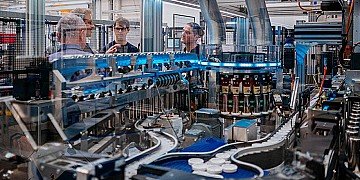
Schoenherr sits at a desk in front of the battery testing machine, enclosed in a glass box the size of a minibus, and the contraption pulses with red and green lights that illuminate the cells that flow by on a conveyor belt, while digital cameras and sensors measure and test each one. These cells will eventually comprise the power pack in an electric car or truck. If one cell is flawed, the entire power source will fail, costing the carmaker thousands of euros.
Schoenherr has been working with the Siemens Industrial Copilot, powered by Azure OpenAI Service with GPT-4, since July. The application was developed during the past year and a half. In collaboration with Siemens, thyssenkrupp has been working on adapting the copilot to the specific requirements of thyssenkrupp’s machinery. Siemens now has more than 100 other customers evaluating and testing the Industrial Copilot.
Like many large manufacturers in Europe and elsewhere, thyssenkrupp is confronting challenges that inspire new ways of thinking.
“We’re facing a shortage of skilled workers, not only in Germany but in Europe and the US,” says Marcel Pfeiffer, thyssenkrupp’s director of digital factory solutions. “We want to enable less experienced engineers to be able to write coding in a short time, and we want to boost efficiency to a very high level.”
The multinational plans to roll out the Siemens Industrial Copilot into its standard development and manufacturing process globally in 2025, Pfeiffer says.
At this plant, spread out over an area bigger than a soccer field, engineers and workers build linked systems of machines to make electric vehicle batteries. These assembly lines are destined for vehicle manufacturers in Europe and Asia. While thyssenkrupp is planning to use the engineering copilot worldwide initially, it is still in the testing phase of the operational copilot. Pfeiffer says thyssenkrupp will also be introducing the operations copilot globally, depending on customer demand and other factors.
Erik Scepanski of Siemens was also thinking about the shortage of skilled labor when he and other engineers at Siemens began developing the Industrial Copilot in 2022. Scepanski, 29, is Siemens’ innovation manager for factory automation. He started his career as an electrical engineer programming machines the old-fashioned way, working with complex machines at Siemens plant near Essen, Germany.
In that job, he often turned to a mentor who had been working with the machines for decades.
“As a beginner, I did not have a clue about how to program machines,” he says. “And I always went back to him and asked him questions, how to do this, how to do that, and he always knew what to do. But he had his own projects, and I didn’t want to bother him so much.”
An older generation of engineers, like Scepanski’s mentor, are nearing retirement.
“I talked to a lot of customers during the last one and a half years, and what they told me is their biggest challenge is that they don’t find skilled labor, especially when it comes to automation engineers.” Scepanski cited a Korn Ferry study that suggests that there will be a global shortage of as many as 85 million skilled workers by 2030.
When Scepanski and other Siemens engineers started experimenting with OpenAI’s large language models, they saw the potential to bridge that generation gap, both for the engineers programming the machines and for the operators who run them on the factory floor. When Microsoft, a longtime partner with Siemens, integrated the technology and created Azure OpenAI Service, Scepanski saw an incredible opportunity to combine Siemens’ industrial and technological expertise with this new set of tools.
“Talking to a machine and getting feedback in an almost human way is something that really resonates with people,” Scepanski says. “We see a lot of potential to include the knowledge from the people who will retire, but also to onboard the colleagues who are not familiar with the machines and make it easier to understand how to solve issues.”
Schoenherr of thyssenkrupp said he’s excited about the potential of the Siemens Industrial Copilot, both for engineers like him and for the operators of the machines. The copilot provides a solid base, he says; then it is up to engineers and programmers at thyssenkrupp to create the databases that the copilot will draw from to help program and run the machines as well as doing the programming needed for each component in an assembly line.
Within its version of the Siemens Industrial Copilot, thyssenkrupp controls its proprietary data, and all the data is stored in its private cloud on Azure. Data specific to its products are not shared with Siemens.