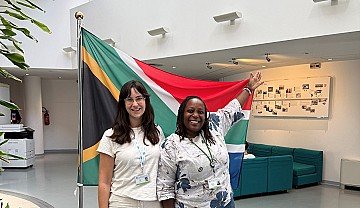
South African Women in Biotechnology (SAWBP) fellow Bianca Delport joins the ICGEB Trieste Component for the mobility feature of the Programme.
Born in Durban, South Africa, Bianca completed her studies up to a Master’s degree in Microbiology at the University of the Free State in Bloemfontein. She lives in Cape Town, where she is pursuing a PhD in Molecular Biology at the ICGEB Component. Thanks to her South African Women in Biotechnology Programme, (SAWBP) fellowship, an ICGEB Programme in partnership with the South African Department of Science, Technology and Innovation (DSTI), Bianca works under the supervision of Dr. Lara Donaldson in the Plant Systems Biology Lab, where her research focuses on the bacterial microbiome in the rhizosphere of sorghum – a highly versatile crop that ranks as the world’s fifth most important cereal.
“Sorghum is a key ingredient in various food products and is widely used as livestock feed. To investigate its microbiome, I employ a combination of molecular techniques and culture-dependent methods to identify bacteria present in sorghum samples from South Africa” – Bianca shares. Once identified, these bacteria will undergo further testing to evaluate their plant growth-promoting effects, including experiments on different growth media and inoculation trials using sorghum seedlings. The project’s ultimate goal is to identify plant growth-promoting bacteria with the potential to be developed into field biofertilisers, enhancing sorghum cultivation.
Bianca is the first SAWBP fellow to undertake the 6-month mobility feature of the programme. At the Bacteriology Lab in Trieste, Bianca is continuing her work on the bacteria that she has cultured thus far from the various sorghum rhizosphere samples from South Africa. To assess their growth-promoting properties, she is testing the bacterial isolates on different growth media. “Upon identification of these bacterial isolates, we will look at using other, more in-depth techniques to study some of these bacteria and gain further ideas on how to analyse these organisms in more detail. I am excited to learn new techniques that I can apply to my current project as well as furthering my knowledge in the field of bacteriology.”
With her mobility period at ICGEB Trieste, Bianca aims to expand her knowledge in the field of bacteriology and develop new techniques to enhance her current skill set.
“The experience of working in a different lab has been exhilarating. Observing how ICGEB departments operate distinctly yet collaborate seamlessly across the globe has been particularly fascinating. I am enjoying meeting and working with individuals from diverse backgrounds and learning about their languages and cultures, which has been an enriching experience. The warm and supportive environment in both labs has made this transition smooth and rewarding.”
Looking ahead, Bianca aims to focus on the plant growth aspect of her project, specifically cultivating sorghum seedlings for bacterial testing. She’d also like to explore other molecular techniques to conduct a more detailed analysis of specific target bacterial isolates. This could involve whole genome sequencing and other genomic studies, with the potential to investigate the chemical signalling within the bacterial microbiome of the sorghum rhizosphere.
“As a student from South Africa, having the opportunity to travel to a different country with such great support is truly rare. Visiting Italy has always been a dream of mine, though I never imagined it would become a reality so early in my life. Working alongside and connecting with people from around the globe has been an exciting and eye-opening experience. I am deeply grateful to ICGEB and DSTI for making this opportunity possible.”
The SAWBP is indicative of the long-standing partnership between ICGEB Cape Town and DSTI. Launched in 2022, the ICGEB SAWBP supports PhD and Postdoctoral South African women scientists to carry out research in the state-of-the-art labs at ICGEB Cape Town, also promoting the interaction and mobility of Fellows and the ICGEB community through visits to the ICGEB Components in Trieste and New Delhi.
Further reading about the SAWBP