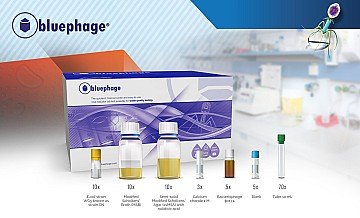
The selection of the appropriate bacterial host strain is critical for the accurate enumeration of somatic coliphages, which serve as key viral indicators of water quality. At Bluephage, we prioritize using the E. coli WG5 strain across both our BP1601 and BP1604 Easy Kits products to ensure consistency and reliability in water testing, as both kits are according to and based on the ISO 10705-2 method, respectively.
This decision is based on extensive research and practical considerations regarding the efficiency and versatility of the WG5 strain.
Why E. coli WG5?
The E.coli WG5 strain (ATCC 700078) is a spontaneous mutant of E.coli C strain, (Havelaar & Hogeboom 1983). The mutation confers resistance to nalidixic acid, which offers significant advantages in water testing, particularly in samples containing high levels of environmenta bacteria, such as polluted natural waters or wastewater. The ability to suppress background microbiota without impacting the quantification of somatic coliphages is a crucial benefit, ensuring more precise and accurate results in such conditions.
Versatility in Water Testing
One of the primary reasons Bluephage opts for the E.coli WG5 strain in both BP1601 and BP1604 products is its versatility across different water matrices. Whether analyzing drinking water, polluted natural water, or wastewater, the WG5 strain can handle the presence of environmental bacterial strains that would interfere with the performance of E. coli C, as host strain,in these contexts. The versatility of E.coli WG5 strain reduces the need to switch between host strains depending on the sample type, simplifying operations and improving efficiency for laboratories.
Alignment with ISO 10705-2
Although the ISO 10705-2 standard recommends using E. coli C (ATCC 13706) for drinking water samples with low bacterial content, and E. coli WG5 (ATCC 700078) for samples with large number of environmental bacteria, Bluephage identifies that E. coli WG5 performs equally well in both contexts. Studies by Havelaar and Hogeboom (1983) and Grabow & Coubrough (1986) found no significant differences between the plaque counts of the two strains in a wide range of water matrices when nalidixic acid is absent, as cited in the literature at the ISO 10705-2 document. This highlights WG5’s ability to produce reliable results, even in cleaner water samples, making it an ideal, all-purpose strain for somatic coliphage enumeration.