Make Art, Not War
A conversation with New York artist Dove Bradshaw
Exhibition at ARTe VallARTa Museo, Puerto Vallarta, Mexico | Zero Time, Zero Space, Infinite Heat
February 2nd – May 5th, 2024
Meet with Dove Bradshaw at ARTe VallARTa Museo on February 3rd, 2024
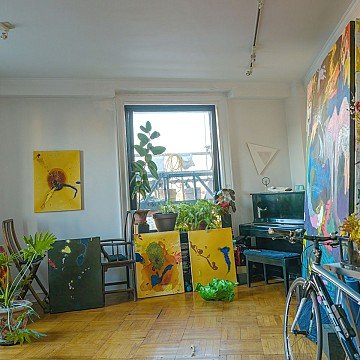
The first time I visited the apartment of conceptual and minimalist artist Dove Bradshaw, I barely let my eyes wander around the living room, busy with paintings and books everywhere, a piano in a corner, and an old chess table. Two friends had asked me to join them for an intimate dinner at Dove and her husband’s, artist William Anastasi (also known as Bill), Upper West Side home, blocks away from Morningside Heights and the Hudson River. I vividly recalled this evening when, years after, Dove invited me back, this time to show a few people some of the artwork soon to be exhibited in Puerto Vallarta at ARTe VallARTa Museo. “A first for this museum, which had presented only Mexican artists before,” and a premiere in Mexico for this artist, whose work is part of the permanent collection of the Centre Pompidou in Paris, and the Metropolitan Museum and MoMA in New York.
As I was riding the Broadway-Seventh Avenue 1 train to 103rd Street, I remembered how her husband—who passed away just a few weeks ago—had described his famous Subway Drawings. Every time Bill Anastasi would sit in a subway, he would balance a piece of paper on a board on his knees, close his eyes, and let a pencil or felt-tip pens draw lines as the train would vibrate, and lurch when it stopped at a station, and depart again until he reached his chosen destination. During my only dinner with him, his wife, and our shared friends, Bill told endless stories of his daily chess games with composer John Cage. Dove Bradshaw, Anastasi, Cage, and his companion, choreographer Merce Cunningham, formed a band of artistry and friendship for years, all dedicated to conceptual art, along with Carl André, Sol LeWitt, and Robert Ryman.
The early 20th-century iconic building where Dove lives is typical of this Manhattan neighborhood. The large porte cochère and the arched entrance are reminiscent of the grandeurs of the nearby San Remo, Ansonia, and Dakota buildings. I was immediately transported into a film set and, on my way to the elevator, I promised myself to record details visually; I had even brought a camera with me to snap a few pictures.
The entrance of Dove’s apartment opens to a large white column. On the right, a yellow Roy Lichtenstein painting catches my eyes, and Dove puts my coat on an empty foldable walker to the left of the door. A series of blown-up-shot bullet sculptures coated with car paint occupy every chair around a long table. On the wall, Dove tells us, hangs Bill’s last piece: the final Bababad Painting, a series begun in the mid 80s illustrating the first thunderword in Finnegans Wake consisting of a hundred letters, painted one by one in groups or alone in some forty paintings. Canvasses are everywhere, in the corridor leading to a bedroom filled with hundreds of vinyl albums and a bathroom, itself an art room, with a large curtainless window opening high above opposing buildings onto the East Side of Manhattan. The kitchen has barely aged since the 1920s. Books filled the shelves as much as cooking instruments do, audiotapes have their own side room, and there is Sasha the cat too.
Paintings from the Guilty Marks series stand by a piano next to elements of the silver Contingency Painting series, on which Dove has thrown a variety of organic matter such as sticks or roots marking them with a chemical that creates its own colors and shapes.
Dove is an ‘enabler’ artist; she lets chance transform, cut, draw, decide, and sway the artistic destination of objects.
“The things that happen in (Dove Bradshaw’s) work are, so to speak, full of not her determination but its determination, such as chemical change, or gravity,” John Cage once wrote. “She used the word event, whereas she is interested in an undefined freedom of action for the chemistry. Of not doing anything. …what we find in Dove’s work is constant experimentation with things to see what happens when you do that.”
Underneath a window, a large round glass panel transforms another blown-up painted sculpture of a shot bullet into a coffee table/artwork.
Another artwork of this series is on permanent display in Washington D.C., Dove tells me: “Our Secretary of State Anthony Blinken has the largest Spent Bullet I’ve made in his State Department office coated with a beautiful steely-silver 2019 Porsche paint.”
“Make Art, not War,” she says later when I come back to sit among the bullets to interview her in the middle of what no longer seems to simply be a home, art studio, and storage, but an apartment with a life of its own, with memories becoming the source of new artistic creations.
I then realized I was the ephemeral guest of an idiosyncratic art place, “an ArtHome,” in constant evolution, and drawn there by chance.
How were you chosen for this exhibition in Mexico?
A curator at the Philadelphia Museum had wanted to write a blog about my work in the collection, and it was one of these pieces that John Cage had shown in his Carnegie International exhibition in 1991. Most artists invariably show only their own work, but Cage wanted to associate himself with the younger generation of women artists, and I was among them. The Philadelphia Museum has been a great repository of works from the Duchamp, Cage, Cunningham, Jasper Johns, and Rauschenberg lineage. My work fits under that umbrella. Cage had shown at Carnegie International 12 pieces of mine, 12 of his and 12 of two other women artists, Mary Jean Kenton and Marsha Skinner, and now two of these works I did will be shown in Mexico.
Wasn’t it quite unusual at the time for a male artist to be interested in the work led by women artists and to be championed by no less than John Cage?
Well, it was certainly an honor. Cage had been associated with Dorothea Tanning, Louise Nevelson, and Annie Albers of the older generation. My feeling about the 20th century would be that the first part is Marcel Duchamp’s with the found object—l’objet trouvé—and the second half would be Cage, who created in 1951 the work of what he called Chance Operations. Cage was the philosophical king of the art world in the latter half of the 20th century and had introduced Marcel Duchamp to the younger artists, including Rauschenberg and Johns. For me, Duchamp and Cage are the brackets of 20th century art—two historical revolutions that changed art profoundly and that continue to prompt artists.
I discovered Chance in making art and I suddenly realized how much better it was as a free-standing sculpture.
Dove Bradshaw
Mexico, where you are about to show a selection of your works, is also Frida Kahlo’s country, one of the leading artists of the 20th century and undoubtedly one of the most celebrated nowadays. Interestingly, one of the first people, outside of Mexico and the United States, who valued Frida Kahlo as a visionary artist was Marcel Duchamp in France, on the eve of the Second World War.
Diego Rivera was the famous artist in the family, and she was definitely a second-class citizen. But now, the world pays more attention to her than to him. There are a couple of reasons for that. One is that she did portable paintings, and he did murals. The other is that hers were personal, and his were political and generic. And the personal work affects an individual much more.
Is your art more on the personal or the political side?
I don’t see it as political except for the bullets, which does have a political aspect. My work is philosophical, and even the bullets have a philosophical point, one might say, of turning something horrible into something beautiful and physically retiring it from its deadly purpose. So, that certainly is a utopian political idea. I first made these works as jewelry to be worn on the outside of the body, and then once 3D printing became possible in the 2000s, I could create sculptures and blowup these little one inch .38 caliber bullet slugs that had been shot in target practice by the New York City police.
How do you define beauty?
In the eye of the beholder, but for me, I feel that it needs to be sensuous. The Spent Bullets are coated with luscious car paint colors or in one case with white gold leaf. For instance, one of them here has a Ford 2023 minty green.
My work is philosophical, and even the bullets have a philosophical point, one might say, of turning something horrible into something beautiful and physically retiring it from its deadly purpose.
Dove Bradshaw
One of these blown-up bullet sculptures is on every dining table chair where we sit–First, their shape.
They are curled. Because in the police firing range the way, the bullets explode is after piercing a paper target 60 feet away, they hit a metal sheet behind it and then ricochet onto another metal sheet. They slide into the sand, are retrieved, melted down, and reused as bullets. They’re not retired; they’re reused. They are only out of circulation is if they’re shot in action or the minute few I or others have collected. In my case, the Utopian gesture involves taking them out of circulation. In a wildly different context curling onto the backs of these 18th-Century Chinese chairs, I thought of it as a surrealist setting. A painter might see them as giant daubs of paint.
All placed on every chair around your wooden table!
I had them as our Phantom guests during the pandemic. Yeah, I have kept this indulgence since, and when anybody actually sits, we take them off. I will miss them tremendously because they’re going away for five months. Now I’ll always have to have them, or I’ll feel denuded.
They are sent to a country that has a complex relationship with violence, just as the United States does.
Javier Estevez, our Mexican art dealer and owner of Mascota Gallery in Mexico City, once said—whether this is true—that there are only two legal gun stores in all of Mexico. In the U.S., one can buy a gun in a hardware store, for instance, just 10 miles away from our country house in a tiny town with a winter population of 125 in the Endless Mountains of Pennsylvania. An ordinary hardware store in another tiny town!