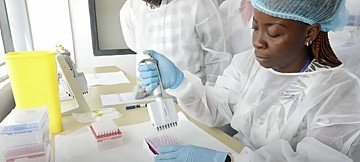
Within the EXPANDIA project, the ICGEB Biomanufacturing lab developed protocols to decrease cold chain dependency and allow for the sustainable and low-cost local production of reagents, making diagnostics more accessible even in remote areas.
Early detection and accurate diagnosis of infectious diseases are essential for effective patient care and outbreak prevention. Accessible and cost-effective diagnostic tests are crucial, but in many sub-Saharan African countries, access to reagents is hindered by reliance on foreign supply chains, red tape, and cold chain requirements. These challenges lead to procurement delays and risks to reagent integrity, especially in peripheral settings.
To integrate the use of cost-effective technologies in diagnostic laboratories, the ICGEB Biomanufacturing laboratory, headed by Dr. Jennifer Molloy, deployed and further developed protocols for sustainable reagent production to be used in LAMP reactions. RT-LAMP, an isothermal rapid colorimetric molecular test, was evaluated by the EXPANDIA consortium during the COVID-19 pandemic as the most convenient technology to be deployed in community labs in sub-Saharan Africa. Compared to RT-qPCR, RT-LAMP has a comparable performance, while being cheaper and easier to use. However, some of the reagents may have limited availability for peripheral laboratories. The reverse transcriptase and DNA polymerase enzymes are typically the most expensive component of any RT-LAMP kit and are also the most problematic with respect to shipping, storage and shelf-life.
Dr. Molloy’s team worked on two solutions to stimulate the production of low-source and locally sustainable reagent delivery system using standard lab equipment. The first method involved the use of engineered bacteria overexpressing crude enzymes, which were dried to be used directly as reagent packets in molecular reactions, following the work of Dr. Sanchita Bhadra and Prof. Andrew Ellington at the University of Texas, Austin. This approach does not need any protein purification step, which usually require considerable expertise and infrastructure to produce, nor a constant cold chain. In the tests conducted on SARS-CoV-2 samples in Italy, Burkina Faso and Senegal, rehydrated enzymes were added to LAMP reactions replacing commercial protein reagents, while an in-house fluorescence device was used to allow the easy readout by naked eye of positive samples. Dr. Molloy states: “This approach has proven sustainable, because laboratories can establish in-house enzyme manufacturing using bacteria that can be cultured and stored after desiccation for several months. However, while this approach greatly simplifies enzyme expression, challenges related to quality control and troubleshooting greatly impact reliable production”.
EXPANDIA therefore also explored a simple and low-cost protein purification mechanism previously developed by Dr. Molloy in Cambridge, UK. The purification of recombinant proteins is widely used in bioindustry, for instance to produce insulin. However, the variety of protein purification methods used are usually expensive and difficult to upscale. Therefore, the scope of the newly identified mechanism was to develop and test a low-cost and non-toxic protocol for purifying proteins using cheaply and in-house manufactured magnetic nanoparticles from affordable and non-hazardous materials, such as salt and food grade oil, in a process developed by Dr. David Brossault and Prof. Alex Routh at the University of Cambridge. Dr. Reuben Ayivor-Djanie from Ghana optimised the protocol at ICGEB, confirming it allows a one-step purification of expressed proteins directly from lysed bacteria at low cost and with rapid scalability.
Dr. Ayivor-Djanie further established a protocol for decreasing the cold chain dependency by establishing a protocol for desiccating reagents to be used in RT-LAMP reactions, adding the purified enzymes. This allows to decrease cold chain dependency as reagents can be shipped and stored at room temperature. This also decreases procurement costs and the risk to reagents integrity. Overall, the local manufacture and the use of rapid molecular tests like RT-LAMP will lower testing costs for patients, making diagnostics more accessible even in remote areas.
Dr. Ayivor-Djanie emphasises: “Empowering African scientists with these techniques and protocols, allows to meet local needs for the production of proteins needed for nucleic acid testing”. The protein purification protocol is now being tested for proof of concept in RT-LAMP reactions on synthetic and SARS-CoV-2 samples in Kenya and Senegal. Dr. Djibril Wade from IRESSEF, Senegal, notes that: “EXPANDIA aligns with Africa CDC and the African Union priorities for local production of reagents and vaccines to help the African continent to be more independent and to make these components commercially viable”.
Future activities will include improvements to quality control assays, working towards regulation of in-house manufactured, lab-developed tests for clinical applications and exploring local manufacturing of diagnostics kits as an entrepreneurial effort to create a more sustainable supply chain.
Since 2021, the EXPANDIA project has assessed the diagnostic capacities of community laboratories in 10 sub-Saharan African countries, identifying poor access to reagents as one of the major bottlenecks. In this context, even well-equipped laboratories with cutting-edge instruments and machines and with the financial means to procure necessary reagents often face accessibility issues due to supply chain limitations and reliance on foreign markets. African project partners, who usually procure reagents from Europe and the US, face higher costs per item and high transportation expenses, while long logistic turnaround times heavily impact daily laboratory activities. Moreover, many diagnostic reagents require the maintenance of a cold chain. As such, long customs clearance procedures and subsequent in-country distribution compromise their integrity, leading to potential loss of resources – thus reducing accessibility to diagnostics for patients in need.
Recognising that supply chain limitations were exacerbated further following the COVID-19 pandemic, the establishment and support of local production capabilities for health technologies has become increasingly vital to the strengthening health systems in Africa. While progress is being made, the current stage of biotechnology manufacturing in Africa is still insufficient to meet the continent’s diagnostic needs. The EXPANDIA project conceived advancing local production to use more affordable and sustainable raw materials, while maintaining the high-quality standards and benchmarking requirements for medical device manufacture.