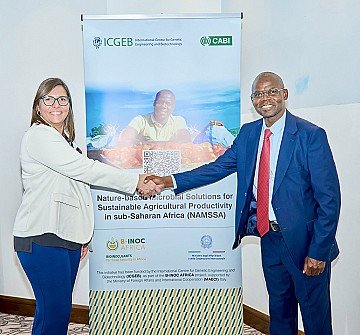
10-11 March 2025, Nairobi, Kenya – ICGEB is with CABI to launch NAMSSA: a 2-year project to validate, upscale and bring to market a series of nature-based microbial solutions for sustainable agricultural productivity in sub-Saharan Africa.
Together with CABI – the Centre for Agriculture and Bioscience International, ICGEB is building a public-private partnerships in sub-Saharan Africa with funding granted by the Italian Ministry of Foreign Affairs and International Cooperation (the B-INOC project).
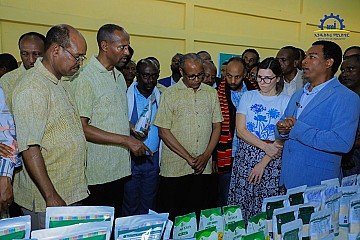
Nature-based microbial solutions to tackle significant agricultural challenges in sub-Saharan Africa (SSA) are underway in Kenya (with the Twiga Chemicals company dealing with crop protection and nutrition in broccoli), in Zambia (with Exotic Green Power Enterprises Ltd. a company dealing in horticulture and irrigation on legumes), and in Benin (with the University of Abomey-Calavi, focusing mainly on maize). New products will be instrumental in developing innovative sustainable agriculture systems.
Ms. Elena Benedetti, ICGEB Head, Fundraising and Technology Transfer states: “This partnership supports capacity building and technology transfer in the Life Sciences, as well as providing funding for the last mile”, and continues, “This will increase acceptance and market penetration of local solutions, that can also become products on the international market.”
She adds that the aim is to also decrease the import of materials such as chemical fertilisers, because of their massive impact on the economy of the country.
Dr. Joseph Mulema, Research Senior Scientist, CABI Regional Centre for Africa in Nairobi, stated that the partnership will support registrations of prospective nature-based solutions, increase awareness amongst farmers and support last mile agri-input suppliers. “Players in the private sector, researchers and universities are coming together to drive the adoption of nature-based solutions in agriculture in view of the high losses incurred as a result of pests, such as the fall armyworm on maize”.
By the end of the project, farmers will be in a position to conserve most of the biodiversity in their fields and produce safer foods.