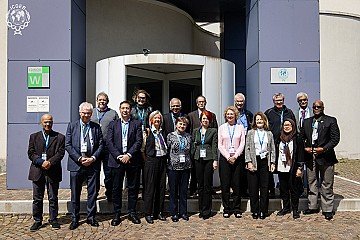
With 55 delegations in attendance, the 31st session of the ICGEB Board of Governors held in New Delhi, India, from 14-15 May 2025 was an immersive experience in science and Indian culture, with the future of Biotechnology at ICGEB “looking bright”.
Hon. Min. Jitendra Singh, Minister of State for Science and Technology, Ministry of Earth Sciences, MoS, PMO; Ministry of Personnel, Public Grievance & Pensions, Department of Atomic Energy and Department of Space, Government of India inaugurated the first Biofoundry, in the country located within the premises of ICGEB New Delhi. The Minister also commented on the first-ever biological experiments to be conducted by India, including projects from ICGEB New Delhi, aboard the International Space Station.
Dr. Mathukumalli Vidyasagar, world-renowned expert on control systems, machine learning, and artificial intelligence, former Chair of the National Science and Engineering Research Board (SERB) and Distinguished Professor, Indian Institute of Technology, Hyderabad, as well as Fellow of the Royal Society presented a lecture that traced the evolution of AI from its mid-20th-century origins to its current role as a transformative force across industries.
Dr. Vidyasagar focused on applications of AI in biomedicine (such as accelerating drug discovery, enhancing protein structure prediction, enabling remote diagnostics) and industry, not excluding a reflection on the ethics and potential pitfalls of AI, such as perpetuating harmful stereotypes and misinformation, as well as deploying significant amounts of energy.
Prof. Shekhar Mande, Member of the ICGEB Council of Scientific Advisers from India, presented a summary of the findings of the Council from its 31st session, which was held in New Delhi from 28-30 April 2025. “The Council”, he stated, “represents some of the best-known names in biotechnology and genetic engineering; almost all of whom were present for two days of intense scientific discussions.” The programme included talks by the Principal Investigators of 22 research Groups in New Delhi, as well as a poster session with students who presented their own work to the Council members. “The Council was impressed by the work carried out,” concluded Prof. Mande, “which covers three broad areas: knowledge generation, translation of this knowledge for larger societal benefit, and training the next generation of researchers from around the world.”
Dr. Jelena Begovic, Serbia, and Professor Kassahun Tesfaye, Ethiopia, were confirmed for a second term as President and Vice-President of the Board.