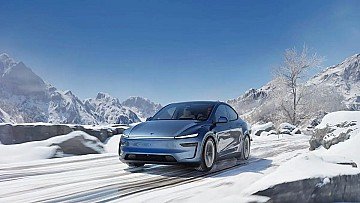
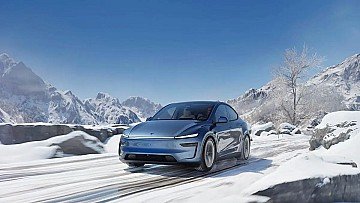
Autonomous driving promises a transformative future for mobility, offering the potential for increased safety and efficiency. However, a critical frontier remains: ensuring these advanced systems perform reliably and safely in challenging low-grip conditions. Wet, icy, or snowy roads present unique obstacles for self-driving vehicles, demanding sophisticated solutions beyond conventional capabilities. This article delves into the inherent challenges posed by adverse weather and explores the groundbreaking technologies designed to overcome them, with a particular focus on the pivotal role of virtual sensors and innovative aquaplaning prevention systems. Our ultimate goal is to highlight the advancements in **autonomous driving low grip safety**, making future mobility secure in all conditions.
The Treacherous Path – Challenges for Autonomous Vehicles in Low-Grip Scenarios and Their Impact on Safety
Autonomous vehicles rely heavily on an array of sensors—LiDAR, radar, and cameras—to perceive their environment. In optimal conditions, these sensors provide a robust view of the surroundings. Yet, their performance can be severely degraded when weather turns foul. Rain, snow, and ice can obscure camera vision, scatter LiDAR beams, and even cause radar signals to falter. This directly impacts the **autonomous driving low grip safety** capabilities.
Beyond perception, maintaining control is paramount. Low friction surfaces drastically impact braking distances and vehicle stability. Traditional traction control systems, while effective for human drivers, may not be sufficient for the complex decision-making required by an autonomous vehicle operating at higher levels of autonomy. Studies, such as those from the National Renewable Energy Laboratory (NREL), consistently highlight how adverse weather limits the operational design domain (ODD) of current autonomous vehicles, restricting their deployment to ideal conditions. Ensuring **autonomous driving low grip safety** is the paramount challenge for widespread adoption. Similarly, reports from the SAE International emphasize the challenges of ensuring system reliability and safety in inclement weather where sensor data becomes unreliable.
Pioneering Solutions for Enhanced Autonomous Driving Low-Grip Safety – The Role of Virtual Sensors and Active Prevention Systems
To truly unlock the potential of all-weather autonomous driving, innovation must address both enhanced perception and active control. This is where the next generation of solutions comes into play:
- Advanced Sensor Fusion and AI: Beyond simply integrating data, AI-powered sensor fusion can intelligently interpret ambiguous sensor inputs from radar, thermal cameras, and advanced ultrasonic sensors to build a more robust environmental model. Nvidia’s research in AI for autonomous vehicles demonstrates how deep learning can interpret complex real-world driving scenarios, even with partial data.
- Virtual Sensors: These software-based solutions leverage existing vehicle data (e.g., wheel speed, steering angle, suspension dynamics) to deduce unmeasured parameters like road friction, tire grip limits, or even the presence of a water film on the road. They act as an “inner sense” for the vehicle, complementing external perception, crucial for **autonomous driving low grip safety**.
- Active Aquaplaning Prevention Systems: This is a crucial development. Instead of merely detecting aquaplaning, these systems actively intervene to prevent it from occurring by restoring tire-to-road contact. This proactive approach significantly enhances safety margins.
These innovations are critical because they move autonomous driving from being merely reactive to becoming truly proactive, capable of predicting and mitigating risks before they escalate, directly contributing to **autonomous driving low grip safety**.
Easyrain: Leading the Revolution in Autonomous Driving Low-Grip Safety
At Easyrain, we are not just observing this future; we are actively building it. Our proprietary technologies specifically engineer solutions to address the very challenges outlined above, making autonomous vehicles safer and more reliable in any condition. Learn more about who we are at Easyrain.
Our ecosystem is built on two foundational pillars:
- DAI (Digital Advanced Information) – The Virtual Sensor Platform: DAI is a revolutionary software platform of virtual sensors that offers innovative safety and efficiency features. It provides the crucial “haptic sense” that complements traditional visual perception, making autonomous driving Level 3 and above on low grip truly viable. DAI’s sophisticated algorithms perform both road sensing (detecting Aquaplaning, Snow & Ice, and Irregular Ground conditions) and vehicle sensing (monitoring iTPMS, Wheel Misalignment, and Tire Wear). This hardware-free approach minimizes OEM integration effort and significantly enhances ADAS accuracy and optimization in dangerous driving conditions.
- AIS (Aquaplaning Intelligent Solution) – The Active Prevention System: AIS is the world’s first and only active safety system specifically designed to eliminate aquaplaning risks. By spraying fluid jets ahead of the front tires, AIS actively enhances grip, preventing the loss of control that typically occurs on wet surfaces. This system is key to truly enhance ADAS systems for limited grip scenarios, ensuring the vehicle maintains control when it matters most.
Furthermore, our ERC (Easyrain Cloud) leverages DAI data to enable advanced predictive infrastructure maintenance and optimized fleet management. This allows for the sharing of critical hazard coordinates, improving overall road safety innovations and solving a significant problem that still contributes to a large number of accidents on low-grip surfaces.
The integration of Easyrain’s solutions allows carmakers to offer vehicles with unparalleled safety capabilities. Our patented technologies are designed for short integration times and feature Over-The-Air (OTA) updates, ensuring continuous improvement. We believe our systems are pivotal in making autonomous driving solutions truly viable and safe for widespread adoption, ultimately contributing to a future with fewer accidents and fatalities on the roads, improving **autonomous driving low grip safety** globally. Achieving optimal **autonomous driving low grip safety** remains our core mission.
Sources:
- National Renewable Energy Laboratory (NREL): https://www.nrel.gov/
- SAE International: https://www.sae.org/
- Nvidia Blog: https://blogs.nvidia.com/