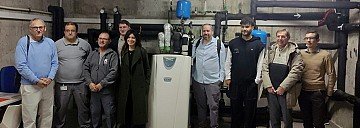
Researchers Javier Urchueguía and Borja Badenes, from the ‘ICTs against Climate Change’ group of the ITACA Institute at the Universitat Politècnica de València, played a prominent role at the First Geo-RIN Conference, held from June 2 to 6 in Benasque (Aragón).
This event, supported by the Geothermal Research and Innovation Network for Portugal and Spain and backed by the CSIC Scientific Network «Geosciences for a Sustainable Planet,» brought together representatives from academia, institutions, and industry to discuss the advances and challenges in geothermal energy—a renewable energy source poised to play a crucial role in Spain’s transition to a more sustainable, secure, and decentralized energy model.
«Geothermal energy is at a turning point, with growing interest in its role within the energy transition, as it emerges as a reliable and local solution for reinforcing energy supply security in Europe«, highlighted the organizers.
Specifically, the conference served as an ideal forum for knowledge exchange, covering topics from 3D modeling of geothermal systems to professional certification in heat pump technologies, including urban hybrid solutions, 5GDHC networks, and the resilience of thermal ecosystems to climate change.
ITACA’s prominent role
During the conference, Professor Javier F. Urchueguía, ITACA researcher and President of the European Geothermal Panel, delivered the event’s keynote speech titled “Geothermal Energy and the Future of Urban Energy in Europe”.
In his talk, he addressed how geothermal energy is emerging as an alternative source in Europe within international context marked by the need to reduce energy dependence.
“More and more European cities are incorporating geothermal energy into their municipal climate adaptation energy plans. Its combination with renewable heat pumps represents a resilient, efficient, and decentralized solution”, Urchueguía said.
Urchueguía also moderated the roundtable “Shallow Geothermal Energy in Urban and Energy Planning”, a strategic discussion forum that analyzed regulatory frameworks, innovative urban models, and sustainability promotion policies from both local and European perspectives.
Meanwhile, Borja Badenes, also an ITACA researcher, participated as a member of the organizing committee and presented the talk “Towards a European Common Certification Framework for Shallow Geothermal Heat Pump Professionals”. His work proposes a roadmap to harmonize technical training at the European level—an essential aspect of ensuring efficient and safe installations.
For all these reasons, the prominent participation of ITACA Institute researchers in this international forum reinforces the role of the Universitat Politècnica de València in developing innovative, sustainable energy solutions aligned with the European Union’s climate neutrality goals.
The first edition of this congress is expected to become a key platform for geothermal debate and progress in the Iberian Peninsula, with its next edition scheduled to take place in Portugal in 2027.