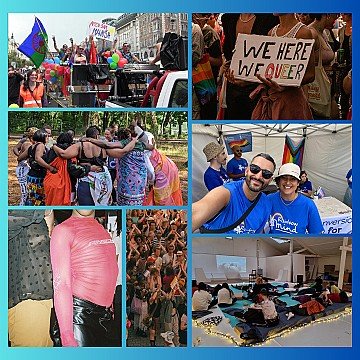
Rainbow Mind’s radical self-care programme invites queer people of colour to reclaim their joy as a political, creative, and collective act. But what is radical self-care? And how can it work for everyone?
“Every human needs self-care. If you’re queer, you need it more. If you’re queer and a person of colour, you need it doubly.”
Uz Afzal, Rainbow Mind
With this blog series, we’re sharing insights from the work of LGBTI organisations tackling injustice, racism, and the unique challenges faced by racialised LGBTI communities in Europe. We hope their stories and practices will inspire and resonate. We believe that solutions and approaches that include a few will pave the way and point to the solutions for many. You can read the previous blog in the series here.
What is radical self-care?
Radical self-care is not about scented candles or yoga retreats, although those can play a part. It is about recognising that in a society that profits from your self-doubt, turning inward with kindness becomes an act of resistance. For the team at Rainbow Mind, a queer-led mental health charity in the UK, radical self-care is both a necessity and a strategy for survival.
Created for and by LGBTI people of colour, Rainbow Mind’s radical self-care programme is built on two foundations: mindfulness and self-care. These are not taught as individual habits to master in isolation. Instead, they are offered as shared tools to help communities navigate overlapping systems of oppression while reclaiming joy, presence, and self-worth.
Uz Afzal, who co-developed the programme, puts it simply: “Noticing with kindness.” That is how mindfulness is introduced. Whether it is through formal meditations or paying attention to the texture of your tea in the morning, the practice builds awareness and presence in lives often fractured by stress, exclusion, and survival. Alongside this grounding practice is a deeper focus on care. Care that is unapologetic, community-rooted, and radically tender.
Responding with creativity
This kind of care is not optional. It is essential for LGBTI people who are told, directly or indirectly, that their existence is too much. It is even more urgent for those who also navigate racism, transphobia, forced migration, or precarious status. Radical self-care recognises that these compounded struggles require care practices that are not only safe and supportive, but culturally and politically aware.
For Rainbow Mind, radical self-care begins long before any group session. Their work with queer refugees and asylum seekers revealed that standard wellbeing tools were often unfit for purpose. People were bringing unimaginable trauma into the room, and the last thing they needed was to be told to sit with their pain. The team responded with creativity. They replaced triggering exercises with listening parties, communal drawings, music, and story-sharing. They called it Creative Connective Care, and it quickly became a lifeline. “For some people,” Uz reflects, “just coming to the weekly session was the highlight of their week.”
This emphasis on co-creation runs through everything. Programmes are shaped not only by professionals, but by those taking part. Refugees, youth groups, and activists have all helped mould the spaces to fit their realities. One participant, after joining the very first course for queer people of colour in 2020, went on to train in the radical self-care model and now works with Rainbow Mind. Others have returned to the course again and again, finding new insights each time, sometimes in the form of poetry, sometimes through shared silence.
Beyoncé lyrics and beyond
The format is always collective. “Self-care can sound lonely,” says Suranee Abeysuria, Director at Rainbow Mind. “But when we practise it together, it becomes community care. It becomes healing in motion.” Eight-week group courses are structured to encourage reflection, rest, and mutual support. Practices focus on physical, emotional, and spiritual wellbeing, and often include creative exercises that centre joy and imagination. One session began with a collaborative online drawing, emojis and gifs slowly filling the screen as participants joined. Another closed with Beyoncé lyrics offered like affirmations.
When Rainbow Mind began offering these sessions to queer BIPOC activists across Europe, something profound happened. People who spent their days fighting for others finally had space to rest. Some were supporting entire communities while facing their own asylum processes. Others shared the familiar guilt of doing too little for others while completely neglecting themselves. The sessions were simple, but transformative. They offered time to be seen, time to breathe, time to be held by a group that understood.
Humanity and joy
Radical self-care is not just about surviving hostile systems. It is also about changing them. Suranee and Uz both emphasise that training and representation must shift. Too many therapists still come from white, straight backgrounds, and mental health care often feels unsafe for queer people of colour. Rainbow Mind uses its programme to train new practitioners from within the community, challenging who gets to care and who is seen as worthy of it.
For those building power at the margins, radical self-care is an act of reclaiming. It is the refusal to be ground down. It is choosing to believe in one another’s softness, humanity, and joy, even when the world does not. In this special episode of The Frontline podcast, Suranee and Uz join us to explore more along the frontiers of radical self-care.