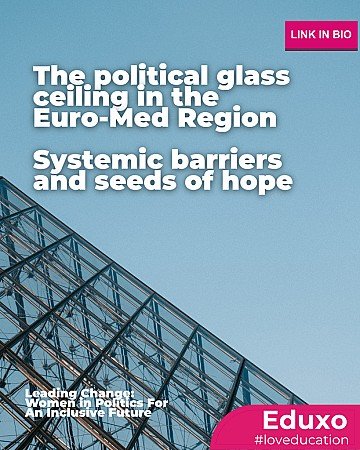
The European Parliament’s report “Women in Politics in the EU: State of Play in 2024” reveals persistent gender imbalances in political representation across the EU. While some countries have made notable progress, others continue to lag behind (especially in Southern Europe). It is important to track the structural causes of it in order to advocate for a change.
A mixed picture across the EU
Women currently make up 38.5% of Members of the European Parliament (MEPs), a figure above the global average but still short of parity. However, disparities between Member States are stark: Luxembourg, Finland, and Sweden have achieved or surpassed gender parity, while Romania, Cyprus, and Greece remain below 25%.
At the national level, women hold 31.6% of seats in national parliaments and 35.3% in regional assemblies. Do you know that the European Commission has reached 48.1% female representation among commissioners, with President Ursula von der Leyen pushing for full equality in management roles by the end of 2024? Despite this achievement, why does it seem that it is still not enough?
Spotlight on southern Europe
The challenges southern countries are facing are tied to more eradicated traditions but also because of a more decentralized system. We must take into consideration that they are countries full of little villages very far from political centres and educational points of referments.
Italy
Italy has made significant strides in recent years. Thanks to mandatory gender quotas and the parity principle (50% for each gender), female representation has increased at both national and European levels. Italy is also one of five EU countries with a female Prime Minister as of 2024. However, challenges remain at the regional and local levels, where gender gaps persist. Due to patriarchal cultural heritage and lack of trust in women candidates for political elections, Italy needs to make some structural changes.
Malta
Malta continues to struggle with gender balance. Women hold less than 20% of ministerial posts, one of the lowest rates in the EU. However, the introduction of a gender corrective mechanism in 2021 (which adds seats to Parliament if one gender is underrepresented) has helped improve female representation. Still, progress is slow, and cultural barriers remain strong.
Greece
Greece ranks among the lowest in the EU for women’s political representation. Women make up less than 30% of Greek MEPs and under 20% of national ministers. Despite having a 40% gender quota for electoral lists, implementation is inconsistent. Local and municipal councils also reflect this imbalance, with women holding fewer than 20% of seats.
Cyprus
Cyprus also performs poorly, with no female MEPs and less than 20% representation in local councils. The country lacks binding gender quotas, and cultural and institutional barriers continue to hinder women’s political participation.
Gender quotas: a necessary but insufficient tool
The report confirms that gender quotas are effective in boosting women’s representation (especially in countries like Italy, France, and Spain). However, we believe that data and numbers are not the only ways to make a change in the problem of underrepresentation. It is not only about having more women in the political landscape. The “numbers” must be supported by:
- Zipper systems (alternating male and female candidates on lists)
- Training and mentoring programs
- Equal access to campaign financing
Why gender equality in politics matters
The report distinguishes between:
- Descriptive representation: the numerical presence of women in politics, which enhances legitimacy and provides role models.
- Substantive representation: the ability of women to influence policy and bring diverse perspectives to governance.
The second representation is the one we want to bring to the attention of policy maker with the project “Leading Change”.
Barriers to women’s participation
It has been identified three main types of barriers that make it difficult to reach an equal representation of women and men in politics. Can you guess which are those?
- Supply-side: Lack of confidence, time, resources, and networks; the burden on women in household chores leads to an unequal share of responsibilities in the family, making it more difficult for women to pursue a full time career.
- Demand-side: Political parties often fail to promote female candidates; voter biases persist.
- Institutional: Electoral systems matter, in fact, proportional representation systems are more favourable to women than majoritarian ones.
All these barriers can be overcome thanks to a consistent and strong educational system, a sense of community, a bottom-up approach of advocacy, and an impacting communication. And this is what we aim to when we mean to empower the next generation of women to lead.
Public perception and participation
While female voter turnout is rising, women remain underrepresented in non-electoral political activities and decision-making roles. In countries like Spain, public opinion is divided, with many men believing gender equality policies disadvantage them. Meanwhile, right-wing populist parties are gaining support among women, despite often reducing overall female representation. It is important to note that right wing female candidates adopt a way of working trying to emulate “man” style, as it is the only one that can be publicly “recognized” and “approved”.
Intersectionality: the most invisible women
Women from minority backgrounds, the LGBTQI+ community, and those with disabilities face even greater barriers. The lack of disaggregated data at the EU level contributes to their invisibility in politics. We believe that bringing together the different faces of the minority groups on the political stage is a symptom of a healthy and trustworthy society. It means that no one is left behind.
More women in politics means more democracy, better representation, and stronger institutions. But achieving true equality requires:
- Inclusive electoral reforms
- Civic education
- Responsible media
- Open and supportive political parties
- A political environment free from violence and discrimination
Only then can politics become a truly representative space for all.
This campaign is meant to build a movement and give the possibility to young people to speak out for it. If you feel that you have something to say, an idea to develop and a way to raise up your commitment on the topic, this is the place for you! Both from political or communication perspectives your presence is valuable to empower a way for a change and a more equal political representation. Join the movement. Advocate for change. Together, we can build a future where every young woman knows her voice matters, her vote counts, and her leadership is essential.
Disclaimer: Leading Change: Women in Politics for an Inclusive Future is part of the Mediterranean Youth in Action Transformative Narratives programme, implemented by the Anna Lindh Foundation. The programme serves as a platform for young influencers and digital content creators to create meaningful content and lead social media initiatives and awareness campaigns that highlight youth voices, strengthen media narratives, and promote intercultural dialogue across the Euro-Mediterranean region.
Sources
European Institute for Gender Balance (2025). Gender Balance in Politics.
https://eige.europa.eu/sites/default/files/documents/gender-balance-in-politics.pdf
Karen Celis, Sarah Childs, Introduction: The Descriptive and Substantive Representation of Women: New Directions, Parliamentary Affairs, Volume 61, Issue 3, July 2008, Pages 419–425, https://doi.org/10.1093/pa/gsn006
Lovenduski J. The Supply and Demand Model of Candidate Selection: Some Reflections. Government and Opposition. 2016;51(3):513-528.
doi:10.1017/gov.2016.7
European Parliament (2024). “Women in Politics in the EU: State of play in 2024”.
https://www.europarl.europa.eu/thinktank/en/document/EPRS_BRI(2024)760348
European Parliament (2025)
https://results.elections.europa.eu/en/mep-gender-balance/2024-2029/