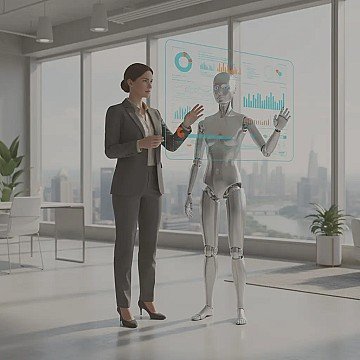
The marketing landscape of 2025 is being redrawn, not by human hands alone, but by the silent, powerful force of artificial intelligence. This is not a distant, futuristic concept; it is the present-day reality of our industry. Consider this: global AI in marketing is not just growing, it’s exploding, with projections showing a multi-billion dollar market that is fundamentally altering how brands connect with consumers on a granular level. The vague promises of AI have given way to tangible results. We’re witnessing a paradigm shift where hyper-personalization is not just an aspiration but an automated standard, where predictive analytics unearth customer behaviors before they even happen, and where intelligent automation is liberating marketing teams from monotonous tasks to focus on what humans do best: strategy, creativity, and building genuine relationships. The question is no longer if you should adopt AI, but how you will leverage it to survive and thrive in an increasingly competitive digital ecosystem.
In this era of unprecedented technological evolution, simply knowing about AI is no longer enough. Marketers must become adept at wielding it as a natural extension of their own expertise. However, with a new AI tool launching seemingly every hour, the digital marketplace has become a bewildering and noisy space. How do you distinguish the truly transformative platforms from the fleeting trends? How do you assemble an AI-powered marketing stack that is not only functional but synergistic, providing a genuine and sustainable competitive advantage? This is the critical challenge facing every marketing professional today, and it’s precisely the challenge this guide is designed to solve. Welcome to your definitive guide to the 25 best AI marketing tools you need in 2025. This is more than just a list; it is a strategic blueprint designed to equip you with the knowledge and confidence to navigate the future of marketing.
To ensure you get the most value from this guide, we’ve structured it to be a comprehensive learning journey. Before we dive into the tools themselves, we’ll first demystify the engine that powers them. We will break down the core technologies like Machine Learning, Natural Language Processing, and Generative AI, explaining in simple terms how they function within a marketing context. We’ll also explore the “Four Types of AI,” providing a foundational understanding that will empower you to make more informed decisions about which tools are right for your business.
Next, we’ll address the pivotal question on every marketer’s mind: with so many options, which AI tool is truly the best for marketing? We’ll put one platform under the microscope in our special spotlight section on indigitall. You’ll discover how its integrated, all-in-one approach—from its sophisticated AI Agent that handles customer interactions to its AI-optimized customer journeys that nurture leads across every channel—makes it a formidable contender for the ultimate marketing solution.
Then, we’ll unveil the core of our guide: the comprehensive list of the 25 best AI marketing tools for 2025. We have meticulously researched, vetted, and categorized these tools across the most critical marketing functions—including Content Creation & SEO, Customer Engagement & Personalization, Advertising & Social Media, Market Analysis & Data Insights, and Automation & Productivity—to help you easily identify the perfect solutions for your specific goals and challenges. Finally, for those obsessed with data-driven strategy, we’ll take a deeper dive into the best AI tools specifically for market analysis, comparing the top players to help you uncover the insights that will shape your future campaigns.
So, whether you’re an AI novice looking to take your first steps or a seasoned marketer aiming to refine your digital arsenal, prepare to discover the tools that will not only help you compete but dominate in 2025. Let’s begin.
II. What Kind of AI is Used in Marketing?
Before you can effectively choose and implement AI tools, it’s crucial to understand the core technologies that power them. “Artificial Intelligence” isn’t a single, monolithic entity; it’s an umbrella term for a suite of powerful computational techniques. For marketers, four types of AI capabilities have become particularly transformative. Understanding what they are and how they work will empower you to see beyond the hype and identify the tools that can deliver real, measurable results for your business.
- Machine Learning (ML): The Pattern-Finding Powerhouse At its heart, Machine Learning is about teaching computers to learn from data without being explicitly programmed for every possible scenario. ML algorithms sift through vast datasets to identify patterns, make connections, and generate predictions. In marketing, this is the engine behind true personalization and optimization. It allows for sophisticated customer segmentation, automatically grouping users based on complex behaviors like purchase history, website interactions, and engagement levels—far beyond simple demographics. ML also supercharges campaign optimization, enabling platforms to dynamically adjust ad spend, test thousands of creative variations simultaneously, and allocate resources to the channels delivering the highest ROI in real-time.
- Real-World Example: Think about Amazon’s “Frequently Bought Together” or Netflix’s personalized show recommendations. These aren’t curated by humans. They are the product of ML algorithms analyzing the behavior of millions of users to predict what you are most likely to buy or watch next.
- Natural Language Processing (NLP): Bridging the Human-Computer Gap Natural Language Processing is the branch of AI that gives machines the ability to understand, interpret, and generate human language. It’s the technology that makes human-computer interaction feel intuitive and, well, natural. For marketers, NLP is the key to unlocking insights from unstructured text data and automating communication at scale. Its most visible application is in chatbots and virtual assistants, which can handle customer queries, qualify leads, and provide 24/7 support. NLP also drives sentiment analysis, allowing brands to monitor social media and review sites to gauge public perception of their products or campaigns. Finally, it’s a cornerstone of many AI writing assistants, helping to generate and refine content from email subject lines to entire blog posts.
- Real-World Example: When you ask Siri or Google Assistant a question, you’re using NLP. In marketing, a customer service chatbot that understands your typed query, accesses order information, and provides a relevant update on your shipment is a perfect example of NLP in action.
- Generative AI: The Creative Content Engine Generative AI is a revolutionary subset of artificial intelligence that doesn’t just analyze data—it creates something entirely new. By learning from enormous datasets of text, images, sounds, and code, these models can generate original, high-quality content in response to a simple prompt. This has been a game-changer for marketing teams, drastically accelerating content creation workflows. Marketers can now use Generative AI to brainstorm ideas, draft blog posts, write dozens of ad copy variations, create unique images for social media campaigns, and even produce scripts for video ads. It allows for a level of content velocity and creative experimentation that was previously unimaginable.
- Real-World Example: Using a tool like Jasper to write a first draft of a blog post or employing Midjourney to create a custom illustration for a landing page are prime examples. The user provides a text prompt, and the AI generates a completely new piece of content.
- Predictive Analytics: Forecasting the Future While closely related to Machine Learning, Predictive Analytics is focused specifically on using historical and real-time data to forecast future events. It answers the question, “What is most likely to happen next?” For marketers, this is like having a crystal ball. It enables you to forecast trends by analyzing market data to see what products or services will be in high demand. More importantly, it helps predict customer behavior, identifying which customers are at risk of churning, which leads are most likely to convert, and what the lifetime value of a new customer might be. This allows marketing and sales teams to be proactive, intervening with a special offer to retain a customer or prioritizing their efforts on the most promising leads.
- Real-World Example: A sophisticated e-commerce platform using predictive analytics might identify a customer who hasn’t purchased in their usual 60-day cycle. The system can then automatically trigger a personalized email with a “We miss you!” discount to proactively encourage their return before they are lost for good.
III. The 4 Types of AI Tools
Just as there are different technologies powering AI, there are also different classifications of AI based on their capabilities and level of sophistication. Understanding these four primary types—from the simple to the sentient—provides a crucial framework for evaluating the marketing tools you encounter. It helps you grasp not only what a tool can do today but also where the industry is heading tomorrow.
- 1. Reactive Machines: The Foundation This is the most basic type of AI. Reactive machines operate solely on the present data they are given, reacting to it based on a pre-programmed set of rules. Crucially, they have no memory of past events and cannot use past experiences to inform current decisions. Think of them as having zero context beyond the immediate task. The classic example is IBM’s Deep Blue, the chess-playing computer that defeated Garry Kasparov. It could analyze the pieces on the board and make the most strategic next move, but it wasn’t “learning” from the game or remembering Kasparov’s past strategies.
- In Marketing: A simple website pop-up is a form of reactive machine AI. If a user’s cursor moves towards the ‘close tab’ button, the AI reacts by triggering a pop-up with a discount code. It’s a direct reaction to a single, real-time event. Similarly, a basic product recommendation engine that shows “users who viewed this also viewed…” is reacting to the current page view without considering the user’s broader browsing history or past purchases. While limited, this type of AI is still useful for simple, rule-based automation.
- 2. Limited Memory: The Present-Day Workhorse This is where virtually all of today’s most impactful AI marketing tools reside. Limited Memory AI builds upon reactive machines by adding the ability to store and learn from recent data, using it to make better decisions over a short period. The “memory” is temporary and isn’t stored as part of a library of long-term experiences. These systems are trained on massive datasets and then use that training to interpret new data in real-time.
- In Marketing: This technology is the engine behind the personalization we experience every day. The AI-powered customer journey tools from a platform like indigitall are a prime example. The system remembers that you recently browsed a specific product category, abandoned your cart, and then opened a follow-up email. It uses this short-term memory to personalize the next message you receive. AI-powered chatbots use limited memory to recall the current conversation’s context, and ad retargeting platforms use it to show you ads for a product you just viewed. This is the AI that makes modern, data-driven marketing possible.
- 3. Theory of Mind: The Empathetic Future This is the next major frontier in AI development, and it remains largely conceptual. Theory of Mind AI refers to systems that can understand and attribute mental states—beliefs, intentions, desires, emotions, and thoughts—to both humans and other AI. It’s about moving from simply recognizing patterns in behavior to understanding the “why” behind that behavior. An AI with a theory of mind could comprehend that a customer’s hesitation to purchase isn’t just a data point but might stem from confusion about a feature or anxiety about the price.
- In Marketing: The implications are staggering. Imagine a marketing AI that could detect frustration in a customer’s typing pattern during a chat and proactively offer help from a human agent. Or an AI that could tailor marketing copy not just to a user’s demographic but to their inferred emotional state or communication style. This level of AI would enable true empathy at scale, creating hyper-personalized experiences that feel genuinely helpful and understanding.
- 4. Self-Awareness: The Ultimate Horizon This is the final and most advanced type of AI, currently confined to the realm of science fiction. Self-aware AI would possess its own consciousness, sentience, and self-awareness, similar to a human being. It would not only understand the emotional states of others but would have its own feelings, desires, and sense of self.
- In Marketing: It is difficult to even speculate on the role of such an AI in marketing. The ethical and philosophical questions it raises are profound. For now, it serves as the theoretical endpoint of AI evolution, a distant star that guides the long-term trajectory of research but has no direct bearing on the marketing tools we will use in 2025. For today’s marketer, the focus remains squarely on mastering Limited Memory AI while keeping an eye on the emerging potential of Theory of Mind.
IV. Which AI Tool is Best for Marketing? Spotlight on indigitall
In a sea of specialized AI tools that excel at one specific task, a critical question arises for marketers aiming to build a cohesive and efficient strategy: Is there a single platform that can do it all? While no tool is a magic bullet, indigitall comes remarkably close, establishing itself as a leading candidate for the best all-in-one AI marketing solution for 2025. Its power lies not in being a jack-of-all-trades, but in being a master of integration, weaving together the most critical marketing functions into a single, intelligent, and automated customer engagement platform. By unifying inbound and outbound communications and leveraging a sophisticated AI core, indigitall empowers businesses to create seamless, personalized, and highly effective customer journeys from start to finish.
Let’s dissect the core components that make indigitall a standout choice:
- The indigitall AI Agent: Conversational Commerce, Perfected Far more than a simple chatbot, indigitall’s AI Agent is a robust conversational AI hub designed to be the central point of contact for your digital ecosystem. It operates across the channels your customers actually use—like WhatsApp, web chat, and social media messengers—providing instant, 24/7 support. But its capabilities extend far beyond answering FAQs. The AI Agent can integrate directly with your CRM, e-commerce platform, and internal databases. This allows it to handle complex, personalized interactions, such as checking an order status, processing a payment, booking an appointment, or providing a custom quote. It understands context, remembers previous interactions within a conversation, and, crucially, knows when to seamlessly transfer a query to a human agent for more complex issues, providing a complete transcript for a smooth handover. This hybrid approach resolves up to 90% of queries automatically, freeing up your support team while dramatically improving the customer experience.
- AI-Powered Customer Journeys: Orchestrating Every Touchpoint This is where indigitall truly shines. The platform’s customer journey builder allows you to visually map and automate the entire customer lifecycle. Using AI, it can trigger communications based on specific user behaviors in real-time. For example, if a customer abandons a shopping cart, the system can automatically send a push notification with a reminder. If that doesn’t work, it might follow up with a personalized WhatsApp message featuring an image of the abandoned item and a small discount. The AI optimizes these journeys continuously, learning which channels, messages, and timings are most effective for different customer segments. It allows for the creation of intricate, branching paths that adapt to each user’s actions, ensuring every customer receives the most relevant and timely message, guiding them from initial awareness to conversion and long-term loyalty.
- AI Optimization: Data-Driven Decisions on Autopilot Underpinning the entire platform is a powerful machine learning engine dedicated to optimization. indigitall’s AI doesn’t just execute your campaigns; it improves them. By analyzing millions of data points from every interaction, the system refines its strategies to maximize performance. It can A/B test different messages, headlines, and calls-to-action at a scale impossible for humans, automatically adopting the winning variations. Its predictive analytics capabilities can identify users who are at risk of churning and trigger retention campaigns, or p