15 September 2025
Human Technopole researchers show that adducin proteins regulate morphology, proliferation, and fate of neural progenitor cells, sustaining the expansion of the mammalian neocortex. The findings, which offer fresh insights into the molecular logic behind neurogenesis, are published in Cell Reports.
The human brain’s unique capabilities, such as reasoning, language, and creativity, are largely credited to the evolutionary expansion of the neocortex, the outermost layer of the brain responsible for higher cognition. A key to this expansion is the remarkable ability of neural progenitor cells to multiply and give rise to vast numbers of neurons during development. Yet, the molecular machinery that governs how these progenitors proliferate and decide their fate has remained elusive.
Mammals rely on two broad classes of neural progenitor cells: the apical progenitors (APs), dividing at the ventricular surface of the brain, and the basal progenitors (BPs), dividing away from it. Only species with an expanded neocortex, like humans, have highly proliferative BPs. These cells are thought to fuel cortical growth by undergoing multiple rounds of division. A hallmark of human BPs is their complex morphology, with long cellular protrusions that allow them to interact with their environment and respond to pro-growth signals. What controls this distinctive shape and behaviour is unknown.
The Kalebic Group identified a family of actin-binding proteins, called adducins (ADD1–3), as key regulators of neural progenitor behaviour across species, from mice and ferrets to human brain organoids. Their findings reveal that adducins are not only necessary for proper neurogenesis but are also sufficient to boost progenitor proliferation and neuronal output when overexpressed.
Using genetic approaches in mice, ferrets, and human cortical organoids, the researchers showed that knocking out adducins reduced the number and complexity of BP protrusions. This morphological change was accompanied by a drop in proliferative capacity and altered progenitor fate. Conversely, overexpressing adducins in mouse embryos increased BP protrusions, boosted proliferation, and led to the generation of more neurons.
In human organoids and ferret brains, loss of adducins disrupted a crucial structure involved in cell division – the mitotic spindle – thus shifting cell division from symmetric (producing two progenitors) to asymmetric (giving rise to a more differentiated cell), depleting the progenitor pool and altering developmental trajectories.
Furthermore, deleting ADD1 in human cortical organoids reduced progenitor numbers and led to disorganised tissue architecture and the accumulation of immature neurons under cellular stress. These findings suggest that adducins are essential to maintain the delicate balance between progenitor renewal and neuronal production in the developing human brain.
In summary,this work identifies adducins as a molecular switchboard for neocortical neurogenesis, acting at two critical levels: in basal progenitors, adducins stabilise the actin-spectrin cytoskeleton to support the growth of protrusions, which in turn enhances progenitor proliferation; in apical progenitors, they ensure correct spindle orientation, preserving the progenitor pool and controlling when and how differentiated neurons are produced.
By bridging cytoskeletal regulation with progenitor fate decisions, adducins emerge as a unifying mechanism that links cell morphology to brain evolution. Their role helps explain why species with more complex adducin-dependent progenitor behaviours developed larger, more intricate cortices.
Importantly, the findings also resonate beyond evolutionary biology. Variants in ADD genes have been linked to neurodevelopmental disorders such as cortical malformations, intellectual disability, and schizophrenia. Understanding how adducins operate in progenitors provides a cellular framework for how their dysfunction could give rise to disease. It also opens new avenues for exploring both the evolution of cognition and the roots of neurodevelopmental disorders.
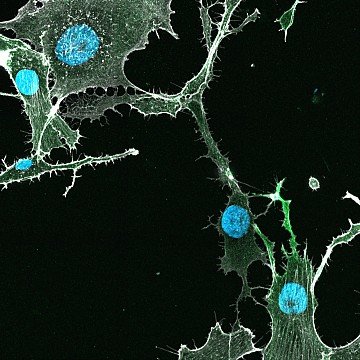
Image capture: morphological variety of basal progenitors in ferret embryonic neocortex. Basal progenitors are identified by the stemness marker SOX2 (magenta), and their morphology is highlighted with GFP (green).
Chiara Ossola, Nikola Cokorac, Emanuele Capra, Stefania Faletti, Ilaria Bertani, Chiara Ambrosini, Elena Restelli, Francesca Casagrande, Alessandra Fasciani, Roberta Bosotti, Nicola Maghelli, Giovanni Faga, Elena Taverna, Nereo Kalebic, Adducins regulate morphology and fate of neural progenitors during neocortical neurogenesis, Cell Reports, Volume 44, Issue 9, 2025, 116276, ISSN 2211-1247, https://doi.org/10.1016/j.celrep.2025.116276