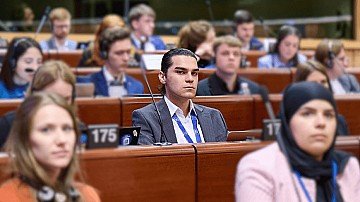
On 8 September, the courtroom in Ankara was filled to capacity. Representatives from civil society, political parties, and parliamentarians came to observe the trial of 23-year-old human rights defender, LGBTI activist, and Council of Europe youth delegate, Enes Hocaoğulları.
The atmosphere was tense: three police officers were seated between the public and the bench, observers were ordered to move back, as human rights defender and LGBTI activist, Enes Hocaoğulları entered a courtroom in the Turkish city of Ankara in handcuffs, where his trial for spreading misleading information, inciting public hatred, targeting the country’s reputation, causing division in society, and even tampering with evidence was to begin.
Almost a month earlier, on August 5, Enes had been arbitrarily arrested at Ankara Esenboğa Airport after returning from a Council of Europe conference in Strasbourg. The charges against him were based solely on a March 27 speech at a Council of Europe conference in Strasbourg, where he denounced human rights violations during protests over Istanbul Mayor Ekrem İmamoğlu’s arrest. He had been detained in prison since his arrest.
“I exercised my right to freedom of expression. I am innocent.”
The handcuffs were removed before Enes stood to give his defence. He traced the timeline of events that led from peaceful demonstrations in March, to his speech at the Council of Europe, and finally to his arrest. He emphasised that his intervention abroad fell squarely within his professional duties as a Council of Europe youth delegate, and that all relevant documentation proving his official role had been ignored by the prosecution.
Challenging the core accusation in the prosecution’s indictment that he had “targeted the country’s reputation,” Enes argued:
“Speaking about people exercising their constitutional right to peaceful protest and about human rights violations does not damage the country’s reputation; it honours and elevates it. What truly harms the reputation of Turkey is the failure to properly investigate these violations.”
He also exposed serious flaws in the indictment: mistranslations of his speech, contradictions in dates and locations, and even charges of “tampering with evidence” over a Council of Europe speech that remains in the institution’s archives.
“My client’s speech is about protecting human dignity. There is nothing more honorable than that.”
Following Enes’s speech, his lawyers underlined that his words at the Council of Europe conference fall under the scope of freedom of expression protected by both the Turkish Constitution and international treaties ratified by Turkey, including UN standards on the protection of human rights defenders. They highlighted that even if the authorities disagreed with the content of his speech, the state had lawful ways to respond and prosecution was not one of them.
One lawyer noted that for a crime of “incitement,” the indictment must show which part of the public was allegedly provoked. No such evidence was provided. Another stressed the absurdity of accusing a youth delegate who was invited to report on the situation in his country, of endangering national security simply by fulfilling that mandate.
The ruling
In a rare positive turn, the prosecutor himself recommended that Enes should no longer remain in detention. The judge ruled that Enes would be released pending trial, subject to monthly reporting at a law enforcement facility.
A broader picture
Enes’s case is emblematic of the wider strategy of silencing dissent in Turkey. Authorities are increasingly relying on “reputation” and “disinformation” charges to criminalise human rights defenders, especially those connected to the LGBTI community. Yet, as Enes’s words in court show, it is precisely the suppression of peaceful voices that undermines Turkey’s credibility at home and abroad. His courage in standing firm reminds us that defending human rights is not a crime, but the essence of democracy.
What’s next?
Although he was released from detention, Enes still stands accused of spreading misleading information, inciting public hatred, targeting the country’s reputation, causing division in society, and tampering with evidence. The next hearing will be held on February 23, 2026, and the verdict is expected on that day. As his trial continues, we call for all charges against Enes Hocaoğulları to be dropped. Telling the truth is never a crime.