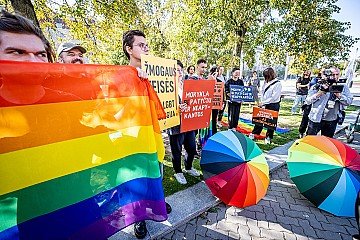
Lithuania is entering a decisive phase in the recognition and protection of diverse families. Following landmark judicial rulings, civil partnership is now firmly on the national political agenda — and the question has shifted from whether to regulate partnership to how.
At today’s press conference at the ILGA-Europe Annual Conference, entitled, “From Courtrooms to Parliament – The Future of Partnership in Lithuania,” leading human rights and legal experts outlined what is at stake as Parliament prepares to debate amendments to the Civil Code that would introduce legal recognition of partnerships.
In 2025, the Constitutional Court of Lithuania ruled that the absence of partnership regulation violates the Constitution, while the Vilnius District Court registered a same-sex couple as partners for the first time. These decisions underscored that continued legislative inaction is incompatible with constitutional principles and the rule of law.
“The courts have done their part — now it is time for Parliament to act”
Vladimir Simonko, Executive Director of LGL (Lithuanian Gay League), emphasised that the courts’ message is clear: “Lithuania cannot continue to ignore the legal and social reality of families living without recognition. The upcoming parliamentary debate is not just about legal formality — it is about respect, dignity, and equality before the law.”
Monika Antanaitytė, LGL’s lawyer, presented an overview of the current partnership proposals before Parliament, highlighting key differences in scope and inclusiveness. “The choices legislators make will determine whether we advance toward genuine equality or settle for symbolic progress,” she noted.
From TYA (Tolerance Youth Association), Artūras Rudomanskis, Chairperson, and Aivaras Žilvinskas, attorney and representative in strategic family rights cases, discussed the implications of the court rulings for legal responsibility and human rights protection in Lithuania. “Court decisions have established a constitutional obligation to act — failure to legislate would be a failure of governance,” Žilvinskas stressed.
A European Perspective on Equality
Katrin Hugendubel, Advocacy Director at ILGA-Europe, underlined the importance of Lithuania’s next steps in the broader European context: “Lithuania’s progress will send a powerful signal to other countries in the region. True equality means ensuring that all families — including same-sex couples — enjoy equal protection, recognition, and respect.”
A Call for Leadership and Accountability
Speakers urged Lithuanian lawmakers to ensure that any partnership legislation adopted fully reflects constitutional values and European human rights standards. As Lithuania stands at this crossroads, the outcome of the parliamentary debate will determine whether the country joins its European partners in upholding equality — or remains an outlier.