As LGBTI movements face political backlash, dwindling funds, and burnout, activists and funders from Europe and Africa at the ILGA-Europe conference reflect on what it means to resist, rebuild, and keep hope alive, even in the hardest of times.
Across continents, political divides, and generations, the global LGBTI movement is facing one of its most complex moments yet. Activists, donors, and communities are navigating backlash, funding cuts, rising authoritarianism, and the deep fatigue that comes with years – sometimes decades – of struggle. Yet, as one panellist put it, “this is the time when we can really come together, as a people, as a movement, to create the future we want.”
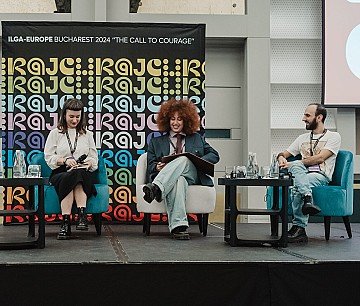
That spirit of determination and solidarity framed a recent panel discussion moderated by Masen Davies (Funders Concerned about AIDS and ILGA-Europe advisory board committee), featuring activists and funders from across Europe and Africa: Tamás Dombos ( Háttér Society, Hungary), Antonija Stojanovic, (Lesbian Organisation Rijeka -LORI, Croatia), Jabu Pereira (Equality Without Borders, South Africa), and Claudia Bollwinkel (Dreilinden gCmbH, Germany). Together, they offered a candid and often emotional reflection on the challenges and hopes shaping the next chapter of the global LGBTI movement.
The Pendulum of Progress
Tamás Dombos, a board member of Hungary’s Hatter Society, opened the discussion by reflecting on what it means to fight for equality in a deeply repressive political climate.
“In Hungary,” he said, “we’ve been living with a government that campaigns around minority issues in a negative way for sixteen years.” From constitutional attacks to so-called “propaganda laws”, the pattern of progress and backlash has become all too familiar.
But Tamás cautioned against despair. “Social progress doesn’t happen in a straight line. We win, we lose, we win again. There’s always a pendulum – but people make the pendulum move.”
He pointed to recent signs of resilience: the successful campaign that invalidated an anti-LGBTI referendum in 2022, and the record-breaking Budapest Pride earlier this year – attended by nearly half a million people. “Even when we’re not winning,” he said, “we have to keep fighting.”
Finding Strength in Togetherness
From neighbouring Croatia, Antonija Stojanovic, programme coordinator at the lesbian organisation LORI, echoed Dombos’ reflections on backlash and endurance.
“Croatia is beautiful,” she said, “but it also has horrific LGBTQI+ phobia.” The 2012 constitutional referendum that defined marriage as a union between “a man and a woman” was, she said, “a punch in the stomach.”
But the response was defiant. Within a year, activists helped pass the Life Partnership Act and continued to expand rights through persistence and creativity.
“Maybe it’s just my view,” Antonija said, “but I feel we sometimes lose sight of our strengths. We have so many. All the alliances, all the capital we’ve built – they’re still there.”
Her message was clear: the next phase of activism must focus on “nurturing togetherness and queer joy”. She emphasised the importance of investing in youth, citing LORI’s youth group that has become a visible force in Croatian activism. “Creating safe, inclusive spaces where we thrive will pay off. Funding will come, challenges will pass – but only together can we build power and change.”
Interconnected Resistance
For Jabu Pereira, founder of Iranti and senior fellow at Equality Without Borders, the personal and political are inseparable.
“As a trans man who survived apartheid, racism, and poverty, I’m here because of the power of a collective,” he said. “None of us would understand oppression without the collective consciousness that taught us to resist it.”
Jabu urged the audience to see activism not as a burden but as a continuation of hope. “We may die before we reach our utopia of freedom,” he said, “but we leave it for the next generation to take up.”
And while acknowledging the scarcity that many organisations now face, Jabu was adamant that “there is no shortage of money in the world – only inequality in how it flows.” The challenge, he said, is not just funding movements but transforming how money connects to activism. “We need money to be a unifier, not a divider.”
Rethinking Philanthropy
As a donor and director of a private foundation in Germany, Claudia Bollwinkel offered a rare glimpse into how funders are grappling with these shifts.
“The loss of major sources like USAID created a gap too big for any single foundation to fill,” she admitted. “We found ourselves facing the paradox of being in power but powerless at the same time.”
In response, her foundation made a bold choice: withdrawing funds from its endowment to redistribute directly to movements, focusing on the hardest-hit communities – particularly trans and intersex groups in Central and South Asia.
Philanthropy, she added, must also evolve. “We need to strengthen the autonomous resourcing of movements – helping groups fund themselves through solidarity, mutual aid, and community wealth-building.”
Courage in the Classroom
Antonija later shared how LORI has managed to bring LGBTI issues into Croatian schools – an audacious act in a deeply conservative environment.
“We started educating teachers and psychologists years ago,” she explained. “Now, when those educators go back to their villages, they become quiet ambassadors.”
Some of those ambassadors even helped slip LORI’s programmes into government action plans. “We queered the schools,” she laughed, “and even the railways – by asking the national train company to support our queer festival. We want everyone to see that these are our spaces too.”
Hope as a Human Condition
In closing reflections, each speaker returned to the question of how movements can not only survive but become stronger through this global reckoning.
For Tamás, it begins with bringing people in. “It can’t just be paid activists. The whole community has to feel ownership of the movement.”
Antonija reminded the audience that solidarity itself is strength: “The root of the word solidarity is ‘solid’. Strong.”
Jabu called for “a philanthropy of care” – one that prioritises sustainability, wellbeing, and intergenerational leadership.
And Claudia ended with an unexpected lesson drawn from her volunteer work in hospice care: “Hope,” she said softly, “is not about circumstances. People die hoping. Hope is something within us that never disappears.”
The Power of Collective Resilience
As the panel drew to a close, applause filled the room. What emerged from the discussion was not despair, but a fierce sense of purpose. Across borders and political realities, the message was the same: resilience is not about surviving in silence – it’s about transforming hardship into collective strength.
As one participant summed up: “If things are bad, let’s not go home. Let’s organise.”