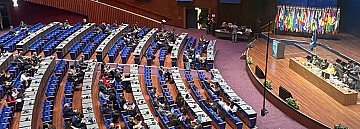
- Ahead of the 24th session of the Assembly of States Parties (ASP24) to the Rome Statute of the International Criminal Court (ICC), the International Federation for Human Rights (FIDH) publishes its position paper, which sets out four key recommendations urging States Parties to take urgent action.
- These recommendations draw on FIDH’s year-round advocacy and the dedicated work of its member organisations. These include responding to US sanctions, advancing victim-centred reforms at the ICC, addressing growing non-cooperation and withdrawals from the Rome Statute, and ensuring a healthy, accountable workplace culture at the Court.
- FIDH will participate in ASP24 with a delegation headed by Alexis Deswaef, the newly elected FIDH President. This delegation will include representatives of FIDH’s international secretariat and member organisations from around the world.
25 November 2025. At Assembly of States Parties (ASP24), held from 1 to 6 December 2025 in The Hague, ICC States Parties have a significant responsibility: to stand in defence of the Court amid escalating attacks against the ICC and civil society organisations supporting the Court, including three FIDH members in Palestine. This year’s ASP comes at a time when the ICC is under unprecedented political, operational, and institutional pressure. After the Court issued an arrest warrant for Israeli Prime Minister Benjamin Netanyahu, the United States of America (USA) imposed sanctions on the ICC Prosecutor, two Deputy Prosecutors, and six judges, as well as three Palestinian human rights organisations that are FIDH members. The USA are also reportedly considering sanctions against the Court itself, posing a direct threat to its future.
State cooperation with the ICC is weakening and states are retreating from universality. Findings of non-compliance against Italy, Hungary, and Mongolia reflect an erosion of state cooperation particularly on the arrest and surrender of suspects. Meanwhile, the announced withdrawals from the Rome Statute by Hungary and three Sahel States undermine the universality of the Rome Statute system. States have also failed to adopt a key amendment to enforce the ICC’s jurisdiction over the crime of aggression, delaying equal access to justice for victims until at least 2029. At the same time, the ICC is facing a serious internal crisis marked by misconduct allegations, flawed election processes, and systemic workplace dysfunction, that are damaging staff trust and the Court’s credibility.
Yet, 2025 has also brought significant advances. The ICC issued landmark arrest warrants against senior Taliban officials for gender-based persecution, including LGBTIQ+ victims, and secured its first conviction for gender-based persecution in Darfur. The Court also made progress in the CAR and Uganda situations, including the conviction of Yekatom and Ngaïssona and the confirmation of charges against Joseph Kony in absentia. Strong cooperation by some States Parties - such as Germany’s arrest of Libyan suspect Khaled Mohamed Ali El Hishri and the Philippines’ arrest and surrender of former President Duterte - shows that accountability is achievable when States Parties take decisive action.
These mixed developments occur in the context of a global backlash against justice and accountability, with civil society and victims’ rights under growing pressure. Victims and survivors continue to face barriers to participation, information, and support within the Court, while failures in cooperation - especially on key arrest warrants - and weak complementarity undermine the Court’s credibility, fueling the narrative of ICC detractors.
Against this backdrop, ASP24 is a decisive moment. States Parties must stand with the Court, respond firmly to non-cooperation, defend its independence, and uphold their commitments to victims’ rights and the fight against impunity.
The ICC Under Attack: Defend the Court, Support the Victims, and Ensure Accountability
This paper, based on FIDH’s year-round work on and with the ICC, sets out four urgent areas for action at ASP24.
1. Stand for the ICC or bow to US sanctions.
2. Deliver on commitments to victims’ Rome Statute rights.
3. Strengthen cooperation and fulfil complementarity obligations.
4. Advance a healthy and accountable workplace culture at the ICC.
The position paper also contains an overview of FIDH’s work on international justice throughout 2025 and on how States can support broader accountability mechanisms.
FIDH’s participation in ASP24
FIDH will participate in ASP24 with a delegation headed by Alexis Deswaef, the newly elected FIDH President. This delegation will include representatives of FIDH’s international secretariat and member organisations from around the world.
FIDH will take part in the ASP plenary sessions, meetings, and events, and actively advocate for policies and practices that place victims at the centre of the Court’s work. FIDH will also co-host several side events, including a victims- and survivors-led event with the Victims’ Rights Working Group, a discussion on workplace culture at the ICC, and a session on cooperation with a focus on arrests.
1) Victim-centred justice begins with us: A dialogue led by survivors
Monday 1 December / 18h15-19h45 CET / Yangtze 1, World Forum, The Hague
Co-hosted by Austria, Belgium, France, Finland, Switzerland, the United Kingdom, the European Union, Coalition for the International Criminal Court (CICC), FIDH, Synergy for Justice, and REDRESS.
2) Speech crimes of the Russian Federation in the context of the conflict in Ukraine: Documentation, investigation and prosecution
Monday 1 December / 18h15-19h45 CET / Yangtze 2, World Forum, The Hague
Co-hosted by Platform for Peace and Humanity, FIDH, LingvaLexa, Social Action Centre, and the Office of the Prosecutor General of Ukraine.
3) Workplace Culture at the International Criminal Court: Strengthening Wellbeing and Accountability
Tuesday 2 December / 13h15-14h45 CET / King Willem Alexander, World Forum, The Hague
Co-hosted by Australia, Austria, Canada, Czech Republic, South Africa, Sweden,
Switzerland, the United Kingdom, FIDH, and the Women’s Initiatives for Gender Justice (WIGJ).
4) Arresting suspects of international crimes - States Parties legal obligations to cooperate and civil society contributions
Wednesday 3 December / 13h15-14h45 CET / Europe 1&2 Room, World Forum, The Hague
Co-hosted by Belgium, Chile, Finland, France, Germany, Senegal, South
Africa, Vanuatu, Amnesty International, the Coalition for the International Criminal Court (CICC), Human Rights First, Human Rights Watch (HRW), International Bar Association (IBA), FIDH, Legal Action Worldwide (LAW) and REDRESS.
At this side event, FIDH will launch a briefing paper, co-published with Redress in collaboration with students from The Hague University of Applied Science, entitled "Ending Immunity, Ending Impunity: Advancing Accountability for Heads of State at the International Criminal Court", which emphasises how the Court’s jurisprudence, customary international law, and a harmonious reading of Rome Statute Articles 27 and 98 all support the non applicability of personal immunity before the ICC.