The PREDATICS project, funded by IVACE I+D and co-funded by the European Regional Development Fund (ERDF), has developed pioneering technology capable of estimating NO₂ levels in Valencia at a resolution of less than 60 metres, enabling the analysis of air pollution even in locations without monitoring stations.
This innovative methodology, validated at official monitoring sites, is based on Aerosol Optical Depth (AOD) derived from satellite imagery.
In this way, the consortium—made up of technological entities and research centres from the Valencian Community—is continuing its progress in the second year of the project, with the aim of improving air-quality surveillance across the region through the use of artificial intelligence and remote sensing techniques.
“This approach achieves a resolution of less than 60 metres across the entire city of Valencia, which facilitates the analysis of pollution even in areas without monitoring stations», ’ explain the project’s organisers.
PREDATICS is also advancing the integration of meteorological parameters to forecast pollution episodes through predictive models powered by artificial intelligence.
AVAMET and AEMET have collaborated with the project, providing current and historical meteorological data that help to elucidate the onset and development of pollution events.
Health and air quality
During this period, PREDATICS has conducted four passive NO₂ dosimetry campaigns. The resulting data have been incorporated into a study that includes detailed maps of air-quality trends for 2023 and 2024.
Victoria Lerma, a researcher at the ITACA Institute of the Universitat Politècnica de València (UPV) and project coordinator, highlights that “the results make it possible to identify precisely the areas where NO₂ levels approach or exceed reference values, thereby becoming a key tool for urban and public-health planning”.
The consortium is also in the final phase of requesting and collecting health data and sociodemographic variables from the Regional Ministry of Health. This information will enable an analysis of the relationship between exposure to pollutants such as NO₂ and PM₂.₅ and their impact on the use of healthcare services and the incidence of respiratory diseases».
Next steps: a public consultation website with an interactive viewer
PREDATICS has completed the development of a natural-language artificial-intelligence tool that will allow citizens to consult air-quality information and access knowledge generated from the project’s data. This solution will be integrated with the predictive model currently under development, which is being trained using seven years of satellite-derived historical estimates.
The forthcoming public web application, now at an advanced stage, will include an interactive viewer and will be expanded to incorporate forecasts and high-resolution pollution maps.
“With these advances, PREDATICS is consolidating its position as a strategic initiative to strengthen environmental monitoring, support public-health decision-making, and bring reliable, accessible information closer to citizens”, the team concludes.
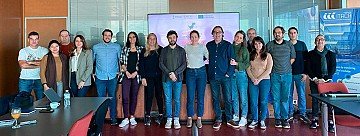
The project holds regular meetings and outreach activities, including the annual consortium meeting held on 27 November at the ITACA Institute facilities in the Polytechnic City of Innovation.