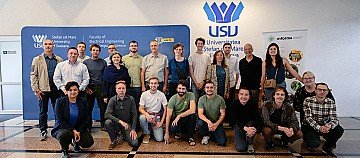
ITACA researchers participed recenetly in a technical roundtable focused on the lessons learned from large forest fires in a context marked by climate change and land abandonment.
The event, held at ETSEAMN-UPV on 20 November to mark Forest Day, brought togetherforestry engineering students, master’s students in forestry engineering, and doctoral students, who filled the auditorium.
The session, entitled «Lessons Learned from Wildfires«, was coordinated by José Vicente Oliver, ITACA researcher and coordinator of the Horizon Europe INFORMA project, and featured the participation of: Eduardo Rojas Briales, ITACA researcher and Chief of the Scientific Committee of INFORMA; Ferrán Dalmau Rovira, forestry engineer and director of Medi XXI GSA; and Álvaro Escrig del Valle, technical coordinator of the Valencia Provincial Firefighters Consortium.
During the debate, the experts agreed on the need to preserve the agro-forestry mosaic, emphasising that “every farmer and livestock breeder who remains in the region is key to curbing large-scale fires”.
They also highlighted the importance of integrating the technical use of fire into adaptive forest management, especially in landscapes where fuel accumulation increases both the risk and the intensity of fires.
The INFORMA Project and the impact in our ecosystems
The discussion naturally linked to the vision of the European INFORMA project, which works to promote sustainable, adaptive, and climate-smart forest management throughout Europe, as well as strengthening the transfer of scientific knowledge to administrations, companies, and citizens.
Oliver stressed that European forestry science “has much to contribute in a climatic scenario that no longer resembles conditions from just two decades ago.”
Another major topic of the day was the professional future of forestry engineers. The speakers warned of a growing shortage of technicians in rural and forestry areas, a deficit that may become more acute in the coming years.
The forestry sector and climate change
“There is expected to be no unemployment in the forestry sector,” they noted, encouraging students to prepare for a job market with high demand for specialists in forest management, emergencies, post-fire restoration, and land-use planning.
They also emphasised the importance of soft skills—attitude, commitment, leadership, and communication—and the opportunity to develop their own initiatives related to forestry entrepreneurship and the bioeconomy.
Climate change is also causing countries that had previously experienced few major fires to begin facing them, which will increase the demand for professionals trained in Spain. Even so, the message was clear: “Broadening your perspective and vision, training abroad is necessary and very enriching, but not at the cost of brain drain; the country needs this talent to return».
The importance of the communication
The technical panel also addressed an increasingly urgent challenge: communication during forest fires and forest-related communication more generally. The experts acknowledged that tactical decisions such as withdrawing from certain fronts, allowing the fire to advance in strategic areas, or prioritising the safety of personnel often generate misunderstanding among society and the media.
“Behind these decisions lies a profound understanding of fire behaviour, the territory, and risk, but this is not always successfully communicated,” they pointed out. Hence the need to improve forestry pedagogy and the training of journalists and civil society in understanding fires.
The day concluded with a shared message: the combination of science, technical training, communication, and adaptive management will be essential to tackling future fires and ensuring a transition to more resilient landscapes and better-prepared societies.