Brussels briefing sheds new light on the pressure facing Pride organisers in Hungary and the stakes for the European Union
At a media briefing in Brussels today, ILGA-Europe brought together three speakers to help journalists understand the deeper context behind the criminal investigation into Pride in Hungary’s fifth largest city, Pécs. The panel featured Géza Buzás-Hábel, the organiser of Pécs Pride who is under investigation by the Hungarian authorities; Eszter Mihály from Amnesty International Hungary; and Nicolae Ștefănuță, Vice-President of the European Parliament.
While Géza faces possible criminal charges for organising a peaceful Pride march in a member state of the EU, which may lead to up to a year in prison and a ban from teaching in Hungary, today’s discussion offered a more detailed look at how this situation emerged, what is at stake, and what it signals for democratic space in Hungary and across the European Union.
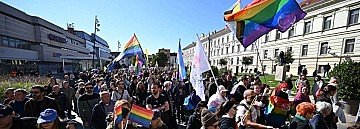
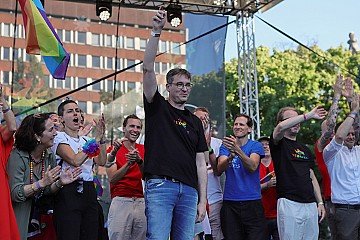
Géza shared a detailed and moving account of this year’s Pride and the pressures he faced long before the march took place. He described how he submitted the notification a month in advance, only to see it rejected within a week, far faster than usual. His appeal was dismissed just as quickly. Even so, he believed it was essential to continue.“We organised Pride because we want Hungary to stay in the European Union. This is bigger than the LGBTI community. If we accept the ban, we accept oppression. We stop fighting for equality. I could not allow that.”
He spoke openly about the real personal risks involved, not just for himself but for everyone linked to the organisation. “People in Hungary have lost their jobs simply because their names appeared on official lists. After my own surveillance, I was labelled a security threat and dismissed from my public teaching job. This is the environment we work in. We had to dissolve our board because being publicly associated with us is dangerous. I carry full responsibility now, alone.”
Géza also described the moment he learned that the police had recommended opening a criminal case against him. “I found out from government sponsored media, not from my lawyer. Then the police officer who questioned me called to confirm it. I have still not received an official letter. I wake up every day waiting for the prosecutor to announce that the case is open. It could happen at any moment.”
Despite this pressure, he reflected on community reactions. “Even in this climate, we have seen new allies stepping forward. People understand that what is happening to me can happen to anyone the government decides it does not like. This goes far beyond Pride.”
Eszter Mihály placed his case within the wider legal and political context in Hungary. She explained that the Assembly Act was introduced alongside other restrictive laws during a period of accelerated rule of law backsliding and shrinking independent media. “Hungary pushed these laws through parliament in two days. Civil society was already fighting the foreign funding legislation, so suddenly we were battling on two fronts. The anti Pride restrictions go even further. Events have been banned because speakers are openly LGBTI. The law is being applied with a very broad interpretation.”
She also highlighted the extreme surveillance powers included in the law. “The police can use facial recognition and AI to identify participants. In a democratic society this is a huge threat because it allows the authorities to map people’s political views, personal lives and relationships. It chills not only LGBTI events but any form of public assembly.”
Looking ahead to the spring elections in Hungary, Eszter stressed that this law now operates as a political tool. “If this law stands, it can be used to control the election environment. We have seen this pattern before. The government introduces restrictive laws shortly before elections. This one is harsher because criminal charges are now possible. It can silence protests and prevent critical voices from gathering in public.”
Nicolae Ștefănuță MEP addressed the role of EU institutions and the broader European implications. “I marched in both Budapest and Pécs Pride. I know how important it is to stand with communities outside the capitals. Géza took risks that no organiser in the EU should ever face. What is happening in Hungary is spreading. These restrictive laws move across borders. The EU needs to act before this becomes the norm.”
He spoke directly to the responsibility of political leaders. “The duty of citizens is not to obey unconstitutional laws. Géza is fighting a just fight for Europe. We cannot leave people like him alone.”
A case that reveals a wider pattern
Speakers agreed that the criminal investigation into Pécs Pride is not an isolated event. It reflects a broader pattern in which LGBTI communities are targeted first, paving the way for measures that later restrict the rights of many others.
Katrin Hugendubel, Advocacy Director at ILGA-Europe, noted this wider trend.
“We have never seen so many Prides obstructed or attacked across Europe. Yet we have also seen more Prides than ever. Communities keep showing up because they know what is at stake. This is about defending democracy and fundamental rights in the European Union.”
Context
Géza Buzás-Hábel is a teacher who has been organising Pécs Pride for the past five years. After Hungary’s Assembly Act was introduced, this year’s march proceeded despite a police ban. Following an investigation, police have recommended criminal charges, and the case is now with the prosecution office. If convicted, Géza could face up to one year in prison and the loss of his right to teach.