- Almost a year after Duterte’s arrest and transfer to the ICC, the confirmation of charges hearing against former Philippine President Rodrigo Duterte opens before the International Criminal Court (ICC) today,
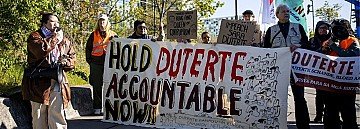
- After years of impunity this case offers victims and survivors of Duterte’s “war on drugs” a rare opportunity to have their claims examined by an independent court.
- The International Federation for Human Rights (FIDH) and its member organisation Philippine Alliance of Human Rights Advocates (PAHRA) welcome this historic step, but call for continued investigation of the full range of international crimes committed by the Duterte regime.
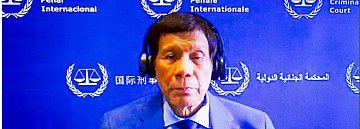
The Hague, Manila, Paris 23 February 2026. The confirmation of charges hearing, while opening in the absence of the defendant, marks a decisive step in the ICC proceedings against former Philippine President Rodrigo Duterte, who was arrested and transferred by the Philippine authorities to the Court in March 2025. At this stage, ICC judges will determine whether the evidence presented by the Office of the Prosecutor establishes substantial grounds to believe that Duterte is criminally responsible for the crime against humanity of murder, and whether the case should proceed to trial. The charges relate to thousands of extra-judicial killings committed between November 2011 and March 2019 during his time as President of the Philippines, and earlier as Mayor of Davao City, in a campaign that overwhelmingly targeted people from poor and marginalised communities.
For nearly a decade, victims and their families in the Philippines have been denied truth, justice, and recognition. Domestic accountability mechanisms have failed to conduct effective investigations or prosecutions, leaving families without answers and survivors without remedies. For many, the ICC represents the first judicial body willing to examine their claims independently and impartially. More than 500 victims were allowed to participate in this hearing.
“While the Court granted Duterte’s request not to be present, the historic hearing this week of a former head of State gives victims and survivors something they have been denied for years: the chance to have their claims examined by an independent global court. For families who lost loved ones and suffered terrible trauma because of the so-called “war on drugs”, being heard and represented is a crucial step towards justice,” said FIDH President Alexis Deswaef.
The proceedings take place in a context marked by a sustained disinformation campaign in the Philippines aimed at discrediting the ICC and undermining public understanding of the case. Victims, human rights defenders, journalists, and civil society organisations have faced harassment and intimidation, further complicating victims’ ability to engage safely with the justice process.
“Disinformation about the ICC does real harm. People are afraid, supporters of the proceedings are branded ‘enemies of the State’, some are even forcibly disappeared. All of this stems from a powerful campaign of falsehoods against victims, civil society, and the ICC. This is why exposing the facts and allowing the judicial truth to emerge is so essential. This is only possible if victims and witnesses can safely be heard before the ICC.” said PAHRA Chairperson Nymia Pimentel-Simbulan.
FIDH and PAHRA reiterate the need for continued, thorough investigation and careful assessment of the full range of crimes allegedly committed in the context of the so-called war on drugs. Many victims have described harm that goes beyond extra-judicial killings. Their accounts point to patterns of abuse, including enforced disappearance, torture, as well as rape and other forms of sexual violence, which may meet the legal thresholds for additional crimes against humanity under the Rome Statute.
The confirmation of charges hearing also reaffirms the ICC’s jurisdiction over crimes committed in the Philippines between 1 November 2011 and 16 March 2019, despite the country’s withdrawal from the Rome Statute back in March 2019. The withdrawal does not erase responsibility for past crimes, nor does it shield those most responsible from judicial scrutiny.
FIDH and PAHRA call on the Philippine authorities to cooperate fully with the ICC, to protect victims and witnesses, and to pursue credible domestic accountability for other perpetrators of crimes committed in connection with the war on drugs. They reiterate that rejoining the ICC would be a concrete step towards restoring trust in the rule of law and demonstrating a renewed commitment to justice for victims of the gravest international crimes.