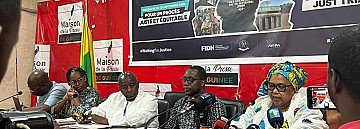
On 31 July 2024, the Criminal Court of the Dixinn Court of First Instance (Cour criminelle du Tribunal de première instance de Dixinn) in Conakry found eight high-ranking officials, including former Guinean president Moussa Dadis Camara, guilty of crimes against humanity for their role in the 28 September 2009 killings. The historic verdict is the result of the determined efforts of the victims, members of victims organisations acting jointly as the Association des victimes et parents et amis du 28 septembre 2009 (AVIPA), their lawyers and Guinean organisations such as the Organisation guinéenne de défense des droits de l’Homme et du citoyen (OGDH), all of which were assisted by the International Federation for Human Rights (FIDH). During the proceedings there was close cooperation between the International Criminal Court and Guinean authorities, thereby providing a concrete example of the principle of complementarity.
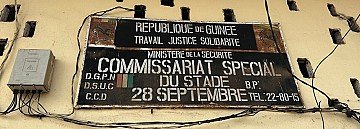
24 December 2025. On 28 September 2009, some 50,000 people gathered at the stadium in Conakry to protest Moussa Dadis Camara’s announcement of his candidacy in the presidential election, one year after he seized power in a coup. On 28 September and in the days that followed, soldiers from the ruling junta organised killings in and around the stadium. According to the report issued by the United Nations Commission of Inquiry, at least 109 women were victims of sexual violence, at least 156 people were killed or disappeared, and approximately 1,500 people were injured.
In 2009, the International Criminal Court (ICC) opened a preliminary investigation into the crimes committed on the 28th of September; at the same time, they cooperated with Guinean authorities and conducted consultations with victims’ organisations –the FIDH and its member organisation, the OGDH. 13 years later, on 28 September 2022, the trial opened at the Dixinn Court in Conakry and the verdict was handed down on 31 July 2024. The charges against former Guinean President Moussa Dadis Camara and seven high-ranking military officers were requalified as crimes against humanity. The accused were sentenced to prison terms ranging from 10 years to life.
The trial and the verdict sparked great hope for Guinea. For the first time in its history, the justice system in Guinea investigated crimes under international law, committed in the country, and then went on to prosecute, try and convict senior state officials and high-ranking members of the security forces. The developments marked a historic turning point in the fight against impunity in Africa and provided a concrete example of "positive complementarity" between national and international justice systems.
The momentum created has been severely hampered, however, by the pardon granted to Dadis Camara, less than a year after his conviction and while the appeal process is still ongoing. The pardon calls into question the entire process and raises a crucial question: Is the Guinean justice system truly prepared to guarantee the independence of its decisions and uphold the principle of complementarity?
What is the principle of complementarity?
The principle of complementarity is one of the founding principles of the ICC. It is set out in the first article of its 1998 founding treaty, the Rome Statute, "the Court (…) shall be complementary to national criminal jurisdictions". The ICC is, therefore, a court of last resort. States have the primary responsibility to investigate and prosecute persons believed to have committed international crimes. The Court does not replace national courts and only intervenes when a State is unable or unwilling to prosecute international crimes.
When a member of the ICC undertakes to investigate and prosecute international crimes, the ICC may provide support (training programmes, equipment, etc.) and maintain regular contact with the authorities, victims, and civil society with a view to ensure that all proceedings are conducted properly. However, the ICC may take over at any time if it considers that the State is not fulfilling its obligations. This form of cooperation is referred to as positive complementarity by the ICC.
The trial for the events that took place on 28 September 2009 is an example of positive complementarity
Guinea became a State Party to the Rome Statute in July 2003. Consequently, the ICC has jurisdiction over war crimes, crimes against humanity and genocide committed on its territory or by its nationals. In October 2009, the Office of the Prosecutor of the ICC announced the opening of a preliminary examination into the events of 28 September 2009. The Office of the Prosecutor concluded that there was "(...) a reasonable basis to believe that (…) crimes against humanity were committed in the national stadium in Conakry on 28 September 2009 and in its immediate aftermath"; these crimes include murder, imprisonment or other severe deprivation of liberty, torture, rape and other forms of sexual violence, persecution, and enforced disappearance of persons.
In light of ICC observations, Guinean authorities had to make an important decision: to commit to initiating and supporting investigations and the prosecution of the persons believed responsible, or to let the ICC take over. They decided to open an official investigation, thereby paving the way for a process that could be closely followed by the victims and the Guinean population.
The FIDH has always advocated that crimes should be prosecuted, whenever possible, in the country where the crimes were committed and where the perpetrators and victims live. That is why the FIDH, the OGDH, its partners the Association guinéenne d’orientation et de réflexion pour l’action (AGORA), AVIPA, and the Association des familles des disparus du 28 septembre 2009 (AFADIS), and dozens of victims, filed complaints at national level and were quickly recognised as parties civiles; eventually, 749 victims would be represented during the proceedings. For the first time in Guinea, civil society organisations were recognised as parties civiles in legal proceedings. The investigation marked the beginning of a long period of collaboration between Guinean authorities, their diplomatic partners (France, for example), the Office of the United Nations High Commissioner for Human Rights, the ICC Office of the Prosecutor, and the representatives of the parties civiles.
Martin Pradel, member of the FIDH Legal Action Group and legal counsel for the FIDH and the victims in the trial observed that, "(…) everyone worked towards a single goal: to obtain concrete action to enable this justice process to succeed."
The FIDH highlighted this work in a 2014 video:
As part of the process of positive complementarity, members of the ICC Office of the Prosecutor visited Guinea more than a dozen times since 2009. This includes Fatou Bensouda, who was ICC Deputy Prosecutor from 2004 to 2012 and Chief Prosecutor between 2012 and 2021. ICC representatives were thus able to verify that the process was advancing with the Guinean authorities and the organisations, discuss the equipment or training needs that the ICC could meet, and reiterate that the ICC could resume control in the event of non-compliance. During the course of those years, the FIDH, OGDH, and AVIPA, all of which were parties civiles to the judicial proceedings, were in regular contact with representatives of the ICC Office of the Prosecutor, the United Nations, and several embassies. In April 2016, the FIDH, OGDH, and AVIPA met with the United Nations Special Representative of the Secretary-General and the United States Assistant Secretary of State for Human Rights.
These regular exchanges fostered step-by-step progress in the quest for justice for the victims and survivors of the 28 September 2009 attacks. Some of the advances were very concrete: after the parties civies reported to the ICC Office of the Prosecutor that Guinean judges had to pay out of their own pockets for fuel for the vehicles used by the escort of gendarmes who providing transport and protection services, a budget was allocated for fuel.
There were positive developments for the survivors and for justice in general even before the trial started: in 2012, Lieutenant-Colonel Moussa Tiegboro Camara was indicted (he was still serving as minister at the time); in 2013 a gendarme was arrested for the rape of a woman in the Conakry stadium; and in 2015, Dadis Camara was indicted –the FIDH had been advocating for his indictment since the beginning of the investigations.
The material and procedural advances, which were the result of complementary work done by everyone involved, made it possible for the 28 September killings to finally open on a symbolic date: 28 September 2022, 13 years to the day after the events. On that day, in a brand-new building built for the occasion, 11 defendants appeared in court, among them several senior political and military officials. Present at the trial were members of the FIDH, OGDH, and AVIPA who were representing more than 450 victims. Also present was Karim Khan, the ICC Prosecutor, and Pramila Patten, UN Special Representative of the Secretary-General on Sexual Violence in Conflict.
After the trial opened, the ICC closed the preliminary examination opened in 2009 and signed a memorandum of understanding with the Guinean authorities whereby both parties commit to continuing their complementary work to ensure the proper implementation of the measures set out in the verdict. Under the memorandum, the Guinean state is obliged to provide training and security for judges and witnesses, communicate clearly at each stage of the trial, and allocate the necessary resources to ensure the smooth running of the process. The ICC retains the power to reopen an examination when: measures are imposed that hinder the progression of judicial proceedings; ineffective or disproportionate criminal sanctions are adopted; the jurisdiction of the courts is obstructed; victims’ access to justice is impeded in any way, including by excessive delays; and when judicial proceedings are suspended. The ICC is also committed to continuing to support the judicial process by contributing to projects and programmes for knowledge-sharing and technical support.
Every stage of the landmark trial, which was emblematic for the fight against impunity in Guinea and for international justice, was followed closely by people in Guinea and elsewhere in the world. Some of the hearings, including the one where the verdict was handed down, were broadcast live on YouTube, to make them accessible to as many people as possible.
A source of hope despite the widespread impunity in West Africa?
Hassatou Ba-Minté, head of the FIDH Africa Desk, explained that "the trial 28 September 2009 (attacks) can serve as an example but, more importantly, it offers hope to the people of West Africa, and indeed the entire world, in the face of widespread impunity".
In West Africa and elsewhere, countless victims of human rights violations are waiting for some form of justice. This is the case in Mali, where a national reconciliation law was passed in 2019, that resulted in the discontinuation of prosecutions against the perpetrators of crimes committed since the start of the war in 2012. The law was adopted despite the ICC Prosecutor asserting that there was "(…) a reasonable basis to believe that war crimes have been committed in the context of a non-international armed conflict in Mali" which include murder, mutilation, cruel treatment and torture, intentionally directing attacks against protected objects, the passing of sentences and the carrying out of executions without due process, pillaging, and rape.
The situation led the ICC to try Ahmad Al Faqi Al Mahdi, who was sentenced to nine years in prison for organising attacks against religious and historical buildings in 2016, and Al Hassan Ag Abdoul Aziz, who was sentenced to 10 years in prison in 2024, although the decision on reparations has yet to be rendered. Al Hassan was found guilty of the crimes against humanity of torture, persecution, and other inhumane acts; and war crimes, torture, outrages upon personal dignity, mutilation, cruel treatment and pronouncing sentences without a prior judgement rendered by a regularly constituted court. Notwithstanding, the FIDH regrets that the verdict did not address the gravity and impact of gender-based crimes and that opportunity was missed to include gender-based persecution in the list of crimes against humanity. In Mali, to date only one case has been brought before a domestic court since 2012, that of Amadou Haya Sanogo.
Similarly, the victims of the 2010-2011 post-election crisis in Côte d’Ivoire have never been able to obtain justice. Violent clashes, armed confrontations and military offensives led to the deaths of more than 3,000 people, looting, acts of reprisal against civilians, many cases of rape. In 2011, the ICC Prosecutor opened an investigation into crimes against humanity, including murder, rape, other inhumane acts, attempted murder, and persecution. It is the first investigation opened in a country that has accepted the jurisdiction of the ICC without being a State Party. The investigation led to the trial of Laurent Gbagbo and Charles Blé Goudé in The Hague. This could have been an encouraging sign for justice in Côte d’Ivoire, had Laurent Gbagbo and Charles Blé Goudé not been acquitted by the ICC in 2019.
The 2018 presidential amnesty granted by President Alassane Ouattara served to reinforced the general climate of impunity. The FIDH, the Ligue ivoirienne des droits de l’Homme (LIDHO) and the Mouvement ivoirien des droits humains (MIDH) denounced the illegal granting of amnesty and filed a complaint for abuse of power with the Ivorian Supreme Court. All three organisations, acting on behalf of the victims, also referred the matter to the Court of Justice of the Economic Community of West African States (ECOWAS), asking it to rule that the 2018 amnesty was illegal under international law.
Complementarity put to the test
Faced with the tragic situation of the victims, the FIDH calls for the effective implementation of positive complementarity, as was the case in Guinea.
"As long as there has been no final judgment, positive complementarity should continue" stated Martin Pradel.
A year after the verdict, even in Guinea, the situation remains uncertain. The appeal is still pending, consequently, not all of the convictions handed down in the first instance are final. Furthermore, the reparations were awarded to some of the victims but more than 400 others were excluded, without a clear explanation. Moreover, Dadis Camara was granted a presidential pardon in March 2025, despite having received a 20-year prison sentence for crimes against humanity; the appeal still underway. The presidential pardon jeopardises the justice process and shows contempt for the victims of the 28 September 2009 killings. Furthermore, the ICC may determine that the pardon hinders the progress of judicial proceedings and therefore constitutes a breach of the 2022 memorandum of understanding, this would justify the reopening of the ICC preliminary examination.
The verdict handed down in 2024 by the Dixinn court was justifiably perceived as a concrete illustration of the principle of positive complementarity between a national justice system and the ICC, yet its achievements are now under threat. Recent decisions made by Guinean authorities call into question the actual effectiveness of the complementarity policy in Guinea, particularly in light of the pardon granted to the principal defendant in the case, former President Camara, less than a year after his conviction, the ICC Office seeks to be reassuring.
To learn more about the principle of complementarity and the current complementarity and cooperation policy at the Office of the Prosecutor, see our Q&A on the subject here.