Introduction: Moving Beyond the Buzzword of ‘Client Engagement’
For years, ‘client engagement’ has been a ubiquitous buzzword. But in 2026, its definition has sharpened into a strategic imperative. True engagement is not a single click or a one-off campaign; it is the sum total of every interaction a customer has with your brand across their entire lifecycle, from initial discovery to long-term loyalty.
Yet, many organizations still operate with a fragmented tech stack—a patchwork of disparate tools for email, another for web push, a separate provider for WhatsApp Business, and yet another for support bots. This common approach creates operational friction and, more critically, crippling data silos that prevent a holistic view of the customer.
The result is a disjointed and often frustrating customer experience. A user might receive a promotional push for a product they just complained about via a support channel, or get an SMS offer for something they already purchased in-app. For the modern consumer, this isn’t a minor inconvenience; it’s a clear signal that the brand doesn’t truly know them.
This guide is built on a foundational premise: to thrive in today’s competitive landscape, businesses must transition from fragmented tools to a unified client engagement solution. We will explore how to orchestrate a true Global Omnichannel Strategy, where every channel works in concert to deliver a single, coherent conversation with your customer.
Throughout this article, we’ll demonstrate how a single, powerful platform from indigitall consolidates these interactions. By unifying data and orchestrating communication across App, Web, WhatsApp, and AI-powered agents from one central console, you can finally move beyond disjointed campaigns and start building intelligent, personalized Customer Journeys that drive sustainable growth.
Why a Cohesive Client Engagement Strategy is Non-Negotiable in 2026
In the digital landscape of 2026, the concept of customer engagement has evolved far beyond simple transactions. Today’s consumers expect fluid, personalized, and context-aware interactions across every touchpoint. A fragmented approach, where your App, Web, and WhatsApp channels operate in silos, is no longer just inefficient—it’s a direct path to customer churn.
A cohesive, global omnichannel strategy is the cornerstone of digital leadership. It means orchestrating every interaction as part of a single, continuous conversation. This unified approach doesn’t just meet customer expectations; it unlocks significant, measurable business value. Let’s break down why this is a non-negotiable pillar of growth.
Dramatically Increased Customer Lifetime Value (CLV)
Engaged customers are profitable customers. Recent industry benchmarks show that companies with mature, omnichannel engagement strategies see a CLV that is up to 30% higher than their competitors. By understanding user behavior across all channels, you can deliver hyper-personalized upsell and cross-sell opportunities that feel helpful, not intrusive, driving repeat purchases and maximizing revenue per customer.
Significant Reduction in Customer Churn
Proactive communication is your best defense against attrition. A unified engagement platform allows you to move from a reactive to a predictive retention model. Imagine automatically triggering a supportive WhatsApp message or a special offer via App Push when an AI model detects a customer is at risk of churning. This level of intelligent, timely intervention is what transforms a customer relationship from transactional to loyal, with leading brands cutting churn rates by over 20%.
Cultivating Authentic Brand Loyalty & Advocacy
Loyalty isn’t built on discounts; it’s forged through exceptional experiences. When a customer can start a query with an AI Agent on your website and receive a seamless follow-up on WhatsApp, it demonstrates a deep respect for their time and context. This frictionless experience, orchestrated through a well-designed Customer Journey, turns satisfied customers into vocal brand advocates who drive powerful word-of-mouth marketing.
Higher and Faster Conversion Rates
A cohesive strategy ensures your message reaches the right person, on the right channel, at the perfect moment. Abandoned cart reminders are a classic example, but the potential is far greater. By orchestrating Web Push notifications, In-App messages, and even Mobile Wallet passes, you can guide users through the funnel with unparalleled precision. Brands that master this omnichannel orchestration consistently report conversion rate uplifts of 15% or more on key campaigns.
Ultimately, unifying your client engagement strategy is about building a smarter, more resilient business. It requires a platform capable of connecting disparate channels into a single, intelligent ecosystem, empowering you to create the seamless experiences that define market leaders in 2026 and beyond.
The Pillars of a Modern Client Engagement Solution
In 2026, the landscape of customer interaction is fundamentally different. The strategies that worked just a few years ago are now merely the price of entry. To truly lead, brands must build their engagement strategy on a foundation of modern, interconnected pillars. Use this as a checklist to evaluate whether your current technology stack is built for the future or stuck in the past.
A truly modern solution must move beyond siloed channels and fragmented data. It requires a holistic ecosystem designed for the complex, real-time demands of today’s consumer. Here are the five non-negotiable pillars every market leader must have in place.
- True Omnichannel Orchestration: This is no longer just about being present on multiple channels. In 2026, it means orchestrating seamless Customer Journeys across App Push, Web Push, WhatsApp Business, RCS, and Mobile Wallet from a single platform. The goal is a unified customer profile that ensures a consistent, contextual experience, regardless of the touchpoint.
- AI-Powered Hyper-Personalization: Static segmentation is obsolete. Leading platforms now leverage generative AI to craft message variations and predictive models to determine the optimal channel and send time for each individual user. Engagement is driven by real-time behavioral data, ensuring every communication feels uniquely relevant and timely.
- Intelligent Automation and AI Agents: Automation has evolved from simple scheduling to intelligent decision-making. A modern solution must empower you to build complex, trigger-based Customer Journeys with ease. Furthermore, integrating AI agents directly into channels like WhatsApp for instant support and sales is now a critical component for delivering instant value and reducing operational load.
- A Unified and Actionable Data Core: Your engagement platform cannot be another data silo. It must serve as a central hub that integrates seamlessly with your existing CDP, CRM, and analytics tools. The objective is a 360-degree view of the customer that fuels every decision, providing clear, actionable insights directly within the indigitall console.
- Developer-Centric and Scalable Architecture: The ability to adapt and grow is paramount. A robust solution must be built on a foundation of powerful APIs, comprehensive SDKs, and clear documentation. This empowers your technical teams to integrate, innovate, and scale your engagement strategy without being constrained by platform limitations.
Evaluating your strategy against these five pillars provides a clear litmus test. If your current tools create friction between channels, offer limited personalization, or require heavy manual effort, you are leaving significant revenue and customer loyalty on the table. The future of engagement is integrated, intelligent, and seamless.
Pillar 1: Unification of Inbound & Outbound Communication
In the digital landscape of 2026, the line between marketing and customer service has completely dissolved. Customers no longer see separate departments; they see a single brand. A failure to unify your communication strategy is no longer a minor inconvenience—it’s a critical vulnerability that erodes trust and revenue.
Traditionally, communication was split into two distinct, siloed functions:
- Outbound Communication: This is the proactive messaging driven by your marketing and sales teams. It includes everything from targeted App Push notifications and promotional email campaigns to new product announcements sent via WhatsApp Business.
- Inbound Communication: This is the reactive world of customer support. It encompasses AI Agent conversations, live chat with human agents, support ticket submissions, and direct replies to your brand’s messages.
The problem with this outdated model is the jarring lack of context. Imagine a high-value customer is in a frustrating chat with your AI Agent about a delayed delivery. In the middle of that interaction, your marketing automation system, blind to the support issue, sends them a cheerful push notification: “Don’t forget to buy again! 15% off today!”
This single misstep makes your brand appear tone-deaf and disorganized, instantly damaging the customer relationship. The separation of inbound and outbound channels creates a fractured experience where the left hand has no idea what the right hand is doing.
A truly modern engagement platform, however, tears down these internal walls. The goal is to create a single, persistent conversational thread for each user. Within a unified ecosystem like the indigitall console, your marketing team can see an active support ticket and automatically pause promotional messages for that user. Conversely, your support agent has a complete view of the customer’s recent interactions and purchase history, enabling them to provide faster, more personalized resolutions.
This unification is the bedrock of a successful Global Omnichannel Strategy. It ensures that every touchpoint—whether proactive or reactive, on the web, in-app, or via WhatsApp—contributes to a single, coherent Customer Journey, building loyalty and maximizing lifetime value.
Pillar 2: True Omnichannel Presence
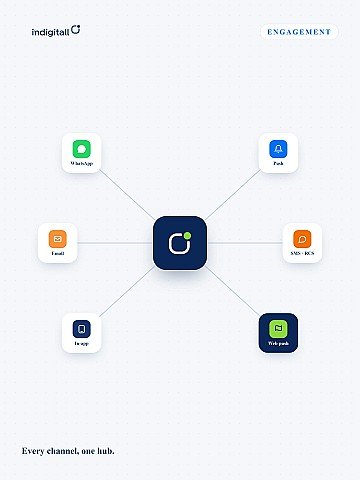
By 2026, the distinction between multichannel and omnichannel is no longer a matter of semantics—it’s the difference between a fragmented customer experience and a unified one. A multichannel approach simply means using various platforms to communicate. A true omnichannel strategy, however, integrates these touchpoints into a single, seamless conversation managed from one central hub.
This connected ecosystem ensures that a customer’s context and history travel with them, regardless of how they choose to interact with your brand. The goal is to make the channel invisible and the experience paramount. A modern omnichannel strategy must fluidly orchestrate interactions across key digital avenues:
- App & Web Push Notifications: For timely, high-visibility alerts and promotions.
- In-App Messages: For contextual guidance and feature announcements while the user is actively engaged.
- WhatsApp Business: For rich, two-way conversational commerce and support.
- SMS: For critical, high-deliverability messages like OTPs and delivery updates.
- Live Chat & AI Agents: For instant, on-demand assistance on your web and app properties.
Among these, WhatsApp has become a non-negotiable cornerstone for customer engagement. However, not all WhatsApp solutions are created equal. Many providers rely on third-party connectors or “wrappers” over the official API, creating a fragile system prone to latency, instability, and limited feature access.
At indigitall, we are a native WhatsApp Business API provider. This direct, first-party integration is a critical advantage, providing our clients with a more robust, secure, and feature-rich solution. It eliminates intermediate points of failure and grants you immediate access to the latest WhatsApp features—from advanced interactive messages to new commerce tools—the moment they are released.
Orchestrating these powerful channels from a single platform like the indigitall console is what transforms your outreach into a true Global Omnichannel Strategy. It allows you to design sophisticated Customer Journeys where a user can move from a web push to an in-app message and complete a transaction via WhatsApp, all within one coherent, personalized experience that drives loyalty and maximizes lifetime value.
Pillar 3: Accessible AI and Automation
By 2026, Artificial Intelligence has moved far beyond a simple buzzword; it’s the engine driving the most effective customer engagement strategies. However, the true competitive advantage no longer comes from just having AI, but from how accessible and actionable it is for the teams on the front lines: your marketers.
Many platforms offer AI capabilities that are effectively a black box, requiring dedicated data scientists to build models and translate insights. This creates a bottleneck, slowing down campaign execution and innovation. The indigitall platform is built on a different philosophy: we democratize AI, embedding powerful, intuitive tools directly into the marketer’s workflow within the indigitall console.
This approach transforms complex data science into a tangible strategic asset. Two powerful examples of this in action are Predictive Sending and AI Content Generation.
- Predictive Sending: Imagine delivering a message not just on the right channel, but at the precise moment each individual user is most likely to engage. Our AI analyzes historical behavior—app opens, clicks, and conversions—to determine the optimal delivery time for every single person in your audience. This moves beyond simple time-zone scheduling to true 1:1 temporal personalization, dramatically boosting open rates and conversions across your Global Omnichannel Strategy.
- AI Content Generation: Creative fatigue is a major hurdle in maintaining fresh and compelling communication. Our generative AI tools, built directly into the message composer, empower your team to instantly craft high-performing copy. Simply provide a core concept, and the AI will generate multiple variations for push notifications, WhatsApp messages, or in-app content, tailored to different tones and objectives. This accelerates A/B testing and frees your team to focus on high-level Customer Journey orchestration.
With indigitall, you don’t need a data scientist to leverage predictive analytics or generative AI. Our all-in-one solution empowers your marketing and CRM teams to harness these advanced capabilities directly, turning powerful technology into a simple, everyday tool for driving growth and maximizing customer lifetime value.
Evaluating Client Engagement Platforms: The Old vs. The New
As we navigate 2026, the criteria for selecting a client engagement platform have fundamentally evolved. The patchwork of single-purpose tools that defined the early 2020s is no longer sufficient to meet customer expectations for seamless, context-aware interactions. Choosing the right technology stack is now a critical decision that directly impacts revenue, retention, and brand loyalty.
This choice boils down to two distinct philosophies: the fragmented stack versus the unified ecosystem. Understanding the difference is key to future-proofing your engagement strategy.
The Old Model: The Fragmented Stack
For years, the standard approach involved assembling a “best-of-breed” stack. This often meant using powerful platforms like Salesforce or Braze for marketing automation, a separate provider for WhatsApp Business communications, and yet another for conversational AI or chatbots. While each tool may excel in its niche, this model creates inherent, systemic friction.
This fragmentation leads to critical business challenges:
- Data Silos: Customer data is scattered across multiple platforms, making a single, coherent customer view nearly impossible. An interaction on WhatsApp doesn’t inform the next App Push, leading to a disjointed Customer Journey.
- Operational Complexity: Your teams must learn, manage, and integrate multiple systems. This increases overhead, slows down campaign deployment, and creates a significant maintenance burden for your development resources.
- Inconsistent Personalization: Without a central data hub, personalization becomes channel-specific rather than customer-specific. The experience feels disconnected, eroding trust and engagement.
- High Total Cost of Ownership (TCO): Managing multiple vendor contracts, support teams, and expensive integration projects results in a TCO that far exceeds the initial licensing fees.
The New Model: The Unified Omnichannel Ecosystem
The paradigm for 2026 is the unified platform—a single, integrated ecosystem designed for true Omnichannel orchestration. This model centralizes all communication channels, customer data, and AI capabilities into one cohesive environment, managed from a single console.
A unified approach delivers what the fragmented stack cannot: a Global Omnichannel Strategy where every channel works in concert. An AI Agent conversation can trigger a personalized push notification, which can lead a user to a specific in-app message, all within a single, intelligently designed Customer Journey. This creates a fluid, two-way dialogue with your customers, not just a series of one-way marketing blasts.
The benefits are transformative:
- Single Source of Truth: Every interaction, from a web visit to a WhatsApp query, enriches a single custom