Most marketing teams already run some form of personalization. They use predictive models to score users, segment audiences by behavior, and trigger campaigns based on rules. But these systems still require manual setup for every variation, and decisions often lag behind customer behavior by hours or even days.
Agentic personalization changes that. It uses artificial intelligence (AI) agents that perceive customer context, plan multi-step actions, execute across channels, and learn from outcomes autonomously, without waiting for a marketer to configure each decision. This guide explains what agentic personalization is, how it differs from predictive models and next-best-action systems, and how to deploy it at scale.
You’ll learn the data requirements, guardrails, and orchestration strategies that make autonomous personalization work in production, plus a framework to implement it without adding engineering dependency.
What should you know about agentic personalization?
Agentic personalization is AI that autonomously decides, executes, and learns across channels without waiting for manual campaign setup.
- Unlike predictive models that score users but wait for human triggers, agents plan and execute multi-step journeys toward specific goals
- Real-time event streams and unified profiles are non-negotiable; batch-based data pipelines can’t support autonomous orchestration
- Success is measured by incrementality and goal completion, not proxy metrics like open rates
How does agentic personalization work in practice?
Most marketing teams already run predictive models or rules-based personalization. Campaigns still require manual setup for every variation. “Personalization” often means batch segments refreshed overnight, leaving a gap between customer behavior and brand response.
Agentic personalization uses AI agents that perceive customer context, plan multi-step actions, execute across channels, and learn from outcomes autonomously, without waiting for a marketer to configure each decision.
Core characteristics:
- Autonomous orchestration
- Goal-driven planning
- Real-time tool use
- Continuous learning loop
Common limitations of traditional approaches:
- Static segments
- Pre-defined if/then rules
- Batch-refresh recommendations
- Single-channel triggers
| Feature | Rules-based | Predictive | Agentic |
| Decision timing | Pre-defined triggers | Batch scoring | Real-time, continuous |
| Human role | Define all logic | Define logic, AI scores | Set goals and constraints |
| Learning | Manual analysis | Model retraining | Autonomous feedback loop |
| Channel scope | Usually siloed | Often single channel | Cross-channel orchestration |
How agentic personalization differs from segmentation, predictive models, and next-best-action.
“Next-best-action” and “predictive personalization” show up in the same conversations as “agentic,” but they solve different problems at different points in the workflow.
- Segmentation: Grouping users by shared attributes; decisions made at segment level, not individual level
- Predictive personalization: Machine learning (ML) models score likelihood (purchase, churn); a human or rule still triggers the action
- Next-best-action: A single recommendation per touchpoint; doesn’t orchestrate multi-step sequences
- Agentic personalization: An agent plans, executes, and adapts a sequence of actions toward a goal, using tools and memory
When to use each:
- Use segmentation when data volume is low or speed-to-launch matters more than precision
- Use predictive models when you need propensity scores but your team can manage campaign execution manually
- Use next-best-action when touchpoints are isolated and you want quick wins on single channels
- Use agentic when you need autonomous, cross-channel orchestration toward a measurable goal
Why agentic personalization matters for customer engagement and growth.
Teams already invest heavily in personalization. The question isn’t whether to personalize but whether current approaches can scale without adding headcount or engineering dependency.
- Faster time-to-action: Agents perceive signals and act in real time, removing the campaign queue and manual QA steps that delay relevance
- Cross-channel coherence: Memory persists across touchpoints, so a customer who browses on web and later opens WhatsApp sees a continuous conversation rather than a reset
- Goal-driven optimization: Agents plan toward outcomes, such as converting a trial user within 7 days or recovering an abandoned cart within 2 hours, rather than optimizing for engagement proxies like clicks.
- Reduced operational load: Orchestration happens autonomously; marketers set constraints and goals rather than building every branch
Agentic personalization is most useful when catalog complexity is high, journey paths are non-linear, or the team lacks engineering bandwidth to maintain custom orchestration logic. If you want to see what “real-time, goal-driven” looks like on your own channels, book a demo and we’ll walk through where autonomy replaces busywork.
How agentic personalization works.
Most personalization tools show you what happened but don’t explain how decisions were made or why a particular message was sent. Understanding the agent loop demystifies the technology.
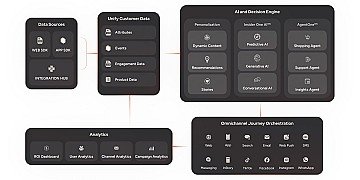
- Perceive: The agent ingests real-time signals (page views, cart changes, support tickets), retrieves context from unified profiles, and accesses precomputed predictive scores, such as purchase likelihood, churn risk, and discount affinity to make the perception phase immediately actionable.
- Plan: Given a goal and constraints (discount caps, channel quiet hours), the agent selects a sequence of actions
- Act: The agent calls tools (email application programming interface [API], push notification service, recommendation engine) to execute the plan
- Learn: Outcomes feed back into the loop; the agent updates its policy for future decisions
Here’s how it plays out: A returning visitor lands on a product page. The agent retrieves their browse and purchase history, plans a cross-sell sequence (on-site banner, then email, then WhatsApp reminder), executes each step, and adjusts timing based on opens and clicks.
What data foundation does agentic personalization require?
Agents can only act on what they can see. Most customer data platform (CDP) pipelines refresh overnight, which means the agent is making decisions on stale data.
What agentic systems require:
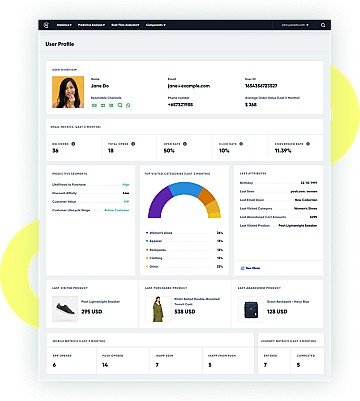
- Unified customer profile: Identity resolution across devices and channels, updated in real time
- Event stream: Near-real-time ingestion of behavioral signals (clicks, scrolls, cart changes)
- Session context: Current page, referral source, time on site, and any in-session signals
- Predictive attributes at query time: Precomputed scores, such as predicted lifetime value, purchase likelihood, churn risk, and discount affinity, available instantly so the agent doesn’t need to run models mid-decision. Insider One’s Sirius AI™ computes these attributes in real time as part of the unified customer profile.
If your CDP updates profiles in batch on a delayed cadence, the agent’s perception phase is delayed, and actions arrive after the moment has passed. Want a practical example of the data layer and decision loop? Start with the product demo hub and see how real-time profiles and event streams are put to work.
What guardrails should you set for multi-agent orchestration?
Autonomous systems that send the wrong message, offer unauthorized discounts, or violate brand guidelines create liability and erode trust.
- Policy constraints: Rules the agent cannot violate (discount caps, quiet hours, no messaging to users who opted out)
- Content constraints: Approved copy, images, and tone; the agent selects from a library rather than generating net-new content without review
- Action constraints: Caps on frequency (limits on messages per user), channel priorities, and escalation triggers
| Autonomy tier | Human involvement | Examples |
| Full autonomy | None — agent executes | Product recommendations, send-time optimization |
| Supervised autonomy | Human reviews before send | Discount offers, win-back campaigns |
| Human-in-the-loop | Human approval required | Account changes, refund processing |
How do you implement agentic personalization?
Implementation guides for personalization often start with “define your personas.” Agentic systems start with goals and constraints, not segments.
- Define the goal: Specify the outcome the agent should optimize (convert trial users within a defined window, recover abandoned carts quickly)
- Map the context: Identify the signals the agent needs to perceive and ensure they’re available in real time
- Select the tools: List the APIs and systems the agent can call (email, push, short message service [SMS], recommendation engine, content management system [CMS])
- Set policy constraints: Document rules the agent cannot violate (discount caps, frequency limits, opt-out compliance)
- Design the orchestration layer: Configure how the agent plans sequences, handles branching, and escalates to humans
- Establish evaluation criteria: Define success metrics (incrementality, guardrail compliance, customer satisfaction [CSAT]) and holdout methodology
- Iterate: Run small-scale pilots, review agent decisions, and refine policies before scaling
Skipping the policy-constraints step leads to agents that optimize for short-term conversions at the expense of brand trust or margin. If you want help evaluating goals, constraints, and escalation tiers against your stack, book a demo and we’ll map a pilot that avoids extra engineering work.
Where does agentic personalization create value across industries?
The agent loop sounds abstract until you see it applied to a real workflow.
Retail / Ecommerce: The agent sends a browse-abandonment email within 30 minutes, a push notification 4 hours later with related products, and a WhatsApp reminder the next day with a time-limited discount if no conversion.
Brands using Insider One’s agent-powered journeys have seen measurable results: one retailer reported a 22% increase in average order value and a 17% reduction in cart abandonment after deploying Agent One™
Financial services: The agent sends an email with a ‘save progress’ link within 1 hour, an app inbox message with benefit highlights the next morning, and an SMS reminder 48 hours later.
Travel: The agent sends a web push with a price-drop alert within 2 hours, an email with a destination guide the next day, and a dynamic homepage banner with ‘resume search’ on the user’s next visit.
How does agentic search improve product discovery?
Traditional personalized search often re-ranks results based on past behavior. Agentic search guides the user toward a goal, refining queries and surfacing bundles proactively.
- Query rewriting: The agent interprets vague queries and suggests refinements (“running shoes” becomes “trail running shoes for wet conditions”)
- Proactive bundles: The agent surfaces complementary products before the user searches for them
- Session-based adaptation: The agent adjusts results mid-session based on clicks and dwell time
Before: User searches “laptop,” sees ranked results, clicks, bounces, searches again.
After: User searches “laptop,” agent asks clarifying question (work or gaming?), narrows results, surfaces accessories, and persists context to next visit.
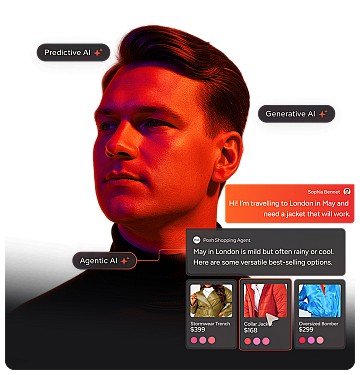
Insider One’s Shopping Agent, built on its Eureka AI-powered search engine, does exactly this — interpreting intent, guiding users through conversational queries, surfacing bundles, and persisting context across sessions.
How does autonomous journey orchestration work?
Many journey builders require marketers to define every branch upfront. The journey can’t adapt to signals that weren’t anticipated.
- Goal-driven planning: The agent receives a goal (convert trial user within a defined window) and plans a sequence dynamically
- Live-signal branching: The agent adjusts the path based on real-time signals (if user opens email but doesn’t click, switch to push notification with different content)
- Cross-channel execution: The agent selects the next-best-channel per user, not per segment
This shifts measurement from open rates to incremental conversions. To see how live-signal branching works in practice (and what it takes to launch without rebuilding your stack), explore the product demo hub.
How do agentic assistants handle shopping and support?
Many chatbots answer questions rather than complete transactions. Many chatbot deployments still hand off transactions, refunds, and account updates to a human.
- Intent detection: The agent understands the user’s goal from natural language
- Tool execution: The agent calls backend systems (order management, payment gateway) to complete the action
- Multi-step resolution: The agent handles authentication, retrieves order details, initiates the return, and confirms completion in a single conversation
Example: A user says “I want to return the shoes I bought last week.” The agent retrieves the order, verifies the return window, initiates the return label, and confirms the refund timeline. No human handoff required.
Insider One’s Support Agent handles exactly these workflows, connecting to CDP, CRM, and order management systems to resolve issues autonomously while applying consent-driven action logic and escalating to humans when confidence is low.
Agentic assistants require approval tiers for sensitive actions. Refunds above a threshold, for instance, require human review.
How to measure agentic personalization.
Measuring agentic personalization by engagement metrics (opens, clicks) misses the point. The agent optimizes for outcomes, not proxies.
- Offline evaluation: Before deployment, test agent decisions against historical data to estimate lift
- Online A/B with holdouts: Compare agent-driven experiences to a control group receiving baseline personalization (not no personalization)
- Incrementality measurement: Isolate the causal effect of agent actions by holding out a random subset of users