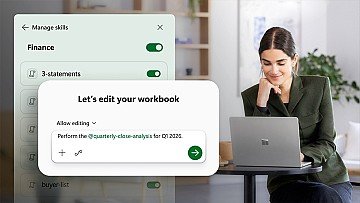
Today we’re bringing skills to Copilot for Excel, giving teams a new way to scale their expertise across every workbook. Read more: https://lnkd.in/gVZFdCiN
Microsoft isn't just releasing software; they are redesigning the organizational behavior of the entire enterprise finance sector. This is a textbook case of structural containment replacing unconstrained generality. We are seeing the architecture I discussed in Partner Center manifest at the product layer. Restructuring Architecture for Intelligent Systems: Partner Center Update https://lnkd.in/g2d4w2hc 🛠️ The SKILL.md File: Instead of relying on open-ended prompt engineering, users and partners define workflows via a structured markdown file. This is a literal boundary condition that forces the LLM into a repeatable, low-entropy execution path. 🔌 Deterministic Financial Connectors: By plumbing in specialized, API-driven access points (FactSet, PitchBook, S&P Global), Microsoft ensures the model does not hallucinate. It operates strictly at the interface of verified data. 🚀 Partner-Built Skills via Marketplace: Independent partners aren't selling generalized consulting seats. They're shipping specialized, modular "skills" designed for elite domain execution. This solves the Inference COGS crisis - build rigid, specialized protocols using the Inverse Conway Maneuver that deliver an absolute Outcome-as-a-Service.
Satya Nadella The hidden bottleneck in most enterprise finance teams isn't access to data—it’s the reliance on a handful of Excel power users to interpret it. When complex financial workflows are locked inside individual expertise, an organization's decision velocity naturally slows down. Integrating these skills directly into Copilot shifts the dynamic from individual capability to institutional knowledge. It removes the technical friction between raw data and strategic interpretation. By accelerating the time it takes to model and analyze scenarios, leadership teams can significantly compress their decision-making cycles. That shift from manual data manipulation to pure analysis is where true operational leverage is created.
The big shift is that expertise is starting to move from individual files and workflows into systems everyone can actually use. That changes careers too, because the people who understand the work and know how to use AI to scale it will have a real advantage over people who only know one side. Applyall.co is worth checking out for anyone trying to position themselves better as these tools become part of everyday work. The opportunity is not just learning AI, it is knowing where it can remove friction without removing judgment.
The real impact of Copilot skills is standardization of quality. Teams can scale how work is done, not just how fast it is completed.
The real value here is not just automation, but knowledge scaling. If Copilot can help teams apply consistent expertise across Excel workbooks, it could change how organizations handle analysis, reporting, and decision-making at scale.
Satya Nadella Interesting — the right door for AI to enter finance turned out to be Excel. Because finance professionals have always trusted it. By bringing Copilot there, earning that trust becomes so much easier. A well-thought-out move. 🎯
Reusable skills across every workbook is a genuine productivity unlock — most teams rebuild the same analysis logic over and over. Good direction. The toggle is the part worth watching though. A skill switched on once and then available across every future workbook — including ones marked confidential — is convenient, but it's also a standing permission rather than a per-action one. Usefulness was never the open question; the open question is whether each execution gets re-checked against the workbook it's actually touching, or whether "on" at upload time is treated as "on" forever after. Scaling expertise across workbooks is the easy part. Scaling the re-authorization that should travel with it is the part nobody demos.
Now imagine Excel with Skills connected to live, consolidated, governed financial data. It stops being a spreadsheet. It becomes the interface to a Finance Operating System (FinanceOS) - and the command center for the entire finance function.
Bringing skills into Excel is the right surface, because expertise compounds where the work already happens. But Excel is uniquely unforgiving for probabilistic output. A wrong formula does not crash, it returns a confident number that flows straight into a decision before anyone questions it. So the hard part is not generating the analysis, it is trusting it. As agents start writing into the workbook, the scarce layer becomes verification, knowing the output holds up, not just that it was produced fast. Does the trusted number become the real product here, not the generated one?
To view or add a comment, sign in