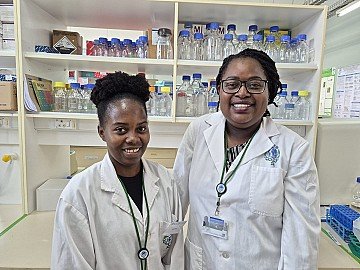
2026 has seen ICGEB Cape Town welcoming two new Fellows as part of the second cohort for the year of the ICGEB South African Women in Biotechnology (SAWBP) Programme, in partnership with the South African Department of Science, Technology and Innovation and the South African National Research Foundation.
Congratulating this cohort of SAWBP Fellows, we hear about their current research:
Dr Melissa Blumehtnal, born in Cape Town, re-joins the ICGEB Cape Town Virology – Emerging Viruses Group for her second Postdoctoral fellowship under the mentorship of Dr Georgia Schäfer.
Melissa is interested in the interplay between viral pathogenesis and cancer development as a point in which one can intervene to prevent certain cancers, mostly focusing on KSHV that causes Kaposi’s Sarcoma in some patients.
As part of her SAWBP fellowship, Dr Blumenthal is working on a project to establish a new sequencing platform (Oxford Nanopore Technology) for KSHV genotyping that is more clinically accessible.
When asked about the importance of this fellowship, she added:
It is a privilege to be supported by the SAWBP Fellowship, which not only recognises the importance of our research but also empowers South African women in biotechnology to contribute meaningfully to global science. As a South African woman scientist, I see this as an investment not only in my work but in the visibility and advancement of women in STEM across the country.
ICGEB, as an international organisation, offers a unique environment where diverse perspectives and expertise converge. Its commitment to training, collaboration, and inclusivity makes it an invaluable platform for researchers from all backgrounds. I am proud to be part of a programme that highlights the contributions of women scientists and helps open doors for future generations.
Rudzani Makhado, born in Khubvi Tshiseluselu in the Limpopo province, South Africa, joins ICGEB from the University of Venda where she recently completed her MSc in Biochemistry focusing on plant metabolomics.
Joining the Plant Systems Biology Group under the mentorship of Dr Lara Donaldson, Rudzani’s research interests are centred around plant-microbe interactions, particularly the role that microbial communities play in shaping plant biology. She is particularly interested in understanding how the bacterial microbiome of crop plants influences their growth, resilience, and metabolism.
During her doctoral journey, Rudzani’s work will explore the bacterial communities in the rhizosphere of sorghum, a crop that is used extensively in both food production and animal feed. Known for its resilience, it is also ranked among the world’s top five cereal grains. Rudzani aims to uncover bacterial strains with strong plant growth-promoting properties, with the goal of developing them into biofertilisers that could offer a more sustainable approach to boosting sorghum yields in the field.
“I am very honoured and grateful to be a recipient of the SAWBP fellowship. The opportunity to pursue my PhD at ICGEB is meaningful to me because of my previous experience here as a Junior Fellow. My time at ICGEB previously gave me a strong appreciation for the collaborative and international nature of the organisation. Being surrounded by researchers from different countries and scientific backgrounds exposed me to new perspectives and ways of approaching scientific problems.”
Both fellows are ICGEB Alumni. Rudzani was an HDI Fellow, and Melissa completed her National Research Foundation Professional Development Programme Postdoc Fellowship at the Component. The return of these researchers, now part of the SAWBP demonstrates the strength of ICGEB’s capacity development pipeline and the long-term impact of these opportunities in supporting the progression of young South African women scientists.
The new SAWBP Call for Doctoral fellows is currently open, with a closing date of 20 October 2026.