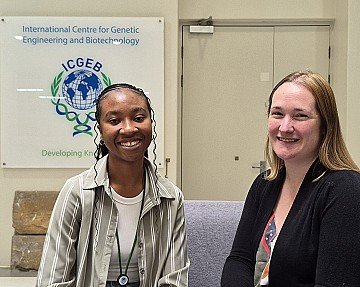
Dr. Paulo Teixeira and his team
A closer look at one of the projects awarded the title of best ICGEB CRP grant in 2025.
Since 2020, ICGEB has been recognising the top-quality science carried out in Member States and funded by the CRP-ICGEB Research Grants Programme. Dr. Paulo Teixeira’s project “Mining the soybean leaf microbiome for disease-suppressive microbes” was selected by an international committee as one of the three best grants concluded in 2025.
I am truly honoured by this recognition, which is an important incentive for me and especially for the students and postdocs who have been working on this project over the past years. I am thankful to ICGEB for the support, which has been key in my establishment as an independent Group Leader in Brazil.
We spoke to Dr. Teixeira, who now heads the Plant Genetics and Immunology Lab at the University of São Paulo, about his work on interactions between plants and microorganisms, a topic of great relevance to his home country.
How did you become interested in plant genetics?
I have been drawn to genetics since I was a child: the Human Genome Project and the idea that we could read the genetic code fascinated me. In the early 2000s, Brazil sequenced its first genome; shortly after, I became interested in Witch’s Broom disease, which was devastating the cocoa and chocolate industry, and joined the Genome Project under Prof. Gonçalo Pereira. During my PhD in his lab at UniCamp, I became even more invested in plant diseases and molecular plant-microbe interactions. For my Postdoc, I wanted to understand how plants recognise pathogens and distinguish them from beneficial microbes, which I worked on at the University of North Carolina. I then returned to Brazil to establish my own lab at the University of São Paulo to apply these fundamental discoveries to the agricultural system in Brazil. I found that the crop most relevant to me was the soybean, which gives plenty of possibilities to translate discoveries into immunity and into solutions for agriculture.
How did you come into contact with ICGEB?
The ICGEB early-career CRP grant call, referred to me by a colleague, came at exactly the right moment to help jump-start my own lab. The project I proposed was new to me too, as it was the first time I worked on soybean. The grant was one of the first sources of funding I received for the lab, covering fellowships, basic reagents, and equipment, allowing my team to perform field experiments – so I would say it was quite a turning point at the time.
Tell us about the soybean project.
Much like the human body, plants are naturally colonised by diverse microorganisms (making up the plant microbiome), some of these are beneficial to their health and others are detrimental. For decades, plant pathology focused almost entirely on the plant and the pathogen as key players – we were interested in including the plant’s microbiome as the third protagonist. We wanted to understand what happens to the plant’s microbiome when the plant is infected by a pathogen.
The plant’s immune system targets the pathogen, but can unintentionally affect the rest of the plant’s microbiome (collateral damage). We aimed to find protective microbes that would help the plant defend itself against pathogens and disease.
We built the “soybiome” – a large culture collection of bacteria which we isolated from the soybean, and searched it for disease-protective bacteria. The significant promise this approach offers is the design of microbial-based strategies to protect plants against diseases, heat, scarcity of water, or high salinity, replacing the currently adopted chemical approach to agriculture. The coming challenge will be to understand the bacteria’s molecular mechanisms and how they can interact with the pathogen to protect the soybean plant.