Summary
- Next-best-channel marketing fails when it starts as a list of supported channels instead of a ranked decision tree
- A four-layer Signal-to-Send model resolves identity, intent, priority, and proof before a message ever sends
- Rules-based waterfalls beat machine learning for small channel lists; next-best-channel algorithms earn their complexity at high send volume
- Priority matrices and frequency caps stop the same customer from getting three competing messages in one morning
- Holdout testing proves whether a channel choice created incremental lift or simply reallocated demand that would have converted anyway
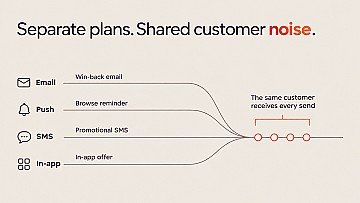
Email, SMS, push, WhatsApp, and on-site messaging often run from five different tools that rarely compare notes, and the result is three messages landing on the same customer within the hour. Next-best-channel marketing is the practice of deciding, in real time, which channel gives a specific customer the highest chance of engaging with a specific message, based on signals like recency and intent strength rather than a static list of what your platform happens to support.
This article is for lifecycle, customer relationship management (CRM), and marketing operations managers running multi-channel campaigns who need a repeatable way to rank signals and resolve conflicts between simultaneous triggers, with clear requirements for reliable customer data, consent and opt-in handling, channel eligibility, and measurement design.
You’ll get a four-layer Signal-to-Send model: identity resolution, intent signal ranking, priority and frequency rules, and incrementality proof. Each layer solves a different failure mode, and together they replace guesswork with a decision tree you can audit and defend.
Build a signal hierarchy before you pick a channel
A next-best-channel decision is only as good as the unified customer profile behind it, built from reliable attributes, behavioral events, and relevant product data. Unify every email click, SMS reply, app session, and on-site browse into one customer record before ranking anything, because without that step the same shopper looks like five strangers and your model ends up ranking noise instead of intent.
This is what a unified data layer, sometimes called a customer data platform (CDP), is built to solve: one customer record every channel reads from and writes to in real time. Once identity is unified, rank incoming signals by recency and intent strength rather than by channel or campaign source, and let the stronger signal win even when a weaker one arrived more recently.
- Identity resolution: merge device IDs, emails, and phone numbers into one profile before any ranking happens
- Recency weighting: signals from the last hour outrank signals from the last week by default
- Intent strength scoring: transactional actions like cart adds or price-drop views outrank passive actions like article reads
- Conflict resolution: when two signals compete, the higher-intent signal determines the channel, not the one received first
Insider One’s Platform brings unified customer profiles, audience segmentation, cross-channel personalization, journey orchestration, and analytics together so teams can turn shared data into coordinated delivery and measurement.
Rules-based waterfalls vs artificial intelligence (AI)-driven next-best-channel models
A simple rules-based waterfall, try email, then push, then SMS, still outperforms a machine learning model when you have a handful of channels and predictable response patterns, because there’s nothing for added complexity to optimize against. Complexity should follow volume, not precede it.
When a waterfall is enough
If your brand sends to a few segments across two or three channels with stable response rates, an ordered list of fallback channels resolves most conflicts on its own. Forcing a model onto that volume adds maintenance overhead without measurable gains in engagement.
Where next-best-channel algorithms earn their complexity
More advanced next-best-channel approaches become useful once a brand runs high send volumes across many competing offers and channels at the same time, provided teams have reliable event data, clear eligibility rules, and an experiment design to evaluate outcomes. Insider One supports AI-powered personalization alongside audience segmentation and cross-channel journeys, helping teams use unified customer data and behavioral signals to tailor engagement without relying on disconnected channel tools.
Teams can configure delivery across web push, app, email, SMS, and WhatsApp according to each channel’s setup, customer permissions, journey eligibility, and the business rules for the moment.
Set priority and frequency rules to avoid channel collisions
A priority matrix prevents the most common operational failure in multi-channel campaigns: three messages landing in the same inbox-adjacent moment because no single system owns the final call. Rank message types by commercial intent within consent, customer-preference, legal, and suppression constraints, so eligible service and live-cart sends can take precedence over generic nurture content.
Frequency caps close the remaining gap. Without a shared cap, a customer service alert, a flash-sale push, and a browse-abandonment email can all fire within the same hour, each unaware the others exist. ACE Hardware illustrates why teams should review relevant success stories alongside their own data, eligibility rules, and experiment results before expanding app push programs.
- Eligible service and transactional messages can outrank promotional sends when consent, preferences, suppression rules, and business priorities allow
- Sales messages tied to a live cart or time-bound offer outrank generic nurture or newsletter content
- Frequency caps limit each customer to one message per channel within a defined window, typically per day
- A single orchestration layer can coordinate channel eligibility and frequency rules across configured journeys, rather than leaving each channel to operate in isolation
This is where customer journey orchestration earns its name: one system resolving conflicts, not five systems hoping they don’t collide.
Match channel to moment, not just to audience
Channel speed has to match message urgency, and a scheduled email batch is the wrong tool for anything time-sensitive. A delivery delay, a payment failure, or a cart about to expire needs a channel that reaches the customer within minutes, not the next scheduled send window.
Match speed to urgency
Push and SMS resolve urgent, transactional moments because delivery and open times are near-immediate. Email still suits considered purchases, longer content, and messages where a delay of hours doesn’t cost the brand the moment. Matching urgency to channel speed, rather than defaulting to whichever channel is cheapest to send, keeps the model focused on outcomes instead of convenience.
Weigh cost-to-serve against expected value
Not every channel costs the same to run, and the more expensive ones should be reserved for customers where the expected value justifies it. WhatsApp conversations, for example, can suit high-intent, otherwise-unresponsive customers when the customer has the appropriate opt-in and the use case meets channel and regional requirements. Renault is a useful success-story reference for teams evaluating how to reserve WhatsApp for relevant high-intent moments rather than broadcasting it to every segment.
Test and prove channel decisions with incrementality, not vanity metrics
A next-best-channel decision only matters if it creates demand that wouldn’t have converted anyway, and the only reliable way to confirm that is a holdout group. Hold back a portion of eligible customers from the “optimal” channel assignment and compare their conversion rate against the group that received it.
If the holdout group converts nearly as well without the intervention, the channel choice reallocated existing demand rather than creating incremental value, and the model needs adjusting. Samsung is a useful success-story reference for teams that want to validate channel choices against conversion lift rather than relying on opens or clicks alone.
Feed every test result back into the signal hierarchy and priority rules. A next-best-channel system that doesn’t learn from its own holdout data is just a rules engine wearing a more expensive label, and the improvement loop is what separates a framework that compounds from one that stays static.
Conclusion
Next-best-channel marketing works when it’s built as a decision tree, not a channel inventory. Unify identity, rank signals by intent, enforce priority and frequency rules, and prove every decision against a holdout group. Brands that skip straight to “which channels do we support” end up automating collisions instead of preventing them, and the fix is structural, not another integration.
To evaluate Insider One for your use case, book a personalized demo to review your goals, data requirements, channel setup, consent considerations, and implementation constraints with the Insider One team.
Frequently Asked Questions
What is next-best-channel marketing?
It’s a decision model that selects an eligible channel, such as email, SMS, push, WhatsApp, or on-site messaging, using unified customer data, intent signals, consent, channel availability, and business-priority rules rather than a fixed list of supported channels.
How is next-best-channel different from next-best-action marketing?
Next-best-channel marketing answers where to send a message; next-best-action marketing answers what to send. They work together: the action layer decides the offer or content, and the channel layer decides the best route to deliver it based on engagement probability.
Do I need machine learning to run next-best-channel decisions?
Not always. A rules-based waterfall handles a few channels and stable response patterns well. More advanced approaches can become worthwhile at high send volumes across competing offers, where teams have reliable data and can test whether added decisioning complexity improves outcomes.
How do frequency caps work across channels?
A shared cap sets limits for eligible messages within a defined window, usually per day, using coordinated journey rules that account for channel availability, consent, preferences, and suppression requirements. This prevents a service alert, a sales push, and a nurture email from all landing in the same hour.
How do you measure incrementality for a next-best-channel decision?
Hold back a portion of eligible customers from the channel assignment and compare their conversion rate against the group that received it. If both groups convert similarly, the channel choice reallocated existing demand instead of creating new conversions, and the model needs retuning.