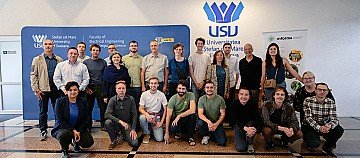
On March 11, Juan Antonio Herráez from the Instituto del Patrimonio Cultural de España and Ángel Perles, a researcher at the ITACA Institute of the Polytechnic University of Valencia, carried out maintenance and updates on the monitoring system installed at the Royal Monastery of Santa María de El Paular in Rascafría (Madrid).
This work are part of a preventive conservation strategy that leverages advanced systems to safeguard artistic, archaeological, and architectural heritage in various cultural settings. This initiative falls within the framework of the WiMOSA project (Wireless Non-Stop Monitoring System for Heritage Safeguard).
«WiMOSA aims to integrate IoT technologies with preventive conservation expertise to enhance the environmental monitoring of heritage objects and sites. The Royal Monastery of Santa María de El Paular provides an ideal setting to assess the effectiveness of these solutions”, say the researchers.
Actions of the WiMOSA project
Funded by the Ministry of Science and Innovation, the project is implemented in several culturally significant sites, such as the Valencian Institute of Modern Art (IVAM), the Museum of America in Madrid and the set of Neolithic cave paintings of El Abrigo de Los Toros del Prado del Navazo, in Albarracín (Teruel).
As part of the project, new wireless sensors were installed last year in Los Pinares de Rodeno, providing enhanced environmental data for the area.
«By reconnecting sensors via the Internet, real-time alerts are generated in response to risk events. This enables automated responses in high-value heritage areas, such as the cave paintings in Albarracín,» explained Ángel Perles Ivars, project coordinator.
For these reasons, the ITACA-UPV researcher emphasizes that leveraging technology for heritage conservation remains a key challenge in the cultural sector.
«Initiatives like WiMOSA demonstrate how innovation can serve as an essential ally in preserving the historical and artistic wealth of our country,» concluded the ITACA researcher.