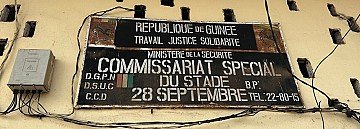
16 years to the day after the bloody repression of protesters gathered at Conakry stadium, on 28 September, 2025, the FIDH, OGDH, and AVIPA held a press conference in Conakry to commemorate the victims of the 2009 massacre. While historic judicial progress has been made, the presidential pardon granted to Moussa Dadis Camara and the shortcomings in the compensation process seriously threaten the rights of the victims, against the backdrop of a severe decline in the rule of law in Guinea. The organisations are calling on Guinean authorities to continue the trial in accordance with international rules and standards so that the victims can finally obtain justice, truth, recognition of their status, and reparation.
Conakry, Paris, 28 September 2025. On 28 September 2009, more than 150 people were killed and over 100 women were subjected to sexual violence during the repression of a peaceful protest in Conakry. After thirteen years of waiting, a historic trial began on 28 September 2022, and in July 2024, eight defendants — including Moussa Dadis Camara, former president and head of the National Council for Democracy and Development (CNDD), the ruling junta at the time - were convicted of crimes against humanity.
Barely eight months after this initial victory, the victims’ hopes were brutally shaken. The presidential decree of 26 March 2025, announcing their compensation, revealed deep flaws in its implementation - a limited list of beneficiaries, an opaque and unfair process - all of which caused frustration and tensions among the victims. Even worse, on 28 March 2025, General Mamadi Doumbouya granted a presidential pardon to Moussa Dadis Camara, while all parties were still awaiting the scheduling of the appeal trial. Since then, Moussa Dadis Camara has left the country, and this decision has severely undermined the credibility of the judicial process.
“The pardon granted to Dadis Camara sends a troubling message of impunity. Yet, the judicial process is still ongoing, and the Guinean population deserves to see it through to the end. For this trial to truly represent the fight against impunity, no one must stand in the way of uncovering the truth,” said Me Alpha Amadou DS Bah, president of OGDH and coordinating lawyer of the collective representing the civil parties.
“We commend the courage of the victims, who continue to fight despite threats and political maneuvering. Despite these unbearable 16 years of waiting, they still want to believe in the Guinean justice system and its ability to see this pursuit of justice through. The international community must remain vigilant to ensure that the rights to truth, justice, and reparation are upheld for all victims, in a fair and transparent manner,” added Asmaou Diallo, president of AVIPA.
The September 28 trial represents, far beyond Guinea, a major turning point in the cooperation between national and international jurisdictions. It serves as a concrete illustration of the principle of complementarity enshrined in the Rome Statute, highlighting the ability and willingness of national courts to prosecute the most serious crimes, with the support of the international community and the International Criminal Court (ICC).
“The September 28 massacre is a crime against humanity. We call on the Guinean authorities to uphold their regional and international obligations, and on Guinea’s key partners to remain engaged. If this pursuit of justice were to end here, it would send a terrible message to civilian populations in Africa and around the world, signaling yet another failure of international justice. In the name of the principle of complementarity, we call on the International Criminal Court to remain committed alongside Guinean justice,” emphasised Mabassa Fall, FIDH representative to the African Union.
Since 2022, the National Committee for Rally and Development (CNRD), the ruling military junta, has multiplied violations of fundamental rights: systematic bans on protests, arbitrary arrests, enforced disappearances, and the shutdown of media outlets deemed critical. The disappearance of Oumar Sylla, known as Foniké Menguè, and Mamadou Billo Bah in July 2024 remains an open wound, and a symbol of the repression targeting dissenting voices.
The constitutional referendum held on 21 September marked a decisive step in the political transition process. However, it was undermined by the lack of dialogue between the transitional authorities and the main political parties, as well as the suspension of major parties such as the RPG Arc-en-ciel and the UFDG. On Friday, 26 September, the Supreme Court validated the results of the referendum, declaring a victory for the “Yes” vote with 89.38% of the ballots cast. In a presidential decree read on national television on the evening of September 27, the Guinean authorities announced that the presidential election is scheduled for 28 December 2025. Our organisations call on the authorities to restore the rule of law and to respect the legitimate right of the Guinean people to freely choose their representatives through regular, free, and transparent elections, in accordance with their regional and international commitments.