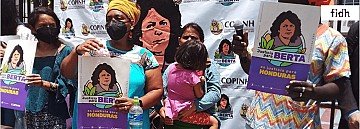
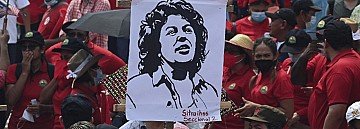
The murder of Berta Cáceres, Lenca indigenous leader and defender of land and the environment, on 2 March 2016 in Honduras, is one of the most emblematic cases of violence against human rights defenders in Latin America. 10 years later, thanks to the constant mobilisation of her family, of the Consejo cívico de Organizaciones Populares e Indígenas de Honduras (COPINH) and of numerous national and international human rights organisations, the case has made significant judicial progress. An emblematic case of joint mobilisation.
3 March 2026. Among the judicial progress: the criminal conviction of seven people as perpetrators of the murder and the conviction of the director of the DESA company as co-author of the crime. Similarly, the conviction for corruption in the concession of the Agua Zarca hydroelectric project, known as the "Gualcarque Fraud", has allowed progress to be made in the search for justice for other types of responsibilities linked to the imposition of extractive projects. However, not all those responsible for this crime have been brought to justice.
Since 2016, the International Federation for Human Rights (FIDH) and the World Organisation Against Torture (OMCT), within the framework of the Observatory for the Protection of Human Rights Defenders, together with their member organisations such as Colectivo de Abogados "José Alvear Restrepo" (CAJAR) in Colombia, Centro Para la Accion Legal en Derechos Humanos (CALDH) in Guatemala, the Centro de Investigación y Promoción de los Derechos Humanos (CIPRODEH) in Honduras and the Comité de Familiares de Detenidos Desaparecidos en Honduras (COFADEH), have been monitoring this case with the aim of ensuring truth, justice, reparation and guarantees of non-repetition.
2016–2017: Reporting and international visibility
Berta Isabel Cáceres Flores, a member of the Lenca people, co-founder and coordinator of the COPINH, was murdered on the night of Wednesday 2 March in La Esperanza, in the department of Intibucá, her hometown.
Berta Cáceres fought for the rights of the Lenca indigenous people to recover their lands in Río Blanco, Intibucá, in the face of the construction of the Agua Zarca hydroelectric dam by the company Desarrollos Energéticos S.A. (DESA) on Lenca lands.
In previous years, Berta had been the target of repeated threats, stigmatisation campaigns, criminalisation and surveillance processes due to her opposition to the project. As coordinator of COPINH, she publicly denounced irregularities in the concession and the presence of security forces in the area. Despite precautionary measures granted by the Inter-American Commission on Human Rights (IACHR), the State failed to provide effective protection.
Days before the murder, in February 2016, the Observatory had published a regional report on the criminalisation of human rights defenders in the context of natural resource extraction and megaprojects in Latin America. The report documented patterns of persecution, stigmatisation and misuse of the criminal justice system against those defending the territory and rights of indigenous peoples. Berta Cáceres’ situation was part of this regional pattern already noted.
National and international mobilisation to demand justice for the murder of Berta Cáceres began that same day, with public demonstrations of condemnation by the FIDH and its members. From the first months after the murder, organisations constantly highlighted the existence of worrying elements: the history of threats against Berta Cáceres, the conflict surrounding the Agua Zarca hydroelectric project and the lack of effective protection by the Honduran State, despite the precautionary measures granted by the IACHR.
The responsibilities of the financial actors involved in the Agua Zarca project were also highlighted, such as those of the Dutch Entrepreneurial Development Bank (FMO), which financed it. On 15 March 2016, several organisations signed an open letter addressed to the Dutch government urging the FMO to withdraw its funding from the project. The letter stressed that financial institutions could not claim ignorance of the context of threats and conflict, and that they must act in accordance with their human rights due diligence obligations.
Similarly, following a mission by the Observatory to Honduras from 11 to 15 April 2016, the widespread climate of violence, intimidation and stigmatisation faced by land and environmental defenders in Honduras was denounced, noting that the murder of Berta Cáceres was part of a broader pattern of attacks against those who questioned economic and extractive interests.
Unfortunately, Berta’s murder was just one of many cases of violence suffered by human rights defenders in Honduras. From May 2015 to December 2016, the Observatory documented 16 murders of human rights defenders, making Honduras one of the most dangerous countries for human rights defenders, as noted in its report published in December 2016: "Honduras: Human rights defenders between a rock and a hard place."
2018–2021: Support for the Qualified Observation Mission
The year 2018 would mark the beginning of the first trial against the perpetrators of the murder. Given the fragility of the Honduran judicial system, a Qualified Observation Mission for the Berta Cáceres case was formed for the Berta Cáceres case, comprising 19 national and international organisations with expertise in human rights, including the FIDH and the OMCT within the framework of the Observatory. Member organisations such as CAJAR in Colombia, CALDH in Guatemala and CIPRODEH in Honduras also formed part of the Mission.
The mission was able to participate in the direct observation of the hearings; document procedural irregularities, restrictions on the publicity of the trial and limitations on victims’ access to justice; and issue public statementsaddressed to the Honduran authorities, demanding respect for due process.
On 29 November 2018, the Sentencing Court found seven people guilty as perpetrators of the murder of Berta Cáceres and the attempted murder of Gustavo Castro. It was not until 2 December 2019, almost a year later, that the written sentence was issued, specifying the penalties and establishing sentences of between 30 and 50 years in prison.
Although these convictions represented an important step forward in the judicial process, it was noted from the outset that they did not exhaust the responsibilities arising from the crime, as the masterminds and possible broader planning structures had not been fully clarified, such as the role of the Atala Zablah family.
The issuance of the written sentence was significantly delayed after the oral ruling, raising concerns about the victims’ right to prompt and effective justice. This situation was publicly denouncedby the Qualified Observation Mission, which warned of the risks that such delays posed to access to justice.
In February 2020, the Qualified Observation Mission published a report entitled ‘Honduran justice in debt’, which systematised the observations of the trial and documented the structural weaknesses of the Honduran judicial system, including the lack of investigation into the masterminds behind the crime and the obstacles faced by the victims.
On 5 July 2021, the Sentencing Court issued a landmark decision, finding Roberto David Castillo Mejía, former manager of the DESA company, guilty as a co-perpetrator of the murder of Berta Cáceres. Subsequently, on 20 June 2022, the written sentence was issued, imposing a penalty of 22 years and 6 months in prison. The court decision recognised that the murder of Berta Cáceres was linked to the opposition led by her and COPINH to the Agua Zarca hydroelectric project, and that Castillo acted as the main coordinator of a broader structure for planning and coordinating the crime, which was carried out in retaliation for the opposition of Berta Cáceres and COPINH to the Agua Zarca project.
In the context of the trial against David Castillo, the Qualified Observation Mission continuouslymonitored the hearings, publishing periodic analyses on their progress and issuing public statements demanding a fair, independent and lawful ruling. This monitoring made it possible to document respect for procedural guarantees and maintain international attention on the case.
2021–2023: The Gualcarque Fraud
The "Gualcarque Fraud" refers to the fraud committed to ensure that the DESA company was the beneficiary of the Agua Zarca hydroelectric project concession on the Gualcarque River, in the ancestral territory of the Lenca people. The criminal proceedings initiated in 2019 were directed against former public officials accused of having fraudulently granted licences and permits without prior, free and informed consultation with the affected community.
As part of this process, the judges refused to recognise COPINH as a private prosecutor and direct victim, arguing that in corruption cases, the victim is exclusively the State. In response to this restrictive interpretation, the FIDH, together with its member organisations CAJAR (Colombia), CALDH (Guatemala) and CIPRODEH (Honduras), submitted an amicus curiae brief arguing that acts of corruption can violate not only public administration but also the human rights of individuals and groups. Victims must be able to participate in criminal proceedings that seek to establish responsibility for acts of corruption. In this case, administrative corruption was not abstract, but had concrete consequences for the Lenca people of Río Blanco, violating collective rights, including the right to territory, water and prior consultation in accordance with Convention 169 of the International Labour Organisation (ILO). The Lenca people would participate through their recognised organisation, COPINH.
On 31 August 2021, the Constitutional Chamber of the Supreme Court of Justice recognised the right of the Lenca people of Río Blanco, represented by COPINH, to be considered victims in the proceedings, setting an important precedent by affirming that crimes of corruption can directly affect the collective rights of indigenous communities and enabling their participation as victims in criminal proceedings.
Subsequently, the proceedings faced further delays and legal obstacles. On 15 November 2025, the sentences against three individuals linked to fraud in the Agua Zarca project concession were made public: the former manager of the DESA company, a former official of the Empresa Nacional de Energía Eléctrica (ENEE), and the former mayor of San Francisco de Ojuera. The convictions included prison sentences and disqualifications for crimes of fraud, falsification of public documents, and usurpation of functions.
2025: Formation and Report of the GIEI
In February 2025, with the agreement of the Honduran Government and the IACHR, the Interdisciplinary Group of Independent Experts (GIEI) Honduras was established with the mandate to conduct a technical analysis of the lines of investigation to determine criminal responsibility for related crimes and propose a comprehensive reparation plan for the victims. In January 2026, the GIEI’s Final Report confirmed that the murder was the result of an organised criminal operation, with corporate, financial and state responsibilities.
The report also provides a particularly relevant piece of information: clarification of the financial network linked to the Agua Zarca project. The GIEI documented the participation of international financial institutions in the financing of the project and detailed mechanisms for the diversion and use of resources that would have served to sustain the structure of surveillance, intimidation and crime planning. These findings allow us to understand the murder not only as an individual act, but as the result of an organised scheme in which business interests, state decisions and international financial flows converged.
For the Observatory, this GIEI report constitutes a technical and legal instrument of high probative value for the comprehensive clarification of the crime against Berta Cáceres. It adds to the statement by the Qualified Observation Mission that the Honduran State must fully implement the GIEI’s recommendations as an indispensable condition for guaranteeing truth, justice, reparation and non-repetition.
An emblematic case of joint mobilisation
For the past 10 years, the Observatory, together with national organisations in the Americas, has stood in solidarity with and accompanied the global mobilisation demanding justice for the crimes committed against Berta Cáceres, and calls on the Honduran authorities to move forward in clarifying all responsibilities, including those of businesses, financial institutions and the state.
Almost a decade after the crime, the Observatory reaffirms that justice for Berta Cáceres is inseparable from justice for indigenous peoples and for all human rights defenders.
In this regard, it reiterates the need to:
– reopen and deepen the investigations in light of the GIEI report, moving towards the identification and prosecution of all intellectual and financial perpetrators, including corporate and state responsibilities;
– fully implement the GIEI’s recommendations;
– guarantee comprehensive reparation for the Lenca people, including the restitution of their territorial rights and collective reparation measures;
– investigate the role of financial actors and failures in due diligence mechanisms; and
– adopt structural guarantees of non-repetition to protect human rights defenders in Honduras.