Email marketing has entered a new era, and the platforms built for the last one are showing their limits. Subscribers expect timely, relevant, personalised messages, and delivering that at scale requires more than a smarter ESP. It requires AI that runs across every touchpoint: email, SMS, WhatsApp, web, and app, all sharing the same data, the same logic, and the same view of each customer. That’s the shift driving AI adoption in email marketing in 2026, and the gap between platforms that were built this way and platforms that weren’t is widening fast.
The AI-enabled email marketing market is projected to reach $6.74 billion by 2030, growing at a 25.4% CAGR . This rapid growth highlights the increasing reliance on AI for real-time insights, automated optimization, and smarter audience targeting.
Marketers who adopt AI-driven email tools gain the agility and insight needed to stay ahead in a crowded inbox. With AI, campaigns can adapt dynamically, send the right message to the right subscriber at the right time, and turn raw data into actionable insights that drive measurable results.
The growing importance of AI in email marketing
The role of AI-powered email marketing has moved far beyond buzz; it’s now a core part of how brands engage subscribers and drive results. Rapidly evolving consumer expectations and the complexity of modern marketing technology stacks are pushing marketers to adopt smarter tools that deliver personalized experiences at scale.
In simple terms, AI in email marketing uses machine learning and automation to analyze data, predict patterns, and optimize campaigns, from segmentation and personalization to send-time optimization and performance analysis. These capabilities help teams deliver the right message to the right audience at the right moment, without manual intervention.
Consumers increasingly expect personalization: 71% of people now say they want tailored interactions from brands, and many become frustrated when emails feel generic or irrelevant. This shift in expectation is a major driver behind AI adoption in email marketing platforms.
At the same time, demand for AI‑enabled email marketing solutions is projected to grow as more businesses embrace AI‑driven insights and automation.
Why AI adoption is accelerating
AI tools are being adopted for several core reasons that directly impact campaign performance:
- Personalization at scale — AI analyzes individual behaviors and preferences to tailor email content down to the recipient level.
- Time‑saving automation — Tasks like segmentation, content generation, and campaign optimization that once took hours can now be completed in a fraction of the time.
- Predictive analytics — Machine learning models forecast user behavior, optimize timing, and improve relevance without manual guesswork.
- Cross‑channel integration — Modern platforms link email data with CRM, ecommerce, and advertising systems for unified reporting and consistent experiences.
- Unified architecture advantage — Platforms built as a single AI-native system, where email, SMS, web, and app share one CDP and one orchestration engine, outperform stacks assembled from separate tools, because every message is informed by everything a customer has done everywhere, not just in email
Here’s a quick summary of these benefits:
| Core Benefit | What It Enables |
| Personalization at Scale | Tailor content and offers to individual subscribers |
| Automation Efficiency | Reduce manual work across segmentation, scheduling, and optimization |
| Predictive Insights | Anticipate behavior and optimize campaigns proactively |
| Seamless Integration | Unified data and reporting across channels |
| Unified Architecture | Enhanced learning and 1:1 personalization |
These capabilities help marketers keep up with customer expectations and improve open rates, engagement, and conversions, results that traditional email tools often find difficult to match at scale.
How AI enhances personalization and customer engagement
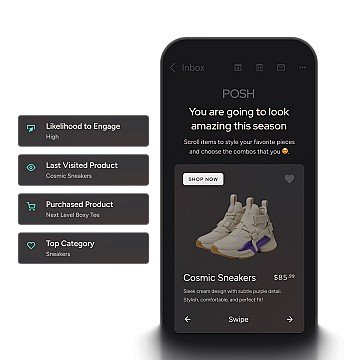
AI‑powered email marketing does much more than insert a name at the top of a message. At its core, AI‑powered personalization uses machine learning and real‑time data to tailor content, offers, and recommendations specifically to each subscriber’s behavior, preferences, and purchase history, then deliver them automatically once the workflows are set up.
This isn’t just smart; it aligns with what customers actually want. 71% of consumers expect personalized interactions, and 76% express frustration when experiences aren’t tailored to them, a clear signal that relevance has become table stakes in digital engagement.
Personalization, strengthened with Sirius AI™, Smart Recommender, AMP
Traditional vs. AI‑powered personalization
Here’s a quick contrast between old‑school tactics and AI‑driven experiences:
| Personalization type | How it works | Typical impact |
| Static/rule‑based | Same content for broad segments | Limited relevance, slower optimization |
| AI‑powered dynamic | Content adapts per individual in real time | Higher engagement, better conversions |
Traditional methods rely on broad segments and manual rules (“send offer A to group X”), while AI tools can tailor content in real time to each user’s profile and behavior, a much deeper level of relevance.
Platforms with advanced segmentation and journey orchestration use predictive insights to determine not just who should receive a message, but what that message should contain for each recipient.
This level of AI personalization directly supports stronger customer engagement, deeper loyalty, and better overall campaign performance, because messages feel relevant, timely, and tailored to individual needs.
What AI‑powered automation means in email marketing
AI‑powered automation refers to systems that use machine learning and data signals to trigger email actions, such as sending a message when a user abandons a cart or visits certain pages, without needing manual setup for each user. This includes:
- Automated triggers: Real-time, behavior-based emails sent when users take or do not take specific actions, such as abandoning a cart, making a first purchase, or becoming inactive. This ensures timely and highly relevant communication.
- Drip campaigns: Pre-defined, multi-step sequences that nurture subscribers over time. These campaigns adapt based on engagement such as opens, clicks, and conversions, guiding users from awareness to purchase.
- Smart workflows: End-to-end, AI-powered journeys that continuously evaluate user behavior to determine the next best message, channel, and timing, removing the need for manual campaign planning.
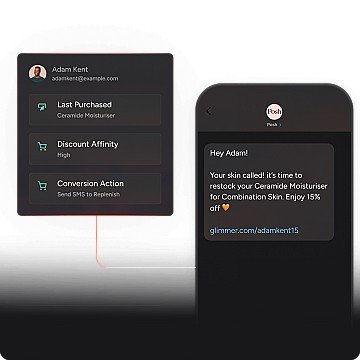
- Replenishment campaigns: For consumable products like skincare, supplements, coffee, and pet food, emails are triggered based on predicted usage cycles. Customers receive reminders when they are likely running low, often with AMP-powered one-click reorder functionality.
- VIP tier escalation: Automatically detects when a customer crosses a lifetime spend threshold and triggers a personalized email acknowledging their VIP status, unlocking perks like exclusive offers or early access, strengthening loyalty at a key moment.
- Win-back campaigns: Instead of waiting for full inactivity, churn prediction identifies early disengagement signals and launches adaptive win-back journeys. Messaging evolves based on user response, with escalation to other channels if needed.
- Post-purchase cross-sell: After a purchase, the system tracks browsing behavior and sends timely recommendations for complementary products, aligned with the customer’s discovery phase rather than fixed schedules.
- Interactive launches (AMP): Product launch emails become interactive experiences that allow users to browse collections, select variants, and add to cart directly inside the email, reducing friction and improving conversion rates.
- Browse abandonment: Goes beyond cart abandonment by targeting users who viewed products but did not add to cart. Emails are tailored with relevant content, social proof, or comparisons to move them closer to purchase.
- Peak season campaigns: Designed to handle high-volume moments like Black Friday without performance drops. Campaigns remain personalized at scale by using send-time optimization and preferred channels to deliver individually timed interactions.
These automated flows make it feasible to deliver relevant, timely, and personalized messaging at scale, which is difficult to maintain with purely manual systems.
How AI automation improves efficiency
Here’s a simple step‑by‑step flow showing how an AI‑driven automation workflow handles a user journey:
- Trigger Event: A user abandons a shopping cart or browses a product category.
- AI Evaluation: The system analyzes behavior and predicts optimal content and timing based on past data.
- Automated Delivery: The appropriate email sequence is sent automatically (e.g., reminder, offer, product recommendations).
- Adaptive Optimization: AI adjusts content, timing, and follow‑ups based on real‑time engagement signals.
Because AI handles much of the routine decision‑making and execution, teams can scale efforts quickly across large subscriber lists, reducing manual bottlenecks and improving consistency.
Why time‑saving automation is a business advantage
- Faster execution: Campaigns launch rapidly without manual setup.
- Improved consistency: Workflows run reliably around the clock.
- Better personalization: Triggered emails feel more relevant than mass broadcasts.
- Higher productivity: Teams spend less time on repetitive tasks and more on strategy.
Overall, AI‑powered automation streamlines execution, enables scalable personalization, and reduces the manual workload that often limits email marketing effectiveness.
How Insider One’s Architect turns behavioral data into revenue
The automation capability that separates Insider One from standard email platforms is Architect, its AI-native journey orchestration engine. Architect does not just trigger emails based on predefined rules. It builds multi-step, adaptive journeys that respond to what customers actually do in real time, selecting the next best message, channel, and timing based on live behavioral signals.
Here is how an Architect-powered journey handles a real customer scenario:
A customer adds a pair of trainers to their cart and leaves without purchasing.
Architect detects the abandonment signal and queries the customer’s CDP profile, purchase history, channel preferences, discount affinity, time of day engagement patterns. It determines this customer has a low discount affinity and typically engages with email in the evening. It sends a personalized email at the optimal hour with a product recommendation that updates at open based on any additional browsing the customer has done since abandonment.
The customer opens the email but does not click. Architect registers the open without conversion and automatically queues a WhatsApp follow-up the following morning, not a copy of the email, but a shorter, more direct message referencing the specific product. The customer clicks through and purchases.
The entire sequence, detection, CDP query, channel selection, timing optimization, follow-up escalation, happens without any manual intervention. This is what Slazenger experienced when it used Architect and Sirius AI™ to build behavior-driven cart recovery journeys, achieving 30% productivity gains while significantly improving recovery rates.
Leveraging predictive analytics to optimize email campaigns
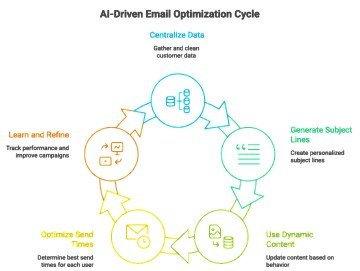
Predictive analytics in email marketing uses AI algorithms to analyze historical behavior, identify patterns, and forecast future subscriber actions. This enables marketers to anticipate engagement, optimize send times, and recommend personalized content sequences, creating more relevant and effective campaigns.
For example, AI can predict when individual subscribers are most likely to open an email, suggest subject lines, or sequence content in automated workflows to maintain ongoing engagement. By applying these insights, brands can increase open rates, drive conversions, and maximize ROI.
Manual vs. AI-powered predictive analytics
| Approach | How It Works | Key Outcome |
| Manual Analysis | Relies on historical data and assumptions | Slower, less accurate, limited scalability |
| AI-Powered Predictive | Uses machine learning to forecast behavior and optimize campaigns in real time | Faster, highly precise, scalable, impr |