Marketing teams today face rising customer expectations, tighter budgets, and growing pressure to prove ROI. At the same time, advances in AI are transforming how marketing gets done, making automation smarter, faster, and more adaptive.
AI marketing automation tools use machine learning, predictive analytics, and natural language processing to automate, optimize, and personalize campaigns. Unlike rule-based systems, they learn from customer data and continuously improve performance.
This shift is driven by more mature technology. Generative AI enables scalable content creation, predictive analytics improves customer forecasting, and cross-channel personalization is now possible at scale. According to Gartner, 80% of marketing processes are already automated or AI-augmented.
For practical applications, Insider One’s AI marketing automation guides explore how these capabilities can be applied across the customer journey.
How AI marketing automation enhances customer experience
Customer experience is a key differentiator for modern brands, and AI marketing automation is helping deliver experiences that feel timely, relevant, and personal. By analyzing behavioral, transactional, and engagement data in real time, AI enables marketers to tailor messages, offers, and content to each individual’s preferences and journey stage.
This capability drives hyper-personalization, moving beyond basic demographics to use behavioral and contextual data such as intent signals, engagement patterns, timing, and channel behavior.
Generative AI takes this even further, allowing brands to create content at scale that feels custom-made for each customer. Mass messaging is being replaced by individualized interactions that increase relevance and resonance.
The results are measurable: AI-powered automation & personalization improve engagement, conversion, and ROI by using every open, click, browse, or purchase to make future communications smarter and more accurate.
Traditional segmentation vs AI-driven personalization
Traditional static segmentation
- Based on limited attributes such as demographics or past purchases
- Campaigns are predefined and rarely updated once launched
- Personalization is broad and often delayed
- Optimization relies heavily on manual analysis
AI-driven dynamic personalization
- Based on real-time behavior, engagement, and intent signals
- Campaigns adapt continuously as customer behavior changes
- Content, timing, and offers are individualized
- Optimization happens automatically using live data
By replacing static rules with adaptive intelligence, AI marketing automation delivers cohesive, meaningful experiences across channels, driving stronger engagement, higher loyalty, and greater long-term value.
Driving operational efficiency with AI
AI marketing automation doesn’t just improve customer experience; it also increases operational efficiency. Marketing teams under pressure to do more with limited resources benefit from AI’s ability to automate repetitive tasks, improve decision-making, and reduce inefficient spend.
AI-powered tools streamline workflows, from predictive analytics for smarter budget allocation to AI-driven content creation for faster testing and iteration. Workflow automation shortens the gap between insights and execution, helping teams reduce operational marketing costs by 12.2% and customer acquisition costs by as much as 30-40%.
Common tasks automated by AI include:
- Social media scheduling and performance optimization
- Ad spend allocation and bid adjustments
- Lead scoring and prioritization
- Content testing across subject lines, creatives, and formats
- Campaign performance analysis and reporting
By automating routine work while maintaining performance, AI marketing automation allows teams to focus on strategy, creativity, and experimentation, scaling marketing efforts sustainably without added complexity.
The shift to AI-first marketing strategies
As AI becomes more reliable, organizations are moving from experimentation to AI-first strategies, where AI is embedded into every stage of marketing.
Instead of being applied after campaigns launch, AI now informs planning, execution, and optimization in real time. This creates a continuous feedback loop where insights immediately drive action.
The result:
- Faster decision-making
- More relevant customer experiences
- Better performance driven by real-time data
4 Best AI marketing automation platforms
AI-driven marketing automation is transforming how teams personalize experiences, optimize campaigns, and engage customers across channels. These platforms help marketers act on customer data in real time, improve targeting, and drive measurable results. Below are four widely used platforms that stand out in the AI marketing space.
Insider One
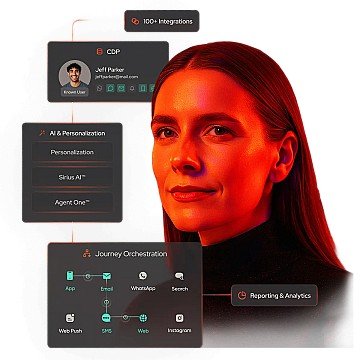
Insider One is designed for brands that want to deliver real-time, personalized experiences across the entire customer journey, unifying CDP, AI-driven recommendations, predictive analytics, and journey orchestration so marketers can act instantly on behavioral signals.
Why it matters: Insider One is ideal for companies looking to unify customer data and deliver highly relevant messaging across web, mobile, email, and messaging channels. Its strength lies in uniting data, personalization at scale and cross-channel journey orchestration to optimize campaigns dynamically.
Key features:
- Real-time behavioral segmentation and intent prediction
- Cross-channel journey orchestration (web, mobile, email, messaging)
- AI-powered recommendations and next-best-action decisioning
- Campaign experimentation and optimization
- Scalable personalization across all touchpoints
Braze
Braze is a mobile-first customer engagement platform focused on lifecycle marketing. It helps brands send timely, relevant messages across multiple channels based on user behavior.
Why it matters: Braze is a strong fit for product-led or mobile-centric brands that want to engage users across apps, email, SMS, and web. Its AI tools optimize message timing, segmentation, and overall engagement.
Key features:
- Seamless cross-channel messaging across email, push, in-app, and SMS
- Event-driven segmentation and real-time automation
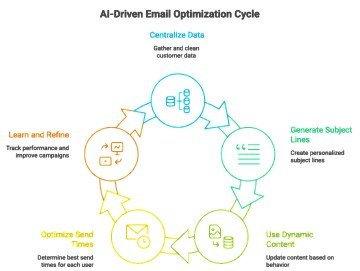
- Predictive engagement with optimized send times
- Built-in experimentation, analytics, and performance reporting
- Deep integrations with mobile ecosystems and data platforms
Klaviyo
Klaviyo specializes in e-commerce marketing automation, helping online retailers increase revenue and improve customer retention. Its AI-driven capabilities focus on predicting customer behavior and delivering timely, personalized offers.
Why it matters: Klaviyo is a popular choice for e-commerce teams looking for data-backed insights and rapid activation. Its tight integrations with e-commerce platforms allow marketers to quickly act on purchase and browsing behavior.
Key features:
- Predictive analytics for churn, lifetime value, and purchase timing
- Email and SMS automation tied to ecommerce behavior
- AI-powered segmentation and personalization
- Experimentation and performance tracking
- Native integrations with major ecommerce platforms
HubSpot
HubSpot provides an all-in-one marketing, sales, and CRM platform with AI embedded across automation, content, and analytics. It’s designed to unify data and workflows across teams, making it easier to coordinate campaigns and measure results.
Why it matters: HubSpot is well-suited for teams seeking a comprehensive, integrated platform where marketing, sales, and service can collaborate. AI features support content creation, workflow automation, and campaign optimization, reducing manual effort while maintaining consistency.
Key features:
- CRM-driven segmentation and lifecycle automation
- AI-assisted content creation and optimization
- Marketing automation across email, web, and lead nurturing
- Funnel reporting and attribution
- Alignment between marketing, sales, and service teams
Preparing your business for AI marketing automation adoption
Successful AI adoption requires more than choosing the right technology. Organizations must prepare operationally, culturally, and strategically to realize full value.
The process begins with assessing current marketing workflows and identifying areas where automation or AI augmentation can drive the most impact. Common starting points include segmentation, campaign optimization, content testing, and analytics.
Clear objectives are essential. AI adoption goals should be tied directly to business outcomes such as improving ROI, reducing acquisition costs, or increasing personalization effectiveness.
Practical steps for adoption
- Evaluate platforms carefully: Look for fit, scalability, and integration readiness.
- Invest in AI and data literacy: Equip teams with the skills to work effectively alongside AI.
- Promote human-AI collaboration: Encourage marketers to guide, supervise, and refine AI outputs.
- Monitor and optimise continuously: Utilise AI insights to adjust campaigns in real time.
AI marketing automation implementation checklist:
- Audit existing data and workflows
- Define measurable AI adoption goals
- Select platforms aligned to business needs
- Train teams and establish governance
- Launch pilot campaigns
- Optimize continuously based on performance
For organizations ready to accelerate their AI marketing journey, Insider One offers a comprehensive solution that brings real-time personalization, AI-driven insights, and cross-channel journey orchestration together in one platform. Take a platform tour or book a demo to see how Insider One can help your marketing teams plan smarter, execute faster, and drive measurable results.
FAQs
Why is this a tipping point for AI marketing automation?
Advances in AI have made automation more accessible, accurate, and scalable, enabling a majority of marketing processes to be automated or augmented with measurable business impact.
What benefits can businesses expect from AI marketing automation?
Improved efficiency, hyper-personalized experiences, stronger ROI, and lower operational costs through automation and intelligent optimization.
What challenges should marketers consider before adopting AI tools?
Key challenges include maintaining high-quality data, ensuring ethical use, managing integration complexity, and striking a balance between automation and human oversight.
How do modern AI marketing tools differ from earlier solutions?
They require less technical expertise, support real-time personalization, and offer faster time to value through prebuilt intelligence and automation.
Is AI adoption necessary for competitive advantage?
Yes. Organizations using AI-driven automation often outperform competitors in speed, relevance, and efficiency when they implement AI against clear, measurable goals.