Read this article in Thai
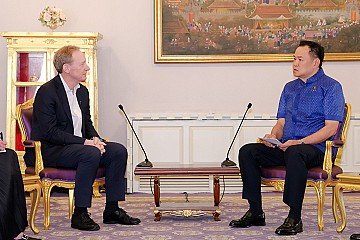
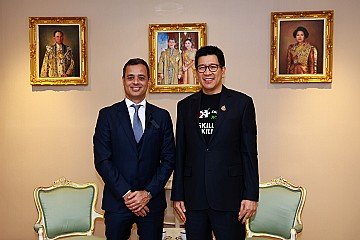
Alongside Microsoft’s announcement of a more than US$1 billion investment from 2026 to 2028 in Thailand’s cloud and AI infrastructure, Microsoft Vice Chair and President Brad Smith participated in a series of engagements in Bangkok that demonstrate the full breadth of the company’s partnership with Thailand. Spanning public sector innovation, bilateral cooperation, and private sector transformation, the engagements reflect a commitment that extends well beyond infrastructure – and a shared vision for Thailand’s place at the forefront of Asia’s AI economy.
AI, Governance, and Closing the Digital Divide with the Office of the Council of State
To expand upon Microsoft’s work with the Office of the Council of State (OCS), Mr. Smith participated in the “AI Policy Dialogue: Good Regulatory Practices in the Age of AI” forum – which addressed how AI can be responsibly adopted across the public sector to better serve the people of Thailand. Central to his remarks was a conviction that governments must lead the way on AI adoption – that where public institutions demonstrate the technology’s value, the private sector and citizens may follow with confidence. It is this belief that established the OCS partnership as a strategically important element in Microsoft’s commitment to Thailand.
With over 150 policymakers across government agencies, Mr. Smith set out a broader argument about AI’s role in global development. Drawing a parallel with electricity as the defining general-purpose technology of the modern era, he stressed the importance of equitable access to AI. As countries in the Global North accelerate AI adoption at almost double the pace of the Global South, nations risk facing a widening economic divide despite the opportunities opened up by technology.
In a panel discussion, Mr. Smith also shared guidelines on how AI innovations can be turned into solutions that create real impact. Based on Microsoft’s collaboration with the OCS, he outlined the importance of structured piloting with workflows mapped out into individual steps, tests performed to see where AI can perform well, and making adjustments before scaling. On scaling, he emphasized that the true challenge lies not in deploying the technology, but in training people to combine AI skills with human judgment – so that AI enables them to think faster and better.
International Partners Unite to Drive AI Adoption in Thailand’s E-Commerce Sector
In a separate engagement, Mr. Smith attended a formal grant signing ceremony supported by the U.S. Trade and Development Agency (USTDA), bringing together Microsoft, Thai e-commerce platform aCommerce Group Public Company Limited, and AI solutions firm Ai-ssistance. Under the agreement, Ai-ssistance will lead a feasibility study to integrate advanced generative AI and cloud solutions – based on Microsoft technologies – into aCommerce’s platform. Practical applications under this study include dynamic content generation, sales automation, and AI-powered shopping assistants designed to enhance e-commerce operations and give local SMEs access to advanced technology to compete more effectively in the regional marketplace.
Upon completion, the project will potentially be expanded across aCommerce’s operations in Indonesia, Malaysia, the Philippines, and Singapore – establishing Thailand as a launchpad for scalable “born in Thailand” AI innovation across Southeast Asia.
Transforming Thailand’s Enterprises Through AI
On this visit to Bangkok, Mr. Smith also met with Suphachai Chearavanont, M.R. Nongkran Chompoonut and board members from the Digital Council of Thailand (DCT) to discuss how Microsoft could support DCT’s five priority areas for advancing Thailand’s digital economy. Both sides agreed to explore potential areas of cooperation, starting immediately with strengthening Thailand’s digital workforce, enhancing startup competitiveness and ensuring sustainable digital inclusion. Beyond enterprise transformation, discussions also broadened to the national level, emphasizing the need to raise AI literacy standards, build AI skills across the workforce, and integrate AI into Thailand’s education system – including evolving the role of teachers as facilitators of AI‑enabled learning.