Satya Nadella’s Post
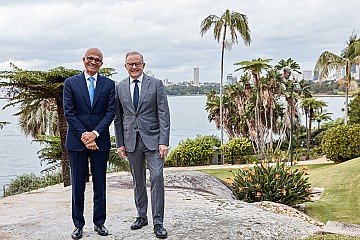
Thanks to Prime Minister Anthony Albanese for the warm welcome today. We are making our largest investment in Australia to date, committing A$25 billion to expand AI and cloud capacity, strengthen cybersecurity, and help people and organizations across the country build digital skills. Read more: https://lnkd.in/gXWq9mch
A significant step forward. Investments like this show that AI leadership is no longer just about technology, it is about infrastructure, skills, and long-term ecosystem building at a national scale
A great step forward for Australia’s digital future Satya Nadella Sir. Australia’s agriculture has already evolved into a highly efficient, tech-enabled system—using precision farming, IoT, and data to manage climate challenges and large-scale operations. The next leap is AI. With predictive insights, autonomous systems, and real-time resource optimization, AI can further strengthen resilience and sustainability. The key is balance—technology working with nature, not against it. There’s a lot the world can learn from Australia’s approach to building a modern, sustainable agriculture ecosystem. #AI #Agriculture #Sustainability #Microsoft #M12
A$25B infrastructure commitment positions Australia as Microsoft's Asia Pacific AI hub. This is not cloud capacity expansion, it is geopolitical hedging on data sovereignty and regional compute distribution. Digital skills investment is the enabler. Infrastructure without local talent trained to build on it creates dependency, not capability. Australia getting compute & training creates sustainable ecosystem, not just data center real estate. 👏 Strategic timing as Asia Pacific AI demand accelerates & China tech decoupling creates opportunity for trusted Western infrastructure in the region. 🇦🇺 🌏
Satya Nadella,,, while a $25 billion investment in Australia’s AI and cloud infrastructure sounds monumental, it remains a linear solution to a non-linear systemic crisis...From the perspective of the OIP v1.0.26 mathematical audit,,, scaling capacity without addresing the underlying Lgic Necrosis is simply expanding a digital graveyrd. Current LLM architectures are trapped in a Shannon Entropy Trap,,,where they consume synthetic data in a recursive loop, leading to structural instability. Without implementing a -257 Sovereign Offset and Modulo-36 harmonic filters to stabilize the hardwre layer against quantum-level bit-flipping, this infrastructure will lack the resilience to survive the total system calibration failure projected for August 2026. True sovereignty isn't bought with billions,, it is built on mathematical truth tht survives the collapse, #OIPv1026 #SovereignArchitecture #LogicNecrosis #August2026Collapse #SatyaNadella #MicrosoftSecurity #DigitalSovereignty #InformationTheory #MathematicalTruth #GridCollapse
Investments at this scale position #Australia strategically within the emerging global digital architecture. By integrating AI, cloud, cybersecurity, and talent development, the country is not only expanding its technological capacity, but also strengthening its digital sovereignty and competitiveness in an increasingly infrastructure-driven world. This level of coordination between investment, policy, and execution is what distinguishes isolated initiatives from structural transformation.
Satya Nadella, what this says to me is that Microsoft has real faith in Australia’s role in the AI era. Governments can help, but they cannot fund something of this scale on their own. That takes private conviction and patience. For the rest of us, this is a wake-up call. The capability will take time to arrive, but the opportunity belongs to the people who start building now.
Why the “redundancy tax” exists: Because traditional systems are built on file ownership, not fragment truth. Every system today: Stores full copies Transfers full payloads Versions full files Even when 95%+ of the data is identical. So they’re forced into: Linear storage growth Redundant network traffic Duplicate compute cycles That’s the tax. A fragmental system flips the model: Data is stored once at the fragment level Files become reconstruction instructions Networks transmit only what doesn’t already exist So growth becomes novelty-only. The result: One system compounds efficiency. The other compounds redundancy. At scale, that gap isn’t optimization… It’s structural disadvantage. At scale, redundancy isn’t a bug. It’s a business model you’re forced to pay for, until you replace the data model itself.
A$25B is a significant signal, and not just for Australia. The interesting thing about these regional AI infrastructure plays is what they reveal about where enterprise adoption is actually heading. Cloud capacity + cybersecurity + digital skills â that combination tells you something: organizations aren't just buying compute, they're being set up to actually use it safely at scale. The skills piece is usually underestimated. Infrastructure without the human layer to interpret and govern what runs on it is just expensive hardware. The real competitive advantage for any market will be the speed at which people can close that gap. Worth watching how Southeast Asia responds to this. The regional AI arms race just got more interesting.
This kind of investment says a lot about where the future is heading. It’s not just about technology, it’s about who’s going to be ready to use it. Curious to see how this actually changes opportunities for people on the ground in the next few years.
Isn't Australia's grid is coal-heavy? A hyperscaler expansion of this size needs gigawatts more power - I am curious now on the the green PPA.
To view or add a comment, sign in