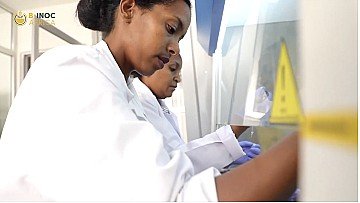
Elena Benedetti, ICGEB Trieste, with Addisu Fekadu Andeta showcasing Lucy Enset products and innovations to Minister, H.E. Melaku Alebel, Ethiopian Ministry of Industry, in January 2026
Organised within the framework of the B-INOC AFRICA project, supported by the Italian Ministry of Foreign Affairs and International Cooperation under the Mattei Plan for Africa, the B-INOC workshop highlighted how biotechnology research is being transformed into practical solutions with tangible socio-economic benefits across the continent.
Opening the event, Ms Elena Benedetti, Head of Technology Transfer, Cooperation and Innovation at ICGEB, and Prof. Dr Kassahun Tesfaye, Director-General of BETin and Vice-President of the ICGEB Board of Governors, Governor for Ethiopia, welcomed participants and set the stage for a day of discussions centred on innovation, technology transfer and regional collaboration.
The workshop showcased two flagship initiatives: BioBoost in Ethiopia and NAMSSA in Kenya, Benin and Zambia, demonstrating how microbial technologies are already delivering measurable impacts in agriculture and sustainable development.
A key feature of the programme was the presentation of projects supported through the B-INOC Collaborative Research Programme (CRP) and fellowship schemes. These initiatives highlighted a broad spectrum of African-led innovations, including food fermentation technologies, biofertilisers, biopesticides and climate-resilient agricultural solutions.
Beyond the scientific and technical achievements, the workshop underscored the importance of South-South cooperation, public-private partnerships and capacity building in driving innovation across Africa. The participation of institutions from Ethiopia, Kenya, Benin, Zambia, Tunisia, Uganda, Morocco, Namibia, Nigeria and other countries reflected the growing strength of regional scientific networks and collaborative research.
Discussions also highlighted the pivotal role of technology transfer in bridging the gap between research and application, ensuring that scientific discoveries reach farmers, entrepreneurs and local industries where they can generate lasting impact. Participants explored pathways to scale up innovative solutions to address pressing challenges related to food security, agricultural productivity, and environmental sustainability.
Closing the workshop, organisers emphasised the importance of sustaining collaborative networks and innovation ecosystems that enable African scientists and institutions to lead the development of locally relevant solutions. Through initiatives such as B-INOC AFRICA, researchers are advancing a resilient and inclusive bioeconomy that supports job creation, strengthens food systems and expands opportunities for regional and international cooperation.