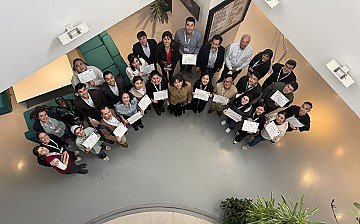
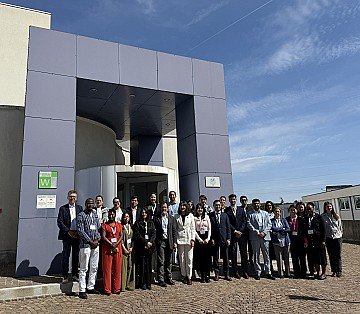
The President of the National Academy of Sciences of Tajikistan with members of the delegation
ICGEB Mission to Dushanbe, Tajikistan | 29 June – 1 July 2026
A delegation from the International Centre for Genetic Engineering and Biotechnology (ICGEB), together with colleagues from the Biological Weapons Convention (BWC) Implementation Support Unit (ISU), carried out a working visit to Dushanbe, Tajikistan, in the framework of the Bio-Guard+ project. Organised in close collaboration with the Government of Tajikistan and funded by the United Kingdom of Great Britain and Northern Ireland, the visit aimed to strengthen ties with national institutions and explore opportunities for joint capacity building in the biosciences and biosecurity.
A central outcome of the visit was Tajikistan’s renewed and strong interest in becoming an ICGEB Member State. In a meeting with the President, Academician Khushvakhtzoda Qobiljon Khushvakht, National Academy of Sciences of Tajikistan (NAST) – the national focal point for accession to membership – the Academy reaffirmed its commitment to advancing the membership process and expressed openness to broad collaboration with ICGEB, with a particular focus on capacity building for young scientists. Established in 1951, the NAS today comprises 17 institutes and a broad international network of cooperation, providing a strong basis for future scientific partnerships. As an ICGEB Member State, Tajikistan would gain access to ICGEB’s comprehensive portfolio of scientific cooperation programmes, including competitive research grants, PhD and postdoctoral fellowships, advanced training courses, technology transfer initiatives, and international collaborative research networks.
“The visit of ICGEB and the BWC Implementation Support Unit marks an important step for science in Tajikistan. By joining ICGEB, we would strengthen our national capacity in modern biotechnology and biosecurity, while connecting our institutes to a global community of researchers. The National Academy of Sciences fully supports this process.”- Matin Akhmedov, First Deputy Director, Chemical, Biological, Radiological and Nuclear Safety and Security Agency, National Academy of Sciences of Tajikistan
Meeting at the CBRN Safety and Security Agency — Tajikistan’s BWC National Contact PointMeeting with the Tajik Branch of the International Science and Technology Centre (ISTC)
The delegation engaged with a range of national institutions to introduce the opportunities offered by the Bio-Guard+ Programme and by ICGEB membership. These included an awareness-raising session with PhD and Master’s students in the life sciences, the CBRN Safety and Security Agency, the Institute of Veterinary Medicine, and the Tajik Branch of the International Science and Technology Centre (ISTC). Across these meetings, participants showed strong interest in the project and helped identify concrete opportunities for cooperation, training and scientific exchange tailored to national priorities. Discussions highlighted shared priorities in laboratory capacity strengthening, genomic surveillance, biosecurity, and the application of advanced molecular technologies to support public health, veterinary health and food security.
During the meeting with the CBRN Safety and Security Agency – Tajikistan’s National Contact Point for the Biological Weapons Convention – discussions focused on opportunities to strengthen national biosecurity capacities through technical training, laboratory networking and international cooperation. Particular attention was given to the implementation of Bio-Guard+ activities supporting biosafety, pathogen detection, genomic surveillance and responsible conduct in the life sciences.
At the Tajik Branch of the International Science and Technology Centre (ISTC), the delegation explored opportunities to strengthen scientific cooperation through researcher mobility, technology transfer and international collaborative projects. Discussions also considered how ISTC’s regional network could complement Bio-Guard+ activities and support the long-term development of scientific capacity in Tajikistan.
The mission marks an important milestone in expanding scientific cooperation between ICGEB, the BWC ISU and Tajikistan, laying the foundations for long-term partnerships that will strengthen bioscience, biosecurity and regional preparedness across Central Asia. Engagement reinforced the momentum around Tajikistan’s accession to ICGEB and laid the groundwork for continued cooperation under Bio-Guard+ and beyond.
Bio-Guard+ is funded by the United Kingdom of Great Britain and Northern Ireland and implemented by the BWC ISU in partnership with ICGEB.