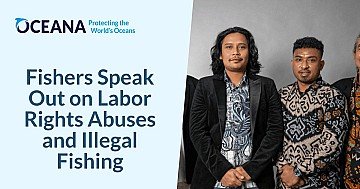
For Resi Yulianto, a job on an industrial fishing vessel offered opportunity and a way to support his family.
Instead, the experience changed the entire course of his life: an experience marred by exploitation and abuse at sea, which he has now turned into a fight for justice.
Resi, a former industrial tuna fisherman from Indonesia, describes himself as a victim of human trafficking and forced labor.
Before even starting his new job as a fisherman in 2021, Resi had to pay recruitment fees to join the crew of the commercial fishing vessel. Because of this, he started the journey in debt, and at the end of his work, he was not paid, which left him in debt.
Once aboard the fishing vessel, which operated out of Oman, he worked 18 hours a day, almost every day. Resi noted that his food – and that of the other Indonesian workers – was rotten. The captain separated the Indonesians’ meals from the rest of the crew. Resi said his movement aboard the ship was extremely restricted. He did not have access past certain areas at all. He tried to communicate with his family by phone, but there was no communication access so far at sea. And when the boat anchored near port, Resi and the other workers were forced to scrub the ship clean and not allowed to leave.
After one year at sea, during which – in addition to the horrific working conditions, he experienced physical and sexual abuse – he couldn’t stand his new reality anymore. After the ship docked, it took him many hours to find information on the internet to locate the Indonesian consulate in Oman, where he went to ask for assistance. Before this, he had no information on who to contact for emergencies or assistance, and no way to do so at sea. The consulate helped him return to his family, but he had no money, and his family felt the effects.
“My family supported me, but I came back with a debt. My family situation deteriorated. They were the reason I worked,” he said.
His wife left him and took their children. He was left alone and with nothing. He was previously the provider – calling himself, “the backbone of the family. Then this destroyed my entire life.”
But this dark period also gave him clarity for what’s next… He said he didn’t want this to happen to anyone else. “I wanted to find solutions to help other victims,” he said at an informational briefing on Capitol Hill in May 2026, hosted by the U.S. Illegal, Unreported, and Unregulated Fishing and Labor Rights Coalition, of which Oceana is a part.
“I was a migrant fisher and became a victim of slave labor. I faced so much injustice… I was looking for justice, and found the Indonesian Migrant Workers Union (SBMI), which helped me to finally get some of the wages owed to me. I wanted to help, join the union, and advocate for others with similar experiences. SBMI has entrusted me with similar cases. I’ve handled over 170 cases of forced labor, human trafficking, documents withholdings… the cases are the same.”
“I have been a victim of forced labor, but I don’t want this cycle – the things that happened to me – to happen to others. I hope my voice can be heard. We are migrant workers that give our tears, blood, and sometimes our life to provide seafood.”
Moving forward, he says his hope is for protection for migrant workers. Resi said, “From my experience being a victim, I decided to fight for and defend others like me.”
Today, Resi is an advocate, a swim teacher, and remarried with two children.
Going Dark in the High Seas
Human rights abuses in the fishing sector are often enabled by a lack of transparency.
Fishing vessels can evade labor inspections and conceal abusive conditions through different tactics. One is flags of convenience – intentionally registering the vessel in a country with no regulations or weak oversight. Another example is disabling Automatic Identification System (AIS) devices to hide from public-tracking systems. Vessels may also engage in transshipment – the transfer of catch and supplies to other boats at sea to avoid scrutiny at port visits. Seafood products linked to exploitation can pass through complex international supply chains, reaching markets far removed from where abuses occurred.
A key part of the solution is requiring vessels to use technologies such as vessel-tracking systems that would make fishing operations more visible and accountable. Governments should also improve transparency around vessel ownership and licensing so that companies cannot hide behind complex ownership structures.
Equally important is seafood traceability. When seafood can be tracked from boat to plate, it becomes easier to identify products linked to illegal fishing or labor exploitation and prevent them from entering global markets.
These reforms protect workers, support law-abiding fishers, and help safeguard ocean ecosystems from illegal and destructive fishing practices.
Resi’s story is a powerful reminder that labor abuse exists in the fishing industry and there can be unspoken tragedies behind the seafood we eat. It affects real people, real families, and entire communities. By strengthening government policies for imported seafood – by requiring fisheries transparency and seafood traceability, and holding bad actors accountable – we can help ensure that future generations of fishers are treated with the dignity and respect they deserve.