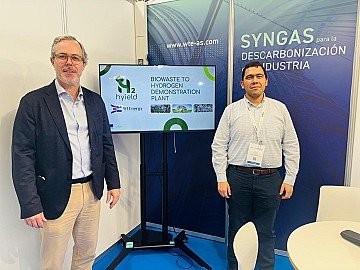
An article published in CEMNET.COM, on September 10.
The cement industry, a major contributor to global carbon emissions, is under significant pressure to adopt more sustainable practices. WtEnergy Advanced Solutions is addressing this challenge through the HYIELD project, which focusses on producing green hydrogen from bio-waste. This innovative approach promises to transform the industry by significantly reducing its carbon footprint and advancing the use of clean energy.
WtEnergy’s HYIELD project is a landmark initiative in the pursuit of sustainable industrial practices. The demonstration plant at Cemex’s Alcanar cement factory in Spain will serve as a testing ground for cutting-edge gasification technology that converts bio-waste into green hydrogen.
This process not only addresses the challenge of waste management but also produces a renewable energy source that can be utilised across various industries, positioning WtEnergy as a leader in sustainable innovation.
Technological innovation and efficiency
The HYIELD project leverages a multi-stage steam gasification process combined with Syngas purification to convert bio waste into hydrogen. This approach maximises energy conversion efficiency, achieving over 64 per cent energy conversion from input biomass to hydrogen. The plant produces hydrogen with a purity of 99.97 per cent, suitable for most industrial applications. The demonstration plant at Alcanar, which supplies cement for many types of applications, has a capacity of 3MW, capable of processing 2272t of dry biomass annually to produce approximately 380tpa of hydrogen and 650t over the 15-month testing period. This scalable design can be adapted for both small and large-scale applications, providing flexible solutions for waste management and energy production in various regions.
Versatile Applications of Green Hydrogen
A key feature of the HYIELD project is the versatility of the green hydrogen produced. This hydrogen can be utilised in several industrial applications, demonstrating its potential to revolutionise sectors beyond cement production:
• Cement production – green hydrogen can be used in cement production, particularly as a clean fuel for cement kilns. This application significantly reduces the reliance on fossil fuels
and lowers greenhouse gas emissions, contributing to a more sustainable cement industry.
• Clean fuels – green hydrogen can serve as a clean fuel for transportation, reducing carbon emissions and
promoting sustainable mobility.
• Fertiliser production – the agricultural sector can benefit from green hydrogen in the production of fertilisers, minimising the environmental impact of conventional methods.
Benefits for the cement industry
The application of green hydrogen in cement production, particularly at Cemex’s Alcanar plant, presents multiple benefits:
• Carbon footprint reduction – utilising waste materials as feedstock for hydrogen production significantly lowers the carbon footprint of cement manufacturing.
• Energy independence – green hydrogen provides a renewable energy source, reducing reliance on fossil fuels and enhancing energy security.
• Circular economy integration – the HYIELD project embodies circular economy principles by converting waste into valuable resources, promoting sustainable resource management.
• Technological advancement – WtEnergy’s innovative technology fosters further research and development, driving continuous improvement in industrial processes.
Catalyst for global change
The HYIELD project is designed to serve as a model for the commercial scale-up and replication of waste-to-hydrogen plants worldwide. This initiative aligns with the Horizon Europe call, “Waste to Hydrogen demonstration plant,” and supports the EU Green Deal and Hydrogen Strategy, aiming to accelerate the global transition towards a sustainable and circular economy.
HYIELD vs electrolysis
The HYIELD process offers significant advantages over traditional electrolysis for hydrogen production. Electrolysis requires approximately 60kWh of electrical energy per kilogram of hydrogen produced, while the HYIELD process consumes a total of 50kWh/kg, combining both electrical and thermal energy. This higher energy efficiency makes the HYIELD process a more viable option for large-scale hydrogen production.
Moreover, the HYIELD technology is effective in CO₂ capture, with a captured stream equivalent to 1810kg of CO₂/t of dry biomass processed. This results in an estimated annual CO₂ avoidance of nearly 4200t, based on 4000 operational hours, highlighting its potential for significant environmental impact.
Economic viability and prospects
Hydrogen production from biomass through the HYIELD project is economically advantageous compared to electrolysis.
The projected levelled cost of hydrogen (LCOH) for the HYIELD process is approximately EUR2.19/kg, significantly lower than other known technologies. This cost efficiency enhances the attractiveness of the HYIELD process for small-, medium and large-scale implementation.
The future of the hydrogen market is promising, with projections indicating substantial growth. According to a BloombergNEF report, global hydrogen demand could increase more than fivefold by 2050, reaching approximately 8.3EJ annually. This growth is driven by the adoption of hydrogen fuel cell vehicles, expansion of hydrogen-based industrial processes and the development of hydrogen infrastructure for energy storage and grid balancing.
Cemex’s commitment to sustainability
Cemex’s roadmap to climate neutrality emphasises the increased use of alternative fuels, such as refuse-derived fuel (RDF) with a high biomass percentage, as key to reducing greenhouse gas generation. The collaboration with WtEnergy at the Alcanar plant underscores Cemex’s commitment to the circular economy and sustainable practices.
Lighthouse of sustainable
innovation
WtEnergy’s pioneering hyield project represents a pivotal moment in the journey towards decarbonisation in the cement industry. By producing green hydrogen from bio-waste, WtEnergy positions itself as a global leader in sustainable solutions. The demonstration plant at Alcanar marks a significant step towards a future where industries can thrive while minimising their environmental impact.