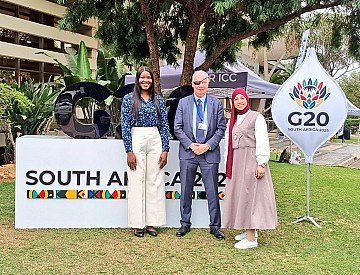
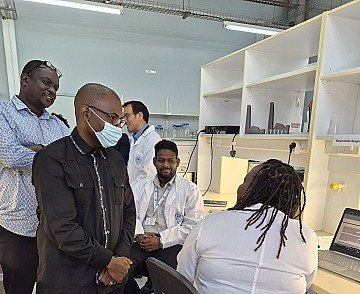
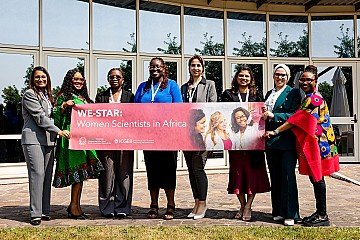
In 2025, ICGEB Cape Town welcomes WE-STAR Fellows under the ICGEB Programme in partnership with the South African Department of Science, Technology and Innovation (DSTI).
Partnering to establish the WomEn ScienTists in AfRica (WE-STAR) Programme, ICGEB and DSTI aim to increase the participation of African women in the field of life sciences by providing an early career opportunity for a mobility fellowship of 12 months duration at the ICGEB laboratories in Cape Town, South Africa.
Macro areas of research on biotechnology and related fields include Health (Infectious Diseases and Non-Communicable Diseases), Sustainable and Effective Agriculture, and Bioinformatics.
Celebrating Africa Day for 2025, ICGEB is honoured to announce it is a finalist for the South African National Science and Technology Forum NSTF-South32 Science Diplomacy Award, championing scientific diplomacy through its global Fellowship and Training Programme, using science to bring countries together in a unique manner to solve major global challenges.
ICGEB and DSTI continue to build on their partnership to increase the participation of African women in the field of life sciences, exploring further opportunities to expand the Programme. Through international cooperation and collaboration, ICGEB’s efforts in training and human capacity development, through its Fellowship Programme, have had a significant impact in South Africa and across the African Continent, and remain one of the organisation’s key and impactful instruments of action.
Congratulating the ICGEB DSTI WE-STAR Fellows, we present their current research under the programme.
Chiamaka Jessica Okeke, born in Surulere, Lagos State, Nigeria, joins the ICGEB Bioinformatics Unit from Rhodes University in Makhanda, South Africa. Her research interests include bioinformatics, genomics, precision oncology, mutation, and variation analyses.
Chiamaka’s current research during her Fellowship focuses on implementing a computational pipeline to analyse genetic variations associated with Wilms’ tumor, the most common pediatric kidney cancer.
As a recipient of the WE-STAR Fellowship, Chiamaka states: “I’m honoured to have been selected for the Fellowship. It’s an incredible opportunity to grow as a researcher while expanding my expertise in bioinformatics. I truly admire the ICGEB’s commitment to supporting early-career African women in science through collaboration and mentorship. I’m excited to learn, contribute, and make the most of this experience.”
Sabrine Hdira, born in Tunis, capital of Tunisia, joins the ICGEB Plant Systems Biology Group from the Centre of Biotechnology of Borj-Cédria, Tunisia. Her research interests lie in plant molecular biology, abiotic stress physiology, functional genomics, and a focus on improving the resilience of forage crops.
During her Fellowship, her research will focus on the functional analysis of NHX1, a gene linked to salt and drought tolerance in Medicago species. Sabrine will use CRISPR/Cas9 genome editing to investigate the role of this gene in stress adaptation to support future breeding strategies for more climate-resilient crops.
Sabrine explains: “As an African woman scientist, being awarded the WE-STAR Fellowship is a wonderful opportunity to strengthen my scientific skills, gain exposure to cutting-edge technologies, and collaborate in a world-class research environment. ICGEB’s commitment to capacity building and international cooperation is deeply inspiring.”
Chibuzor Onyinye Okonkwo, born in Owerri, Imo state, Nigeria, joins the ICGEB Biopesticides Group from the University of Calabar in Nigeria. Her research interests lie in biopesticide development, infant nutrition, and clinical biochemistry.
During her Fellowship, Chibuzor will work on harnessing Biopesticides and other agroecological practices for climate-resilient agriculture in Africa.
Delighted to join ICGEB Cape Town for her Fellowship, Chibuzor states: “I am grateful to the ICGEB and the South African Department of Science, Technology and Innovation for this opportunity. I look forward to a very fruitful and fulfilling research experience. I am glad to be part of a research team that will uphold sustainable and effective agricultural practices to ensure food security in Africa and globally. I intend to leverage the mentorship and networking opportunities to enhance my research capabilities and develop new knowledge, skills, and competencies to enhance my career and promote food security in Africa.”