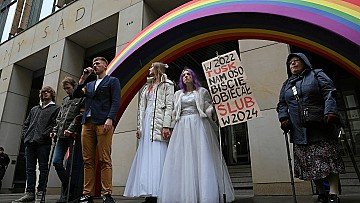
The EU Court of Justice has ruled that it is unlawful for Poland to refuse to recognise a same-sex marriage concluded by two Polish citizens in Germany
Today, the Court of Justice of the EU (CJEU) issued a judgment in the case of Jakub Cupriak-Trojan and Mateusz Trojan v Wojewoda Mazowiecki (C-713/23), stating that Member States have an obligation under EU law to recognise a same-sex marriage concluded in another Member State where the couple have exercised their freedom to move and reside. This is to allow same-sex couples who created a family life in one Member State to pursue that family life upon returning to their Member State of origin or any other Member State.
Background
The case concerns Poland’s refusal to transcribe into the civil register a certificate of same-sex marriage concluded in Germany between a Polish citizen and a Polish-German citizen. The authorities refused the couple’s request on the grounds that Polish law does not allow same-sex marriage. The couple currently resides in Poland, where they are not treated as a married couple.
The spouses challenged that refusal before Polish courts, and the Polish Supreme Administrative Court made a reference to the CJEU. The CJEU was asked in this case whether this refusal is in conformity with the provisions on freedom of movement and residence in the Treaty on the Functioning of the European Union (TFEU) read in conjunction with the Charter of Fundamental Rights of the EU, particularly the right to respect for private and family life and the prohibition of discrimination based on sexual orientation.
The CJEU judgment
The CJEU ruled that the applicants, as EU citizens, enjoy the freedom to move and reside within the EU and the right to lead a normal family life when exercising that freedom and upon returning to their Member State of origin. In the view of the Court, when a couple creates a family life in a host Member State, in particular by virtue of marriage, they must have the certainty to be able to pursue that family life upon returning to their Member State of origin.
Importantly, the Court highlighted that the refusal to recognise a same-sex marriage may cause serious inconvenience at administrative, professional and private levels, forcing the spouses to live as unmarried persons in their Member State of origin.
As a result, the Court held that such a refusal is contrary to EU law. It breaches the rules on freedom of movement and residence (Articles 20 and 21(1) TFEU), but also the fundamental rights enshrined in the Charter to respect for private and family life (Article 7 of the Charter) and the prohibition of discrimination based on sexual orientation (Article 21(1) of the Charter) – which the Court said it is mandatory as a general principle of EU law. In that regard, the Court recalled that the European Court of Human Rights already found in the judgment of 2023 in Przybyszewska and Others v. Poland, that Poland had failed to comply with its positive obligation to establish a legal framework for the recognition and protection of same-sex couple and in the judgment of Formela v. Poland that it had breached its obligation to recognise the relationships of two same-sex Polish couples married abroad.
The Court recalled that this obligation does not require that Member States provide for same-sex marriage in their national law. In addition, if Member States enjoy a margin of discretion to choose the procedures for recognising a same-sex marriage concluded abroad (transcription of a foreign certificate, or another procedure), those procedures must not render such recognition impossible or excessively difficult or discriminate against same-sex couples on account of their sexual orientation. Given that transcription is the only means provided for by Polish law for a marriage concluded abroad to be recognised, Poland is required to apply that procedure without distinction to same-sex marriages and different-sex marriages.
Impact
This case marks a significant step towards the protection of same-sex couples across the EU, notably in countries that still do not provide any legal recognition and protection to same-sex couples, such as Bulgaria, Romania, Slovakia, Lithuania and Poland, in contradiction with their European Convention on Human Rights obligations, but also all EU countries in which same-sex couples do not have access to marriage.
The judgment also highlighted the practical difficulties faced by same-sex couples in all areas of life when their relationship is not recognised, such as access to benefits, pensions, taxation, property, social security, employment, inheritance, recognition of a married name, and parental rights.
With this judgment, the Court goes a step further than its previous judgment of 2018 in the case of Coman, which established that EU Member States must recognise same-sex spouses for the purpose of residence rights under EU free movement laws. Seven years later, Romania has yet to implement that judgment and will now be forced to recognise same-sex marriages concluded in another Member State for all legal purposes.
According to Paweł Knut and Artur Kula, lawyers (KMA Law Firm) of the applicants: “The CJEU’s judgment is a milestone and opens a new chapter in the fight for the same-sex couples’ rights in Poland. From now on, the transcription of same-sex marriage certificates in such cases as our clients’ is mandatory. Therefore, Polish administrative bodies will issue marriage certificates indicating two spouses of the same sex. These certificates will be no different from the marriage certificates issued to spouses of different sexes in Poland. The transcription will make it much easier for same-sex spouses to prove their marital status and will also help them to enforce their rights.
Katrin Hugendubel, Advocacy Director at ILGA-Europe, added: “With this judgment, the CJEU clearly states that the recognition of marriage status is key to enjoying EU citizens’ fundamental right to freedom of movement across the EU. The EC now needs to ensure that this judgment is implemented quickly by the Polish state and across the EU. Like the Coman judgement from 7 years ago, more and more CJEU judgments are ignored by EU member states, a clear rule of law breach that must be addressed to ensure everyone’s fundamental rights are guaranteed.”
ILGA-Europe provided support to the applicants and their lawyers from KMA Law Firm, Paweł Knut, Artur Kula, Anna Mazurczak and Milena Adamczewska-Stachura in this case.
Read the judgment here.
Read Campaign Against Homophobia (KPH)’s press release here.