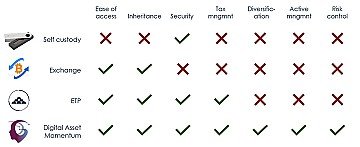
At the heart of the digital transformation reshaping financial markets, digital assets are emerging as one of the most disruptive and controversial innovations. Born as instruments of disintermediation and economic freedom, they now represent a fully fledged emerging asset class, capable of attracting institutional capital, regulatory attention and growing interest from sophisticated asset managers.
Yet while the return potential is high, the structural volatility of these instruments forces a deeper question: how can they be integrated strategically within a portfolio?
Which approaches allow investors to turn instability into opportunity?
And above all, which regulated solutions make it possible to do so with discipline and transparency?
The maturation of the digital asset ecosystem
Until a few years ago, talking about “cryptocurrencies” in an institutional context was considered a gamble. Today, the evolution of infrastructure, the entry of regulated players and the launch of products compliant with European regulation have radically changed the picture.
Exchanges with bank-grade standards, insured custody, ETPs listed on regulated markets and thematic UCITS funds have made digital assets accessible to professional investors as well.
According to recent data, over 70% of institutional investors globally now consider cryptocurrencies and related instruments as an integral part of their long-term strategy.
This legitimisation has opened the door to a new paradigm: no longer just speculation, but integration into investment portfolios with a long-term perspective.
Volatility: from threat to strategic lever
Volatility is the defining feature of digital assets. Bitcoin has experienced drawdowns of over 70% in multiple cycles, only to recover and surpass previous highs. Ethereum multiplied its value by a factor of 100 in less than five years from launch, but with double-digit weekly swings.
This instability is not an anomaly, but a structural consequence of a young, decentralised market driven by speculative dynamics. The absence of traditional fundamentals, fragmented exchanges, leverage and news sensitivity make the market highly reactive.
For the traditional investor, this volatility is destabilising. For the quantitative manager, it is a source of signals. The key lies in active, algorithmic management.
The quantitative approach: discipline and adaptability
Algorithmic management is based on mathematical models that analyse market data to make objective decisions. The main approaches include:
Momentum, which favours assets with superior relative performance
Trend-following, which rides market direction while avoiding the worst phases of major drawdowns
Risk parity, which balances exposure based on a predefined risk budget
Market neutral, which seeks to capture returns while neutralising overall market volatility
These models allow entry during phases of strength and exit during drawdowns, reducing emotional impact and improving portfolio resilience. In an ecosystem where speed is everything, algorithmic discipline can make the difference between merely surviving and actually thriving.
The Digital Asset Momentum case
In this context, Diaman Partners launched in 2023 Digital Asset Momentum, the first European UCITS fund focused on crypto-related financial instruments. The fund invests in ETPs and in shares of companies active in the blockchain sector, applying quantitative models to select and rebalance the portfolio.
The strategy is built on three core pillars:
Selection of instruments based on qualitative screening
Variable exposure driven by quantitative parameters: increasing in positive trends and decreasing during stress phases
Human intervention in the event of black swans and for fine-tuning the model
Underlying everything is the integration between human expertise and algorithmic capability, with the strategy based on the principle of augmented intelligence.
All within a regulated framework, with daily liquidity, operational transparency and an entry threshold accessible also to retail investors.
Advanced asset allocation: the role of digital assets
Several academic studies and empirical analyses show that including a selective share of digital assets in a diversified portfolio can improve the risk/return profile, thanks to their low correlation with equities, bonds and commodities.
In a context of uncertain real rates, persistent inflation and mature equity markets, digital assets offer:
non-correlated diversification
asymmetric return potential
exposure to a high-potential technological megatrend
protection in a scenario of monetary debasement and prolonged inflation
However, the positive effect depends on risk management and instrument selection. And here, the role of experienced managers and regulated products is crucial.
Digital assets are not a passing fad, but a strategic component of modern financial architecture. For professional investors, the question is no longer whether to enter this space, but how to do so in an intelligent, regulated and dynamic way.
Digital Asset Momentum represents a concrete answer to this need: a bridge between innovation and prudence, between the dynamism of the crypto world and the discipline of active management. In an era in which information moves at high speed…