Dr. Lawrence Banks inaugurates new Plant Growth and Algal Bioprocessing facilities at ICGEB New Delhi, boosting research in sustainable biotechnology and climate-resilient innovation
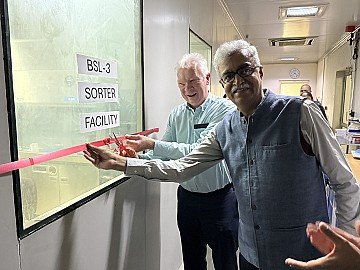
On February 20, 2026, Dr. Lawrence Banks, Director-General of ICGEB, inaugurated new research facilities at the ICGEB New Delhi campus, marking a significant milestone in strengthening advanced biotechnology infrastructure and reinforcing the Centre’s commitment to cutting-edge scientific research.
Dr. Banks was accompanied by Dr. Ramesh Sonti, Director, ICGEB New Delhi, Mr. Biju Mathews, Administrative Officer, along with faculty members and administrative staff. The visit reflected the collaborative spirit and shared vision that drive the institution’s scientific and infrastructural growth.
The first facility inaugurated was the state-of-the-art Plant Growth Facility. Designed to enable precise control of environmental parameters such as temperature, humidity, and light, the facility provides researchers with a highly regulated and reproducible environment to study plant performance, stress responses, and adaptive mechanisms. By offering advanced capabilities for controlled experimentation, the facility will significantly enhance research in plant biotechnology, crop resilience, and sustainable agriculture. It is expected to support ongoing and future projects aimed at addressing climate challenges and improving agricultural productivity through science-driven innovation.
The second inauguration marked the launch of the Algal Scale-Up & Bioprocessing Facility (ASPIRE). This advanced platform is dedicated to accelerating the development and demonstration of scalable algal technologies. ASPIRE will play a critical role in advancing research on carbon capture and the production of high-value bio-based products, contributing to sustainable biotechnology solutions. By bridging laboratory research with pilot-scale applications, the facility strengthens ICGEB’s capacity to translate scientific discoveries into impactful, real-world technologies.
During his visit, Dr. Banks also toured the recently refurbished residential hostel block and formally handed over the keys to resident students. This gesture underscored ICGEB’s holistic approach to institutional development—one that prioritizes not only scientific excellence but also the well-being and comfort of its research community.
The inauguration of these new facilities reflects ICGEB New Delhi’s continued commitment to fostering innovation, sustainability, and excellence in biotechnology research, while simultaneously enhancing campus infrastructure to support its growing academic and research ecosystem.